Latest news
from MSF in Palestine
Gaza
"We did what we could"
An exhibition by Doctors Without Borders
"We did what we could" documents Israel's genocidal campaign in the Gaza Strip following the massacres perpetrated by Hamas and other Palestinian armed groups on 7 October 2023. This multimedia exhibition aims to provide an overview of the siege, the indiscriminate bombing and attacks on the Gazan population and healthcare workers, the total destruction of Gaza and its social fabric, and the consequences for the population.
The first version of the exhibition "We did what we could" was co-produced with the Bayeux Calvados-Normandy Prize for War Correspondents, where it was initially presented in October 2024. It was subsequently expanded to cover the second year of the war. The figures and information presented cover the period between October 2023 and the entry into force of the third ceasefire in early October 2025.
This exhibition was designed by Clothilde Mraffko
and Doctors Without Borders.
- Production
- Doctors Without Borders
and the Bayeux Calvados-Normandie Prize
for War Correspondents - Exhibition curator
- Clothilde Mraffko
- Artistic design
- Aurélie Baumel
- Texts
- Andrea Bussotti, Clothilde Mraffko, Assia Shihab, Agnes Varraine-Leca
- Photographs
- Mohammed Abed/AFP, Omar Al-Qattaa/AFP,
Eyad Baba/AFP, Jack Guez/AFP,
Mahmud Hams/AFP, Karin Huster,
Ali Jadallah/Anadolu via AFP, Ben Milpas, Bashar Taleb/AFP, CICR, MSF - Video editing
- Loïc Adrien, Gabrielle Floquet, Simon Rolin
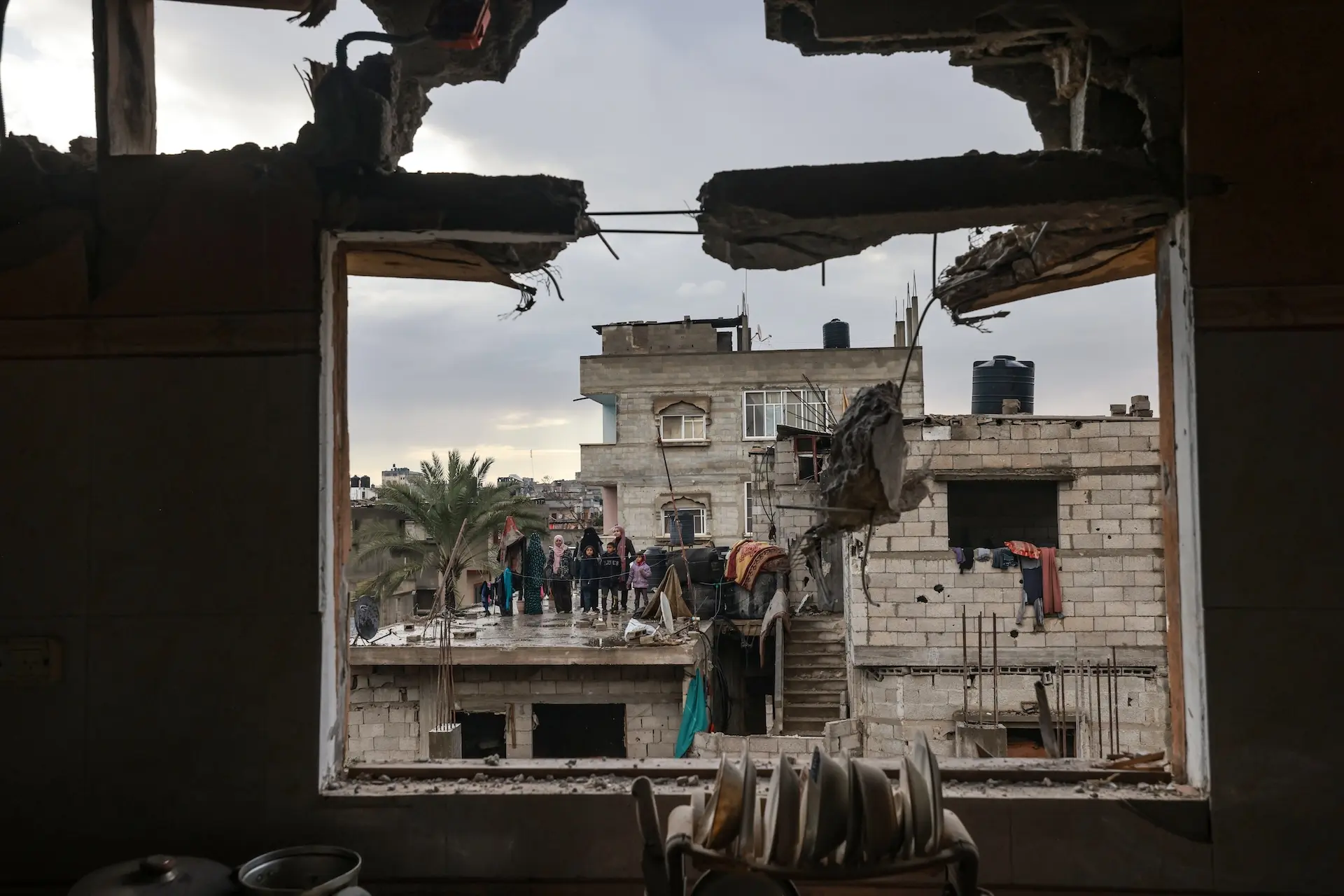
On 7 October 2023, massacres committed by Hamas and other Palestinian armed groups left at least 1,200 Israelis dead and 251 hostages captured. Since then, Gaza has been at the centre of international news coverage. However, Israel has banned foreign media from entering the territory.
The narrow strip of Palestinian territory, about the size of the city of Caen, is cut off from the world. Palestinian journalists and humanitarian workers, including Doctors Without Borders employees, are among the few who can bear witness to the genocidal campaign taking place behind closed doors, the Israeli siege and bombardments, the attacks and the daily horror in Gaza. More than 67,000 Palestinians were killed and nearly 170,000 others wounded between October 2023 and October 2025. These figures, which are greatly underestimated, do not take into account the indirect victims of the war, including the thousands of people still missing under the rubble or those who died of chronic diseases due to lack of access to healthcare.
“We did what we could” recounts two years of war in Gaza through the eyes of MSF staff and AFP photographers, including Mohammed Abed, a Gazan photojournalist who has been documenting the NGO's activities since 2019.
During those two years, Israel has carried out massive, continuous bombing of the Gaza Strip, killing mostly civilians, mainly children. Humanitarian workers, health personnel and journalists were particularly targeted. Two hard-fought truces brought them brief respite, from 24 to 30 November 2023 and from 19 January to 18 March 2025. A third ceasefire was announced on 10 October 2025.
Both ends of the Gaza Strip, north and south, have been razed to the ground. Elsewhere, the destruction is colossal. With bombings, explosives and bulldozers, the Israeli army has reshaped the landscape of the enclave, digging corridors, destroying fields and heritage sites, and creating no man's lands to strengthen its control over this small Palestinian territory. This relentless destruction, combined with forced displacement, bombings that have often wiped out several generations of the same family, and the use of starvation as a weapon of war, leaves little doubt as to the intentions of the Israeli authorities: to make Gaza unliveable for Palestinians. In September 2025, an independent UN commission concluded that Israel was responsible for genocide in Gaza and that there was an intention to destroy the Palestinians of Gaza as a group.

Between October 2023 and October 2025, at least 565 humanitarian workers were killed in Gaza. Under the stated goal of completely eliminating Hamas, which has ruled the Palestinian enclave since 2007, Israel has methodically destroyed most institutions. The United Nations, and in particular UNRWA, the UN agency for Palestine Refugees in the Near East, has responded to the most urgent needs but cannot replace a government and local administrations. Israeli restrictions and the blockade of the enclave prevent humanitarian workers from providing the essential aid needed to meet the basic needs of Gazans.
Israel has also worked to destroy the aid system that has been in place in Gaza for decades. In October 2024, the Israeli parliament banned UNRWA's activities on Israeli territory and in the occupied Palestinian territories. The Israeli authorities then imposed a total siege on 2 March 2025, which was partially lifted nearly 80 days later, with an extremely limited and insufficient resumption of humanitarian aid. In the weeks that followed, they attempted to bypass the UN and international NGOs by promoting an obscure organisation, the Gaza Humanitarian Foundation (GHF). In two months, between late May and early August 2025, nearly 1,400 Palestinians were killed while seeking food, including at least 859 at GHF sites, according to the UN. The Israeli army, after initially denying the facts, has repeatedly acknowledged firing on the starving crowd.
In August 2025, after weeks of siege and obstruction of aid, the UN declared a state of famine in the Gaza governorate, in the north of the enclave, where the city of Gaza is located.
Also hungry and bombarded, MSF staff, most of whom are Palestinian, have been on the front line of Israel's all-out war on health facilities.
The Israeli army claims that fighters are hiding there. In hospitals, medical staff lack everything and work tirelessly to the point of exhaustion.
Each bombing brings waves of wounded, in addition to chronically ill patients and those suffering from lack of hygiene and food. Between October 2023 and October 2025, fifteen MSF employees, all Gazans, were killed in Gaza.
The testimonies and photos you are about to see were collected in hellish conditions: during the influx of wounded, in hospital wards, by caregivers struggling with hunger, fear, exhaustion and the pain of losing loved ones. Due to the lack of electricity and stable internet connection caused by Israel's destruction of the main telecommunications towers, most of their accounts were sent via recorded voice messages, as videos took too long to load. These audio recordings are valuable testimonies to daily life and living conditions in Gaza, which Palestinian journalists have covered throughout these two years, often at the risk of their lives. More than 220 media professionals have been killed since the start of the war, according to a tally published by Reporters Without Borders on 1 September 2025.
To calculate the number of deaths and injuries in Gaza, MSF relied on figures from the Palestinian Ministry of Health, which are also used by the United Nations. In response to the controversy surrounding this count, the Ministry of Health published a note explaining that the figures are certified by its officials in Ramallah, who report to the Palestinian Authority. It also published a list of the names of tens of thousands of deceased persons, most of whom are identified by their identity numbers.
This list can be easily verified by the Israeli authorities, who, as the occupying power, control the issuance of identity documents to Palestinians. When MSF and its epidemiological arm Epicentre surveyed their staff about casualties in their families, the resulting data mirrored
the Palestinian Ministry of Health's statistics.
Two years of wandering
Evacuation orders and forced displacement
The city of Rafah, at the southern tip of the Gaza Strip, had a population of 270,000 before the war. By early 2024, it had taken in nearly 1.5 million people as the Israeli army pushed Gazans further and further south. The displaced people occupied every available space, as can be seen in this photo of a beach near the Egyptian border, taken on 16 January 2024.
In May 2024, the Israeli army seized Rafah. Residents and displaced persons then fled.
The military razed the area near the Egyptian border. In March 2025, they once again meticulously destroyed hundreds of hectares with bulldozers and explosives. On 11 May 2025, an analysis by Le Monde showed that 68% of the urbanised area of Rafah had been reduced to rubble.
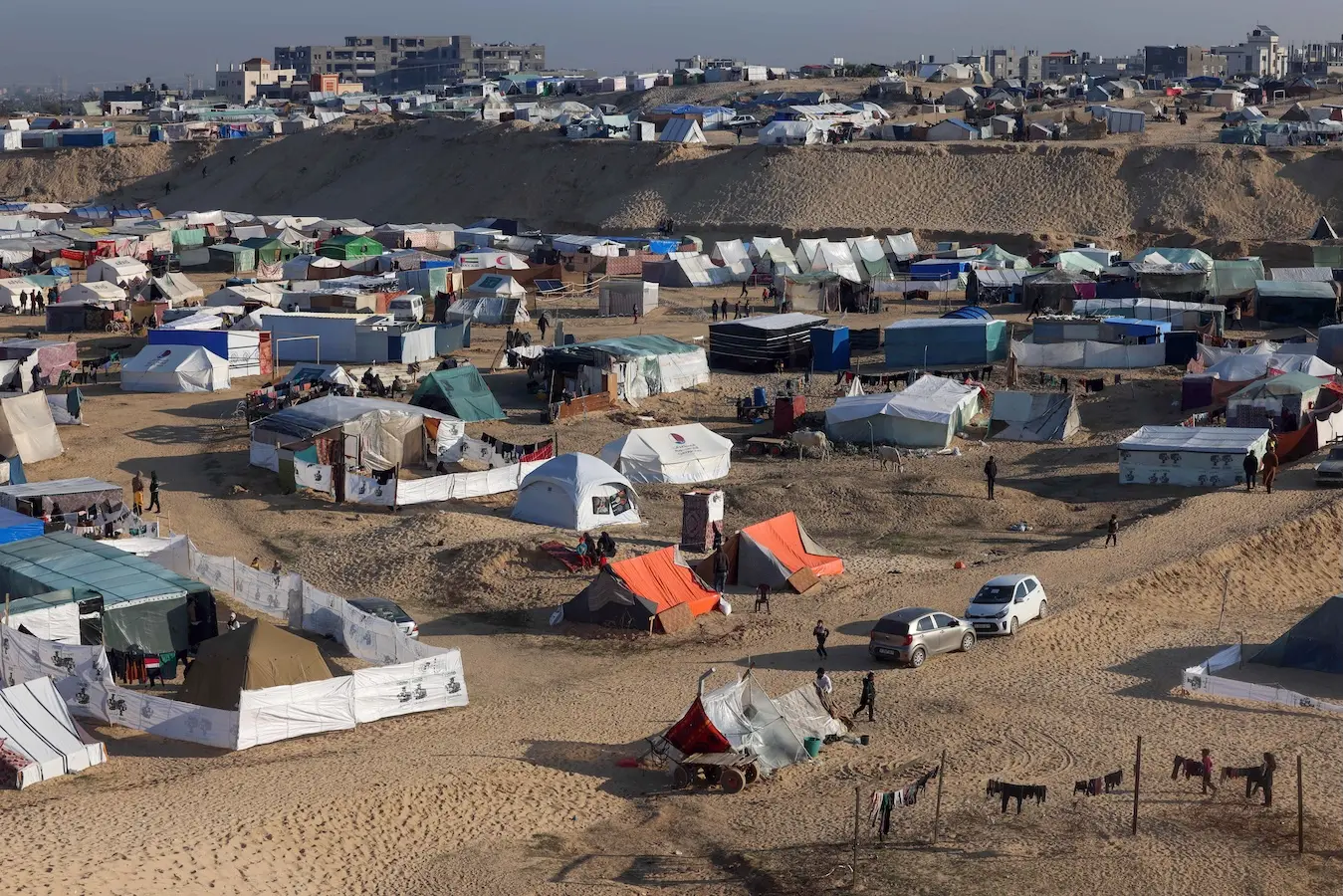
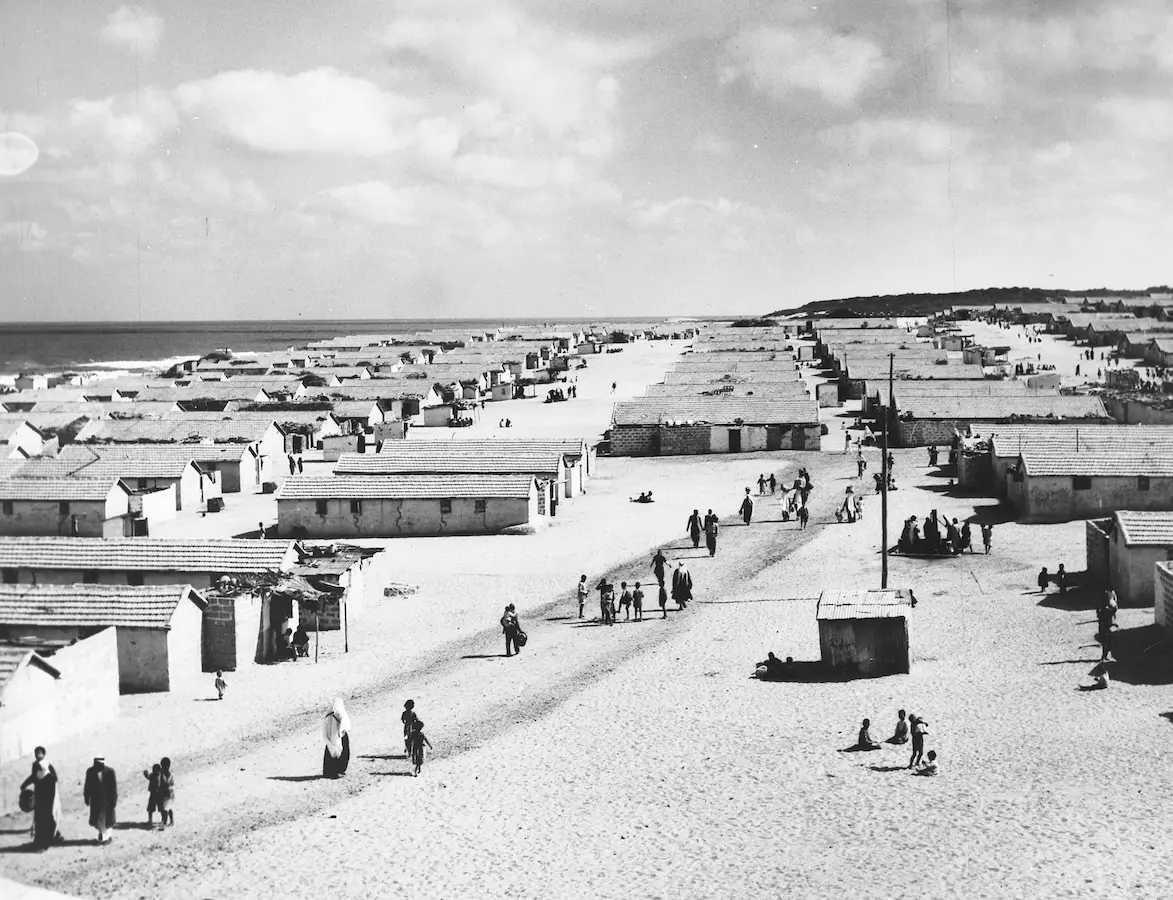
The rows of tents housing displaced persons have reawakened a major trauma in the Palestinian psyche: that of the Nakba, or "catastrophe", of 1948. Shortly before and after the creation of Israel, between 700,000 and 900,000 Palestinians were driven from their homes. Many ended up in the West Bank, Gaza, and neighbouring countries, crammed into refugee camps similar to the one pictured here, built by the International Committee of the Red Cross in Gaza. In the Palestinian enclave, 70% of the population has refugee status. Many have ancestors who lived just behind the barrier, in what is now called in Israel "the Gaza envelope", the target of attacks by Hamas and other Palestinian armed groups on 7 October 2023.
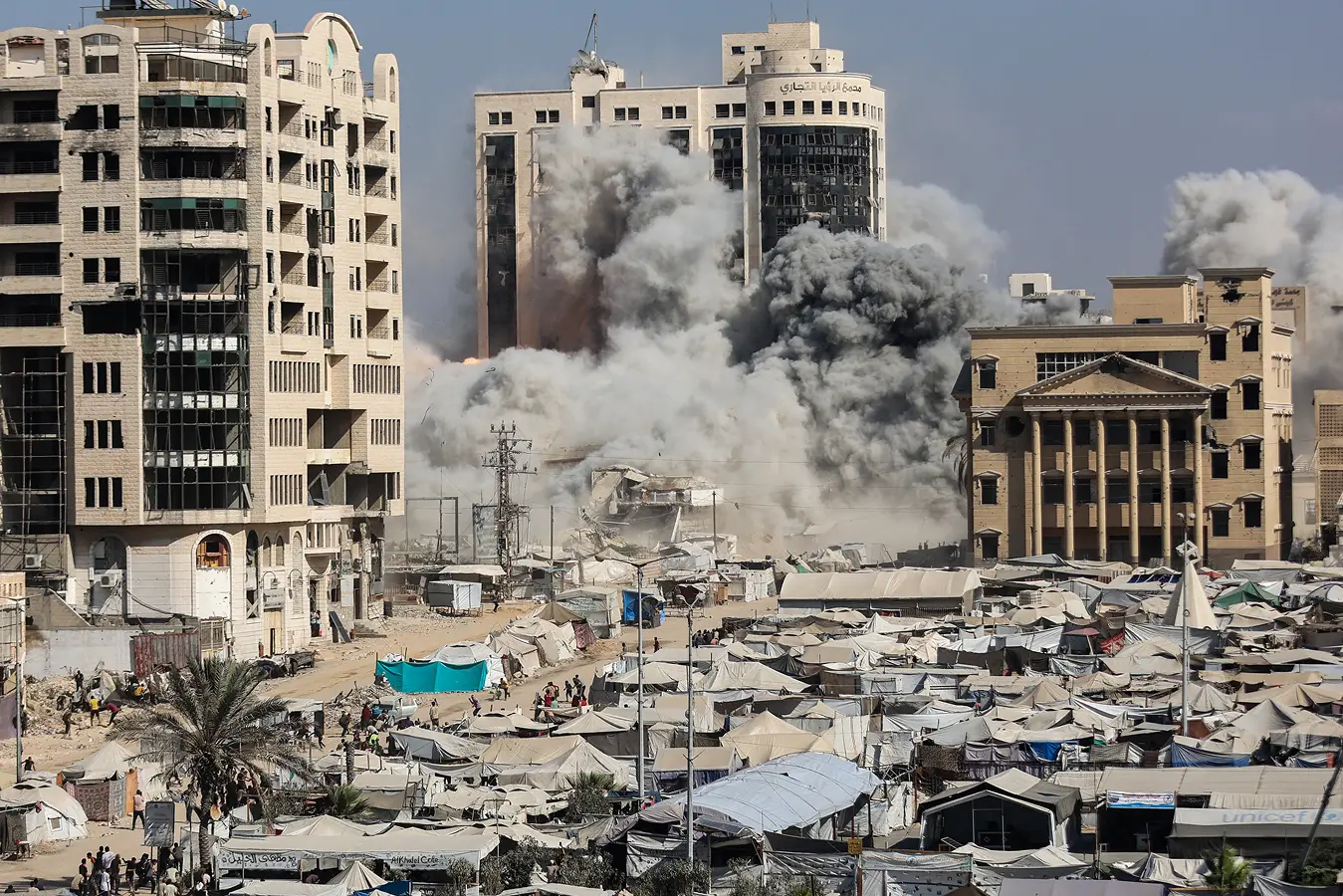
In preparation for its ground invasion of Gaza City, which began on 16 September 2025,
the Israeli army demolished a large part of the high-rise buildings that dominated the skyline of Palestine's largest city, home to around one million people. Here, the Al-Ruya tower
in the Al-Rimal neighbourhood, bombed on 7 September 2025, a few hundred metres from tents housing displaced persons. The small, isolated Palestinian territory, under Israeli blockade since 2007, is one of the most densely populated in the world.
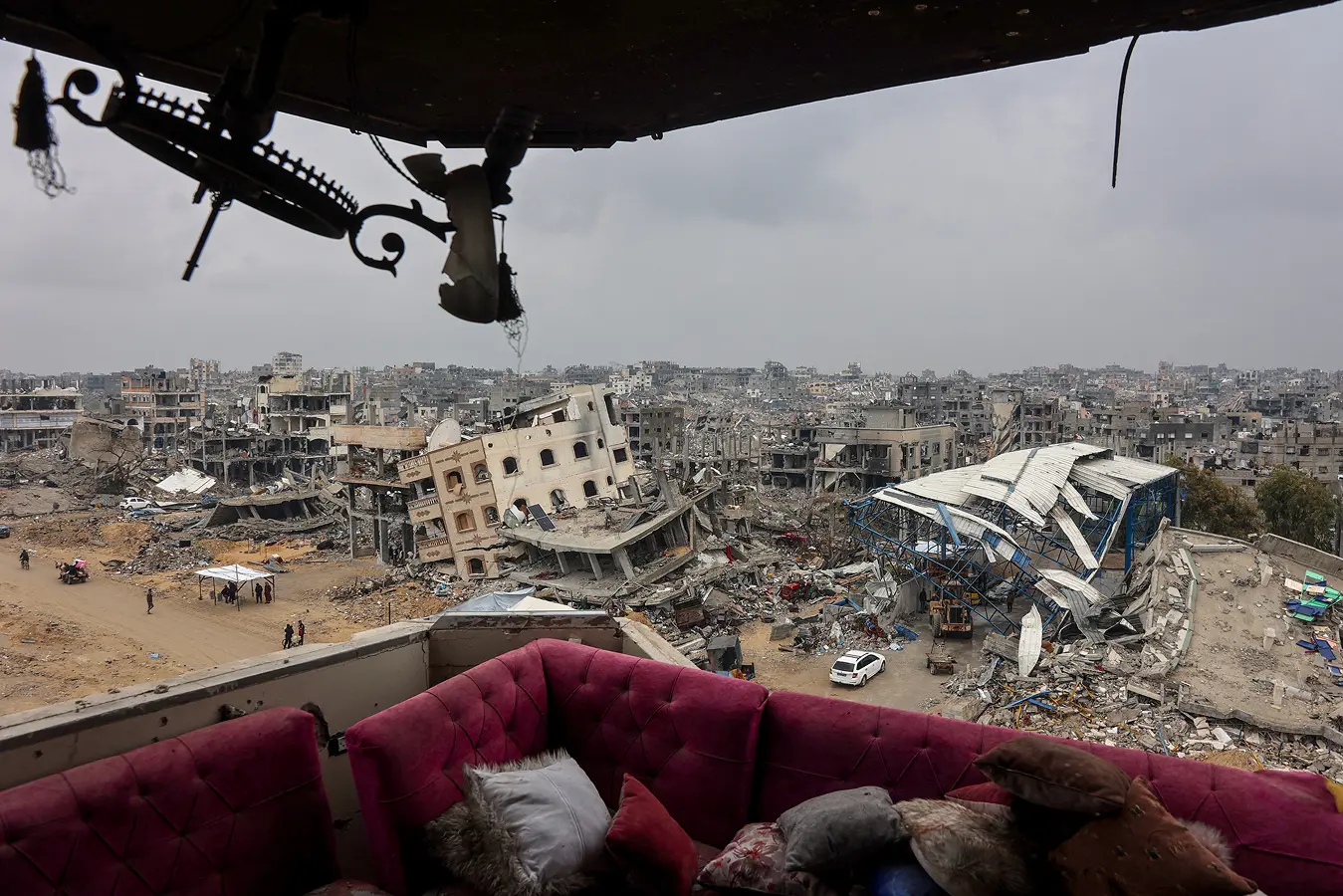
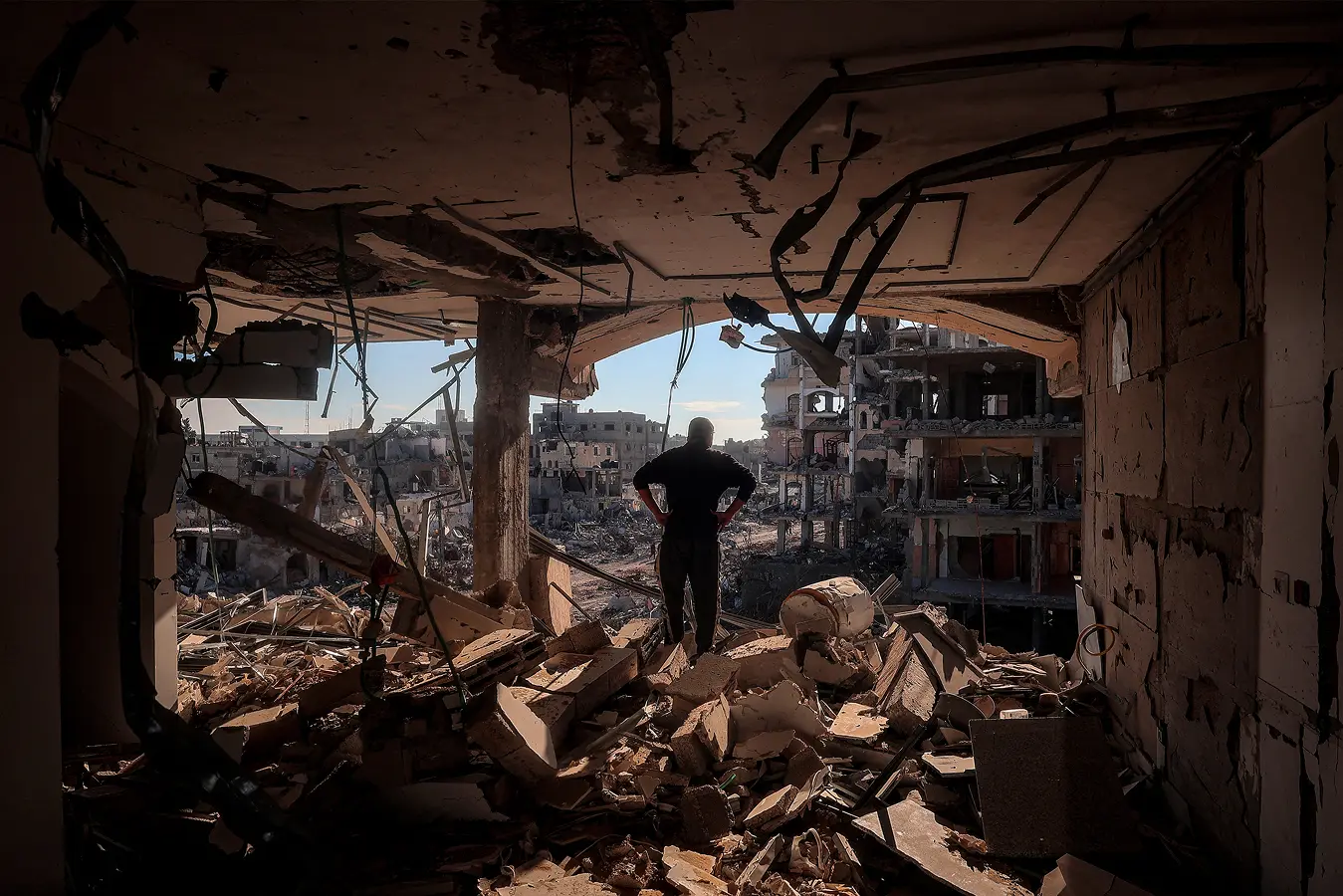
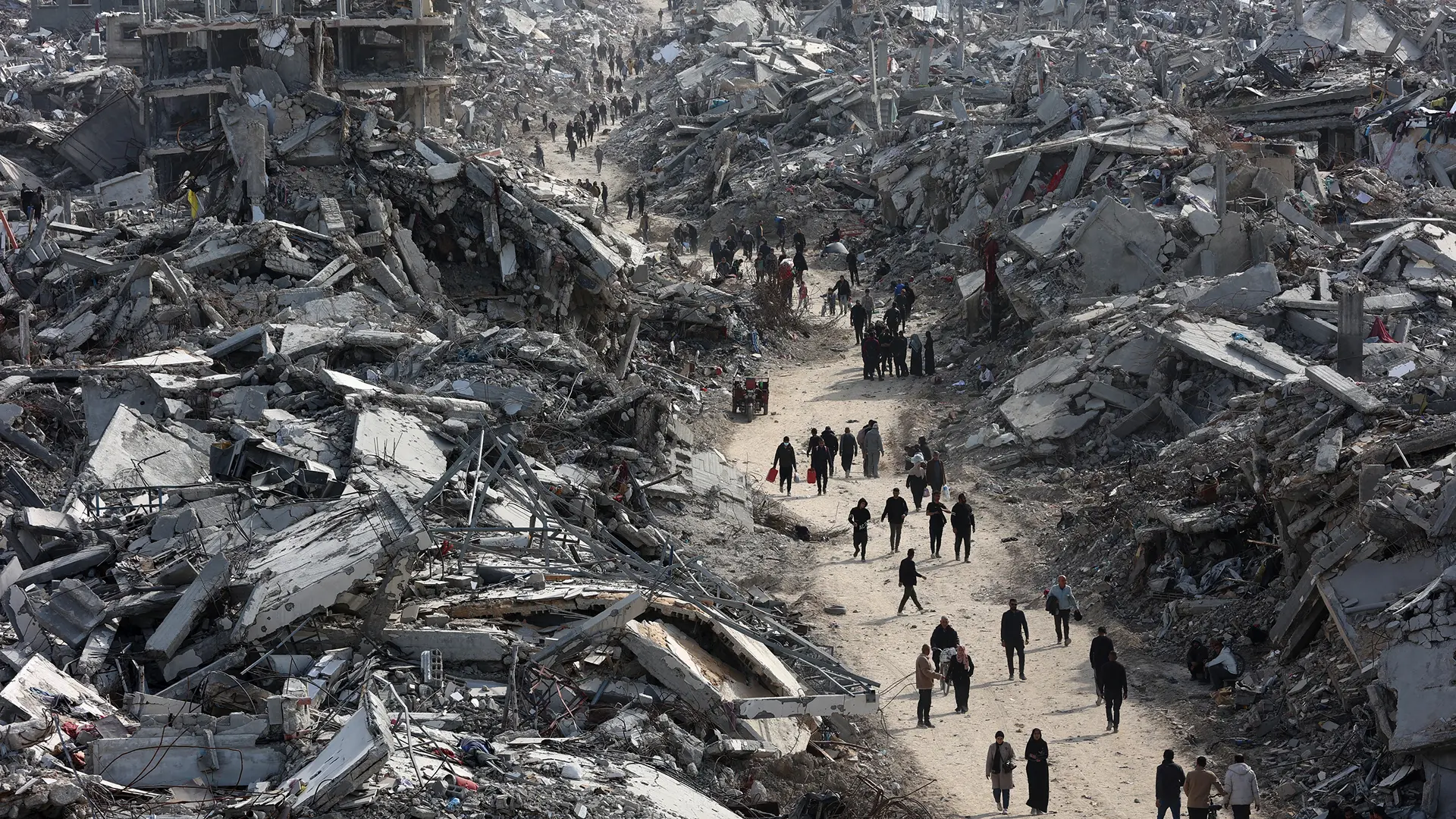
During the second truce in early 2025, residents who returned home after being displaced found entire neighbourhoods in ruins, from Jabaliya in northern Gaza, seen in the photo on the left, taken in February 2025, to Rafah in the south, seen in the photo on the right, taken in January 2025. According to the UN, by September 2025, 78% of buildings in the Gaza Strip had been partially or completely destroyed.
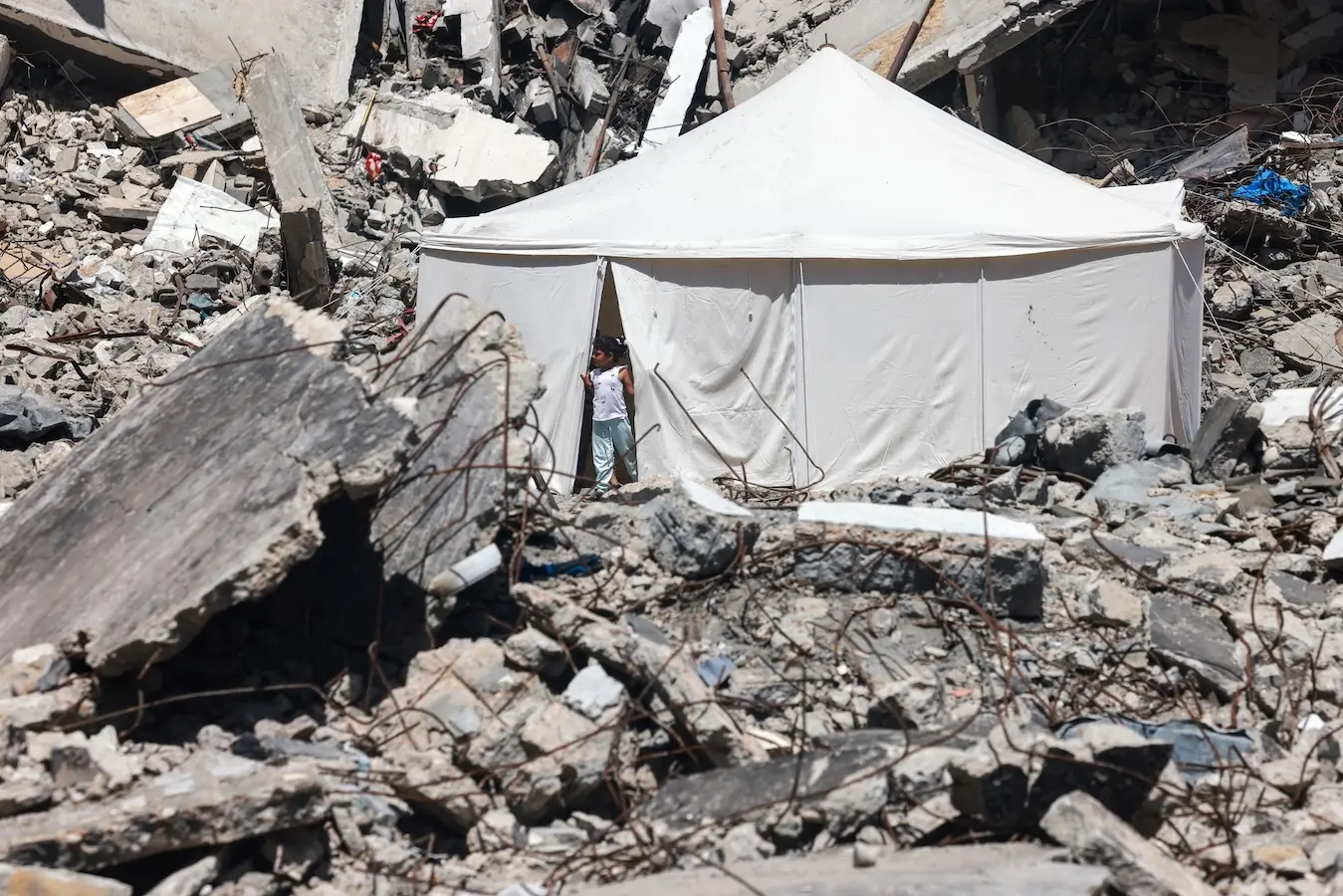
Rafah, southern Gaza, 19 April 2024.
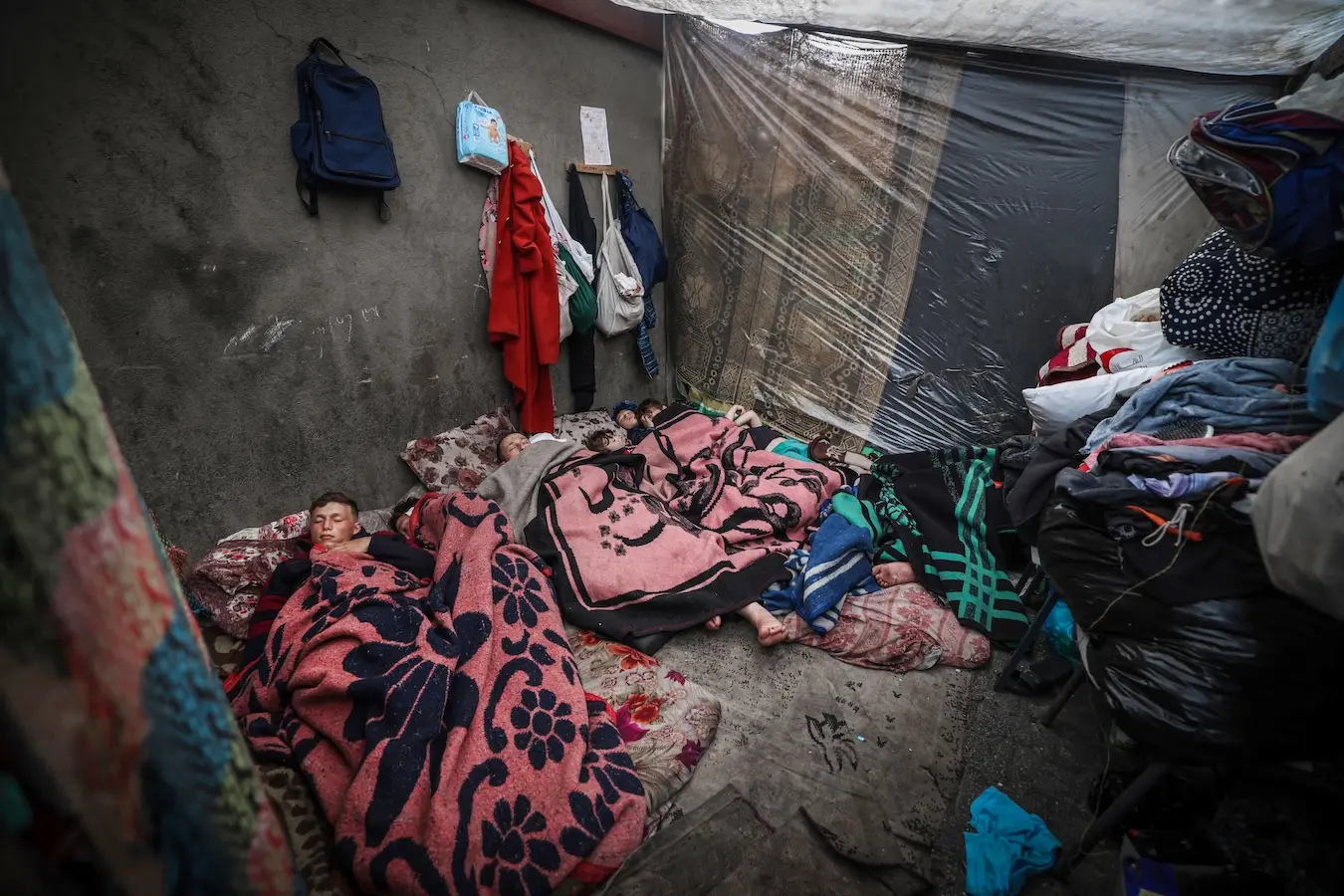
Following the Israeli invasion of Gaza City in September 2025, thousands of people were once again forced to flee to the centre and south of the enclave, where every square metre is at a premium. These makeshift shelters leak water in winter and turn into ovens in summer.
The displaced, some of whom used to live in comfortable, spacious flats, are forced to share latrines with hundreds of other people. Women have no privacy and are constantly dressed
and veiled.
Here in Rafah, on 10 April 2024, on the first day of Eid al-Fitr, which marks the end of Ramadan.
Who among the 2.3 million Palestinians living in Gaza has not been displaced during the war? The UN estimates that around 90% of Gazans were forced to leave their homes during the war. In two years, some have been displaced more than a dozen times. These massive and arbitrary displacements have created an unprecedented humanitarian crisis.
On 13 October 2023, the Israeli authorities issued a mass evacuation order that drove Gazans to the south of the enclave. In May 2024 alone,
during the Israeli offensive in Rafah, nearly one million people
were forced to leave.
This cycle of offensives and forced displacement has been repeated many times since the start of the war. In the autumn of 2024, Israel carried out an operation resembling ethnic cleansing in the far north of the Gaza Strip, bombarding the area heavily and laying siege to it. Within a month, nearly 100,000 Gazans, more than half of the northern population, fled, mostly to Gaza City. Those who remained were trapped in the fighting.
In December 2024, one of MSF's employees was killed in a bombing along with his wife, three children, four nieces and nephew, sister and mother.
In August 2025, Israel again bombarded Gaza City, before launching a ground offensive in mid-September. More than 400,000 people left in a month and a half.
Shortly before a bombing raid, but not systematically, the army issues an evacuation order via leaflets dropped from aeroplanes, text messages and phone calls, or social media. People then have to make a quick decision. Stay, for those who have just given birth, families with young children who have nowhere else to go, the chronically ill who know they are close to carers, or the elderly. Others choose to flee, but where to? Many head for hospitals or schools, hoping to find a little more safety there. But these too are targeted by Israel and have become, over the months, battlefields.
In mid-October 2023, without consulting NGOs or the UN, the Israeli army designated Al-Mawasi,
a sandy area west of Khan Younis and Rafah in the south, as a "humanitarian zone" and encouraged displaced persons to settle there, despite the lack of infrastructure.
On 20 February 2024, an Israeli tank fired on a house sheltering MSF staff and their families in Al-Mawasi, killing two people and injuring six others. On 13 July 2024, an attack targeting two Hamas leaders, including its military chief, Mohammed Deif, killed 90 Palestinians and wounded 300 others. After Israel broke the truce in March 2025, the UN recorded 23 Israeli attacks in Al-Mawasi in one month.
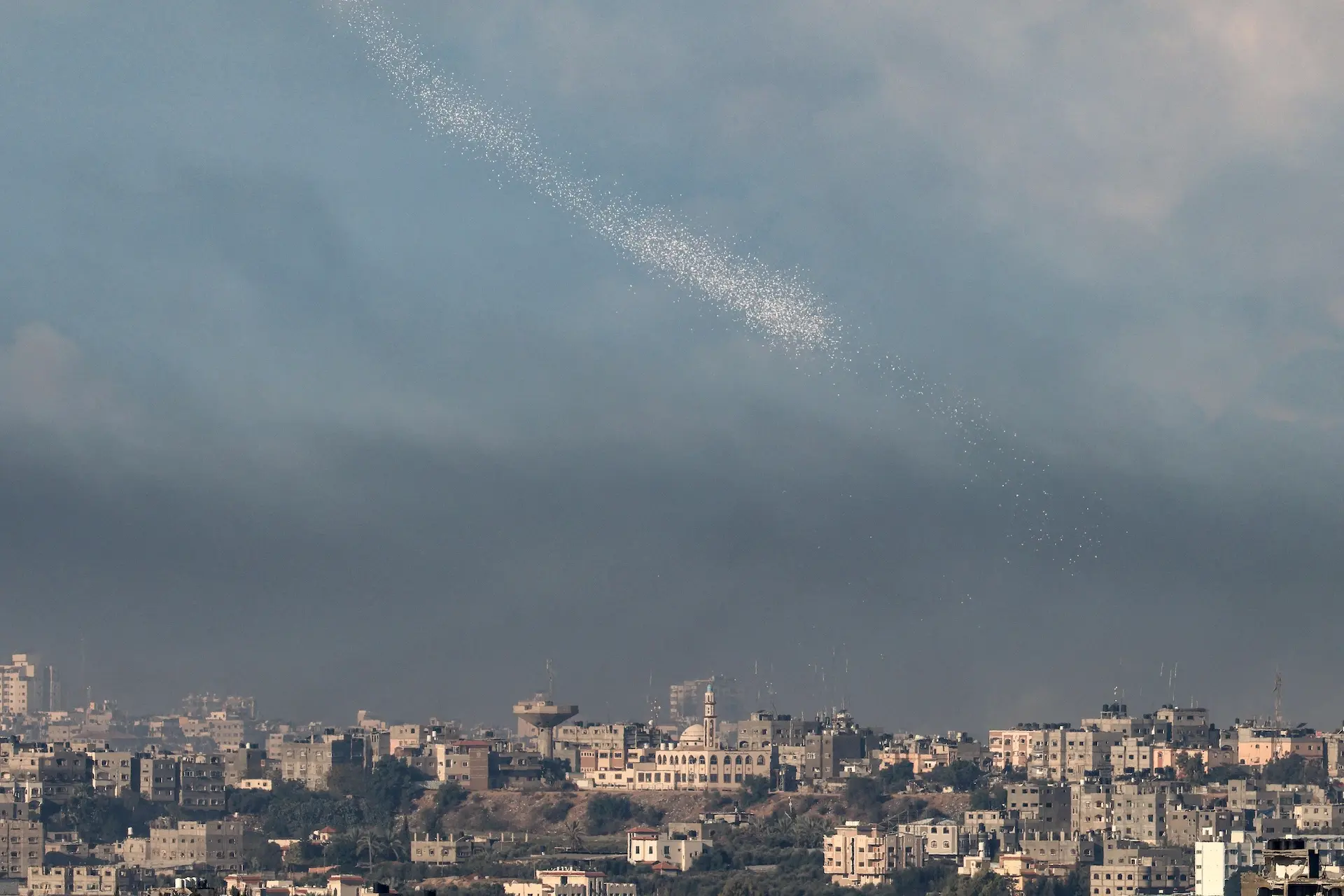
The order comes out of the blue, in the form of leaflets instructing people to evacuate the area. Very often, Gazans have no other information: no roads are safe for them to leave, and bombing can start at any moment.

Gaza City, northern Gaza, 13 October 2023.
In December 2023, just after the end of the first truce, Palestinians in Gaza received leaflets with a QR code printed on them. The code links to a map: the Israeli army has divided the enclave into hundreds of small areas, each with a number. Since then, when it orders an evacuation, it publishes a series of numbers corresponding to the blocks concerned. In October 2025, the UN estimated that 82% of the Gaza Strip was in an Israeli military zone and/or under evacuation orders.
Sometimes, the Israeli army precedes its bombings with a strike to warn residents that they must flee immediately. Sometimes, bombs are dropped without warning, or the military calls one of the residents of a building, who must quickly gather their neighbours. Other times, the Israeli army orders the evacuation of a building, but it is the one next door that is ultimately bombed. Since the beginning of the war, no place has been safe for civilians in the enclave.
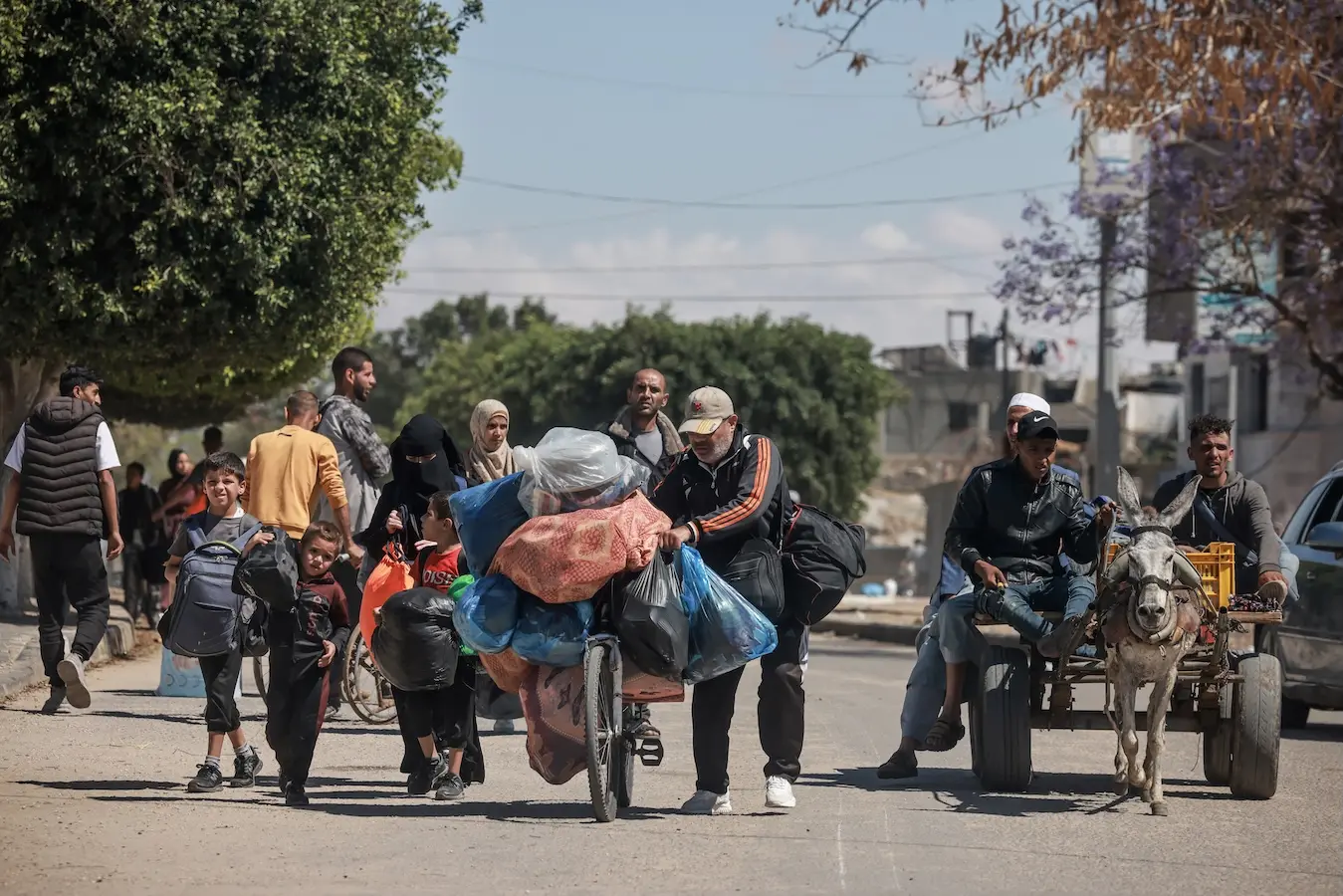
On 19 January 2025, the first day of a two-month truce, Palestinians walk through the ruins in the centre of Rafah to return to their homes. The men often left first, on foot, to scout the way. Fuel is scarce due to the siege. Donkey carts have become a popular means of transport, especially for carrying the wounded.
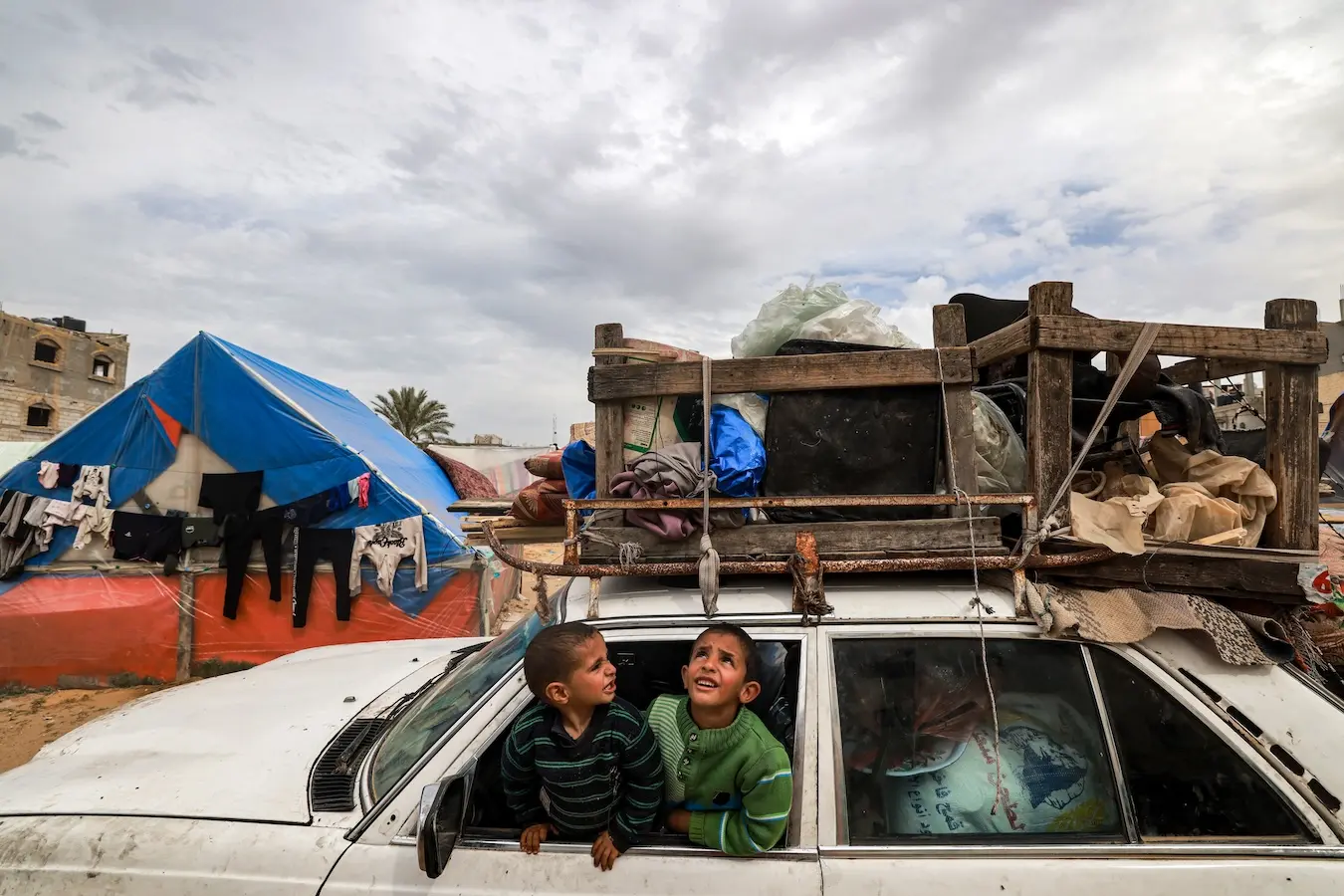
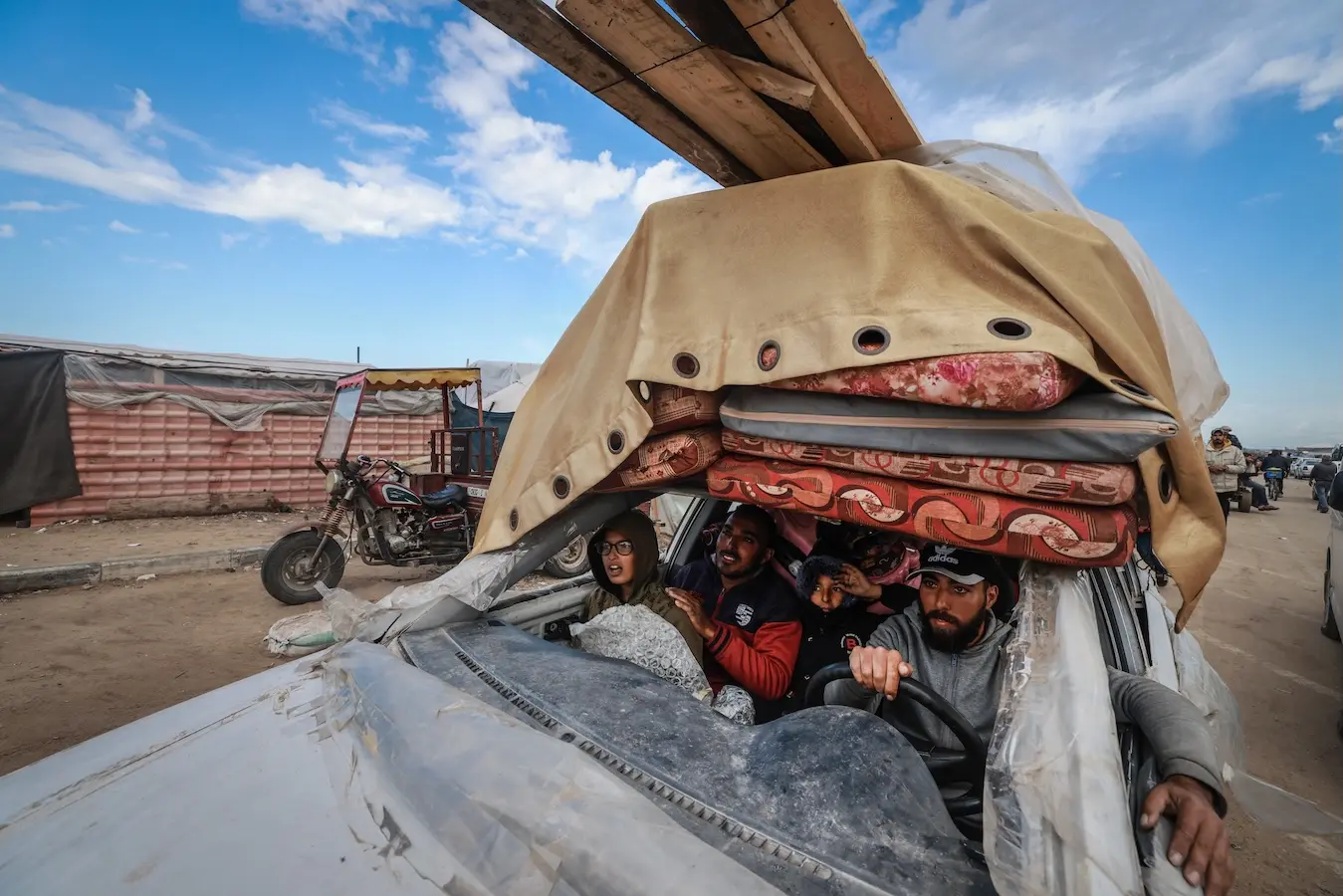
For those displaced, it was necessary to pack their entire lives into a few bundles. Many already had a bag handy containing identity documents, diplomas, etc. This is a reflex inherited from previous wars: Gaza suffered four between 2008 and 2021, in addition to being regularly bombed.
THE WOUNDS OF WAR
Hospitals, places of care and refuge
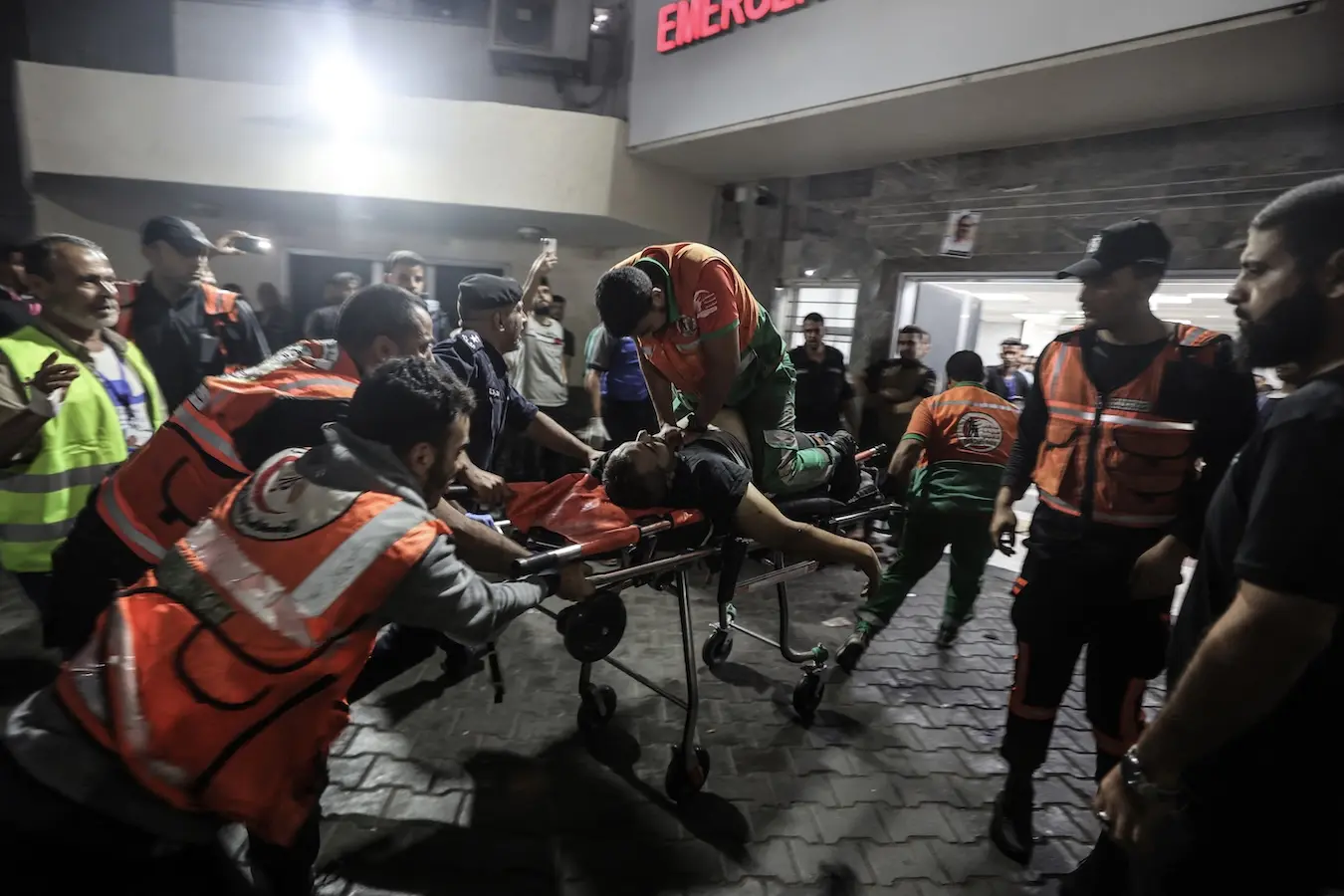
Immediately after a bombing, Palestinian civil defence and Red Crescent teams are the first on the scene to rescue the wounded and search the rubble for survivors. Without equipment, with a shortage of bulldozers, and under bombardment, their task is Herculean. The Israeli army regularly targets ambulances, claiming to be targeting military objectives. Telecommunications are very often cut off, delaying operations. Sometimes there is no fuel to run emergency vehicles, and certain areas are off-limits due to Israeli army restrictions.
In this photo, a Palestinian civil defence rescuer attempts to resuscitate a person injured during an Israeli attack on 16 October 2023 on the forecourt of Al-Shifa Hospital, the largest in the enclave. This institution, a city within a city, was attacked by Israel in November 2023 and March 2024, with the Israeli army claiming that Hamas and Islamic Jihad were using it as an operational base.
According to the WHO, around 20 patients died due to lack of care during the siege of the hospital in March 2024. The main building was set on fire and the hospital was largely destroyed. Four mass graves were discovered on the site.
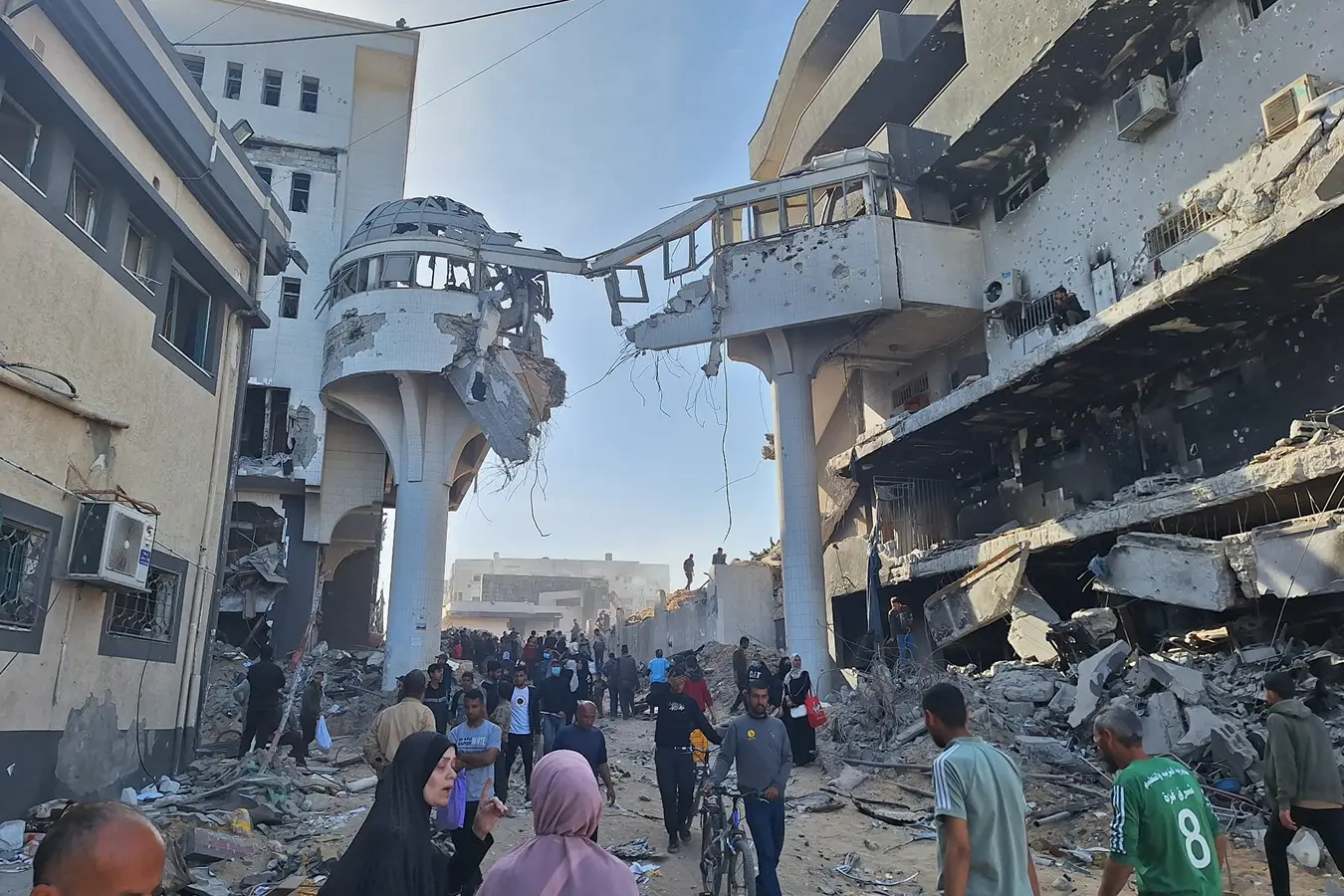
General view of Al-Shifa Hospital in northern Gaza after 14 days of siege by the Israeli army, 1 April 2024.
In Gaza, the Palestinian Ministry of Health recorded nearly 170,000 casualties between October 2023 and October 2025. This number is exceptionally high. It can be explained by the intensity of the bombing affecting the entire territory, which is already densely populated and where the population has no escape route, as well as by the Israeli army's rules of engagement: the latter does not hesitate to accept a large number of civilian casualties when targeting a military objective.
Dr Wesam Sok and Dr Faiz Al Barawi are both doctors working at an MSF clinic in Gaza City. In early September 2025, they describe their daily lives as the Israeli offensive intensifies in northern Gaza.
In November 2024, the UN Human Rights Office reported that nearly 70% of the victims of the war in Gaza were children and women. At the end of August 2025, the WHO estimated that at least 15,600 people, including 3,800 children, needed medical evacuation because no treatment was available in Gaza. This requires prior authorisation from the Gaza Ministry of Health and COGAT, the Israeli army body that manages Palestinian civil affairs in the occupied territories. COGAT's decisions are opaque and often arbitrary. Sometimes the blockages are at the level of the host countries, such as France. France abruptly suspended medical evacuations to its territory in early August 2025 following a decision by its Minister of Foreign Affairs, Jean-Noël Barrot, on the pretext of anti-Semitic posts by a student hosted in France.
Emad, 36, was evacuated with his family from Gaza to France in March 2025.
A nursing manager, Emad worked for nine years with MSF in several health facilities in the Gaza Strip. His seven-year-old daughter Sila suffers from a congenital heart condition, which led to their evacuation to France, where she now receives regular treatment.
In Gaza, medical staff are faced with extreme situations. Healthcare facilities are overwhelmed with an influx of wounded people that would overwhelm any hospital, even one that is fully equipped. However, due to the siege, they lack everything. Healthcare workers have reported having to perform caesarean sections or amputations, sometimes on children, under light sedation or using painkillers, due to a lack of available anaesthetics. The Gaza healthcare system, already weakened by more than 16 years of blockade before the war, has been destroyed.
In July 2025, before the Israeli offensive on Gaza City, the WHO counted 2,085 beds available throughout the enclave, which has a population of approximately 2.3 million.
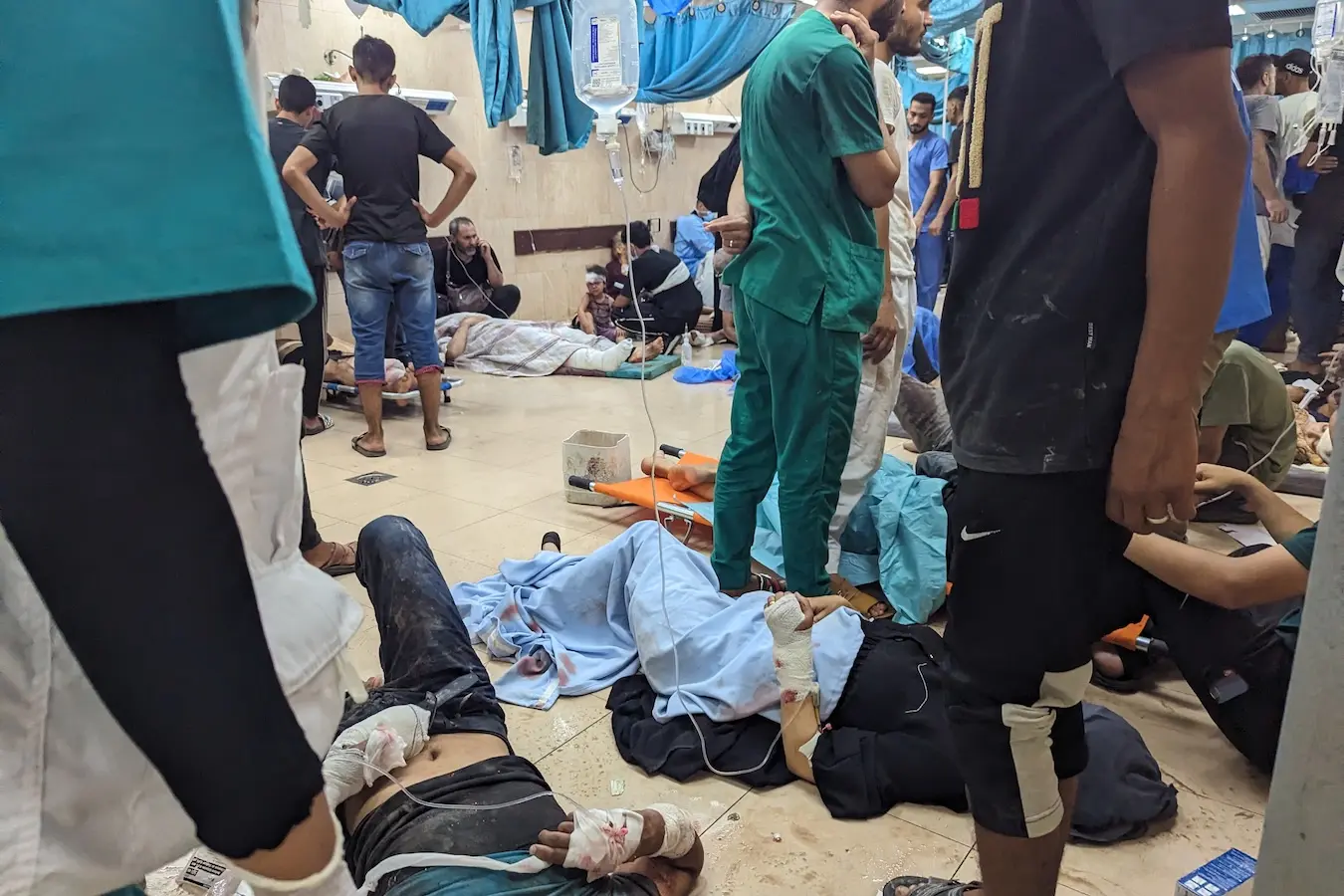
On 8 June 2024, as part of a military operation to free four hostages, the Israeli army carried out a large-scale attack in the centre of the Gaza Strip, in Nuseirat. According to the Ministry of Health, 274 people were killed.
Hundreds of patients arrived at Al-Aqsa Hospital in Deir Al-Balah, some treated on the floor due to a lack of available beds
It was total chaos in the emergency room. Children completely grey or white from shock, burned, calling for their parents, others unable to scream because they were in shock... Nothing, absolutely nothing justifies what I saw.
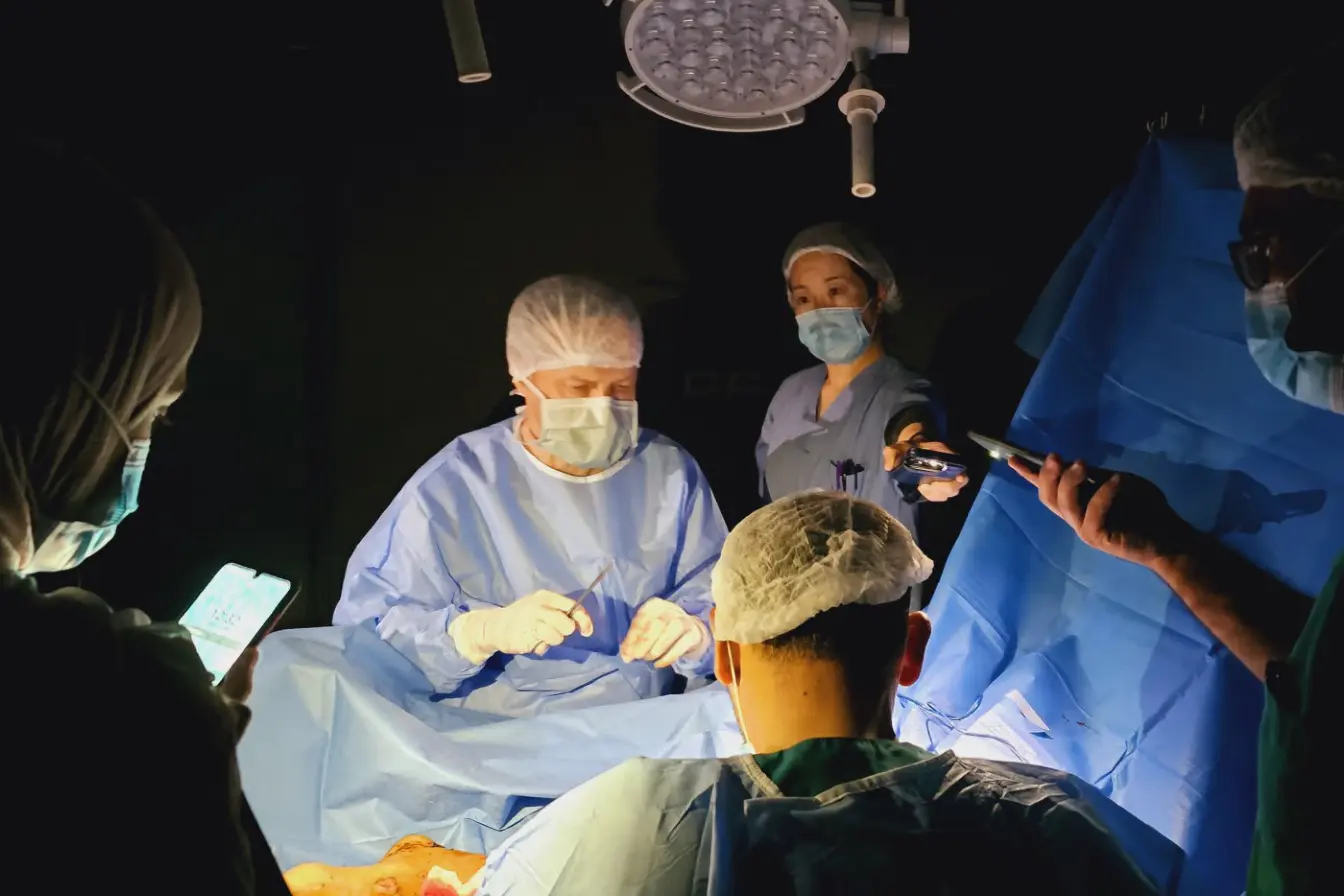
Since the electricity was cut off in Gaza on 11 October 2023, hospitals have been entirely dependent on generators to function. With the electrical systems under power and fuel rationed, power cuts are frequent, including in operating theatres,
as seen here at Nasser Hospital in late November 2023. Surprised by a power cut,
the medical team in the operating theatre uses the light from mobile phones to replace the surgical lamp, while an MSF surgeon operates on a teenager wounded by shrapnel.
Testimony of Dr Obeid, MSF surgeon in Gaza, September 2024.
Dr Mohammed Obeid, who speaks in this video, was arrested on 26 October 2024 by the Israeli army along with several other members of the medical staff at Kamal Adwan Hospital in northern Gaza during a military operation against the hospital. A year later, he was still being held by Israel.
Between October 2023 and July 2025, Israel detained at least 405 healthcare professionals, according to the NGO Health Workers Watch. Two specialists, Adnan Al-Bursh, a surgeon and head of the orthopaedic department at Al-Shifa Hospital, and Eyad Al-Rantisi, director of the women's health centre at Kamal Adwan Hospital, died in detention. Numerous testimonies from Gazan healthcare workers, collected in particular by the NGO Physicians for Human Rights in Israel, have reported torture and deprivation.
We lack equipment and we have a lot of cases. We performed the amputation under light sedation (...) We amputated in front of his mother and sister because there was no room.
The approximately 900 MSF employees in Gaza are going through the same hardships as the rest of the population. Most have been displaced, some are living in tents, their homes have been destroyed and they have lost everything they owned. Like all Gazans, they suffer from anxiety, depression and insomnia. Despite exhaustion and the constant fear of losing loved ones, many have chosen to continue caring for their compatriots in the health facilities that are still more or less functional.
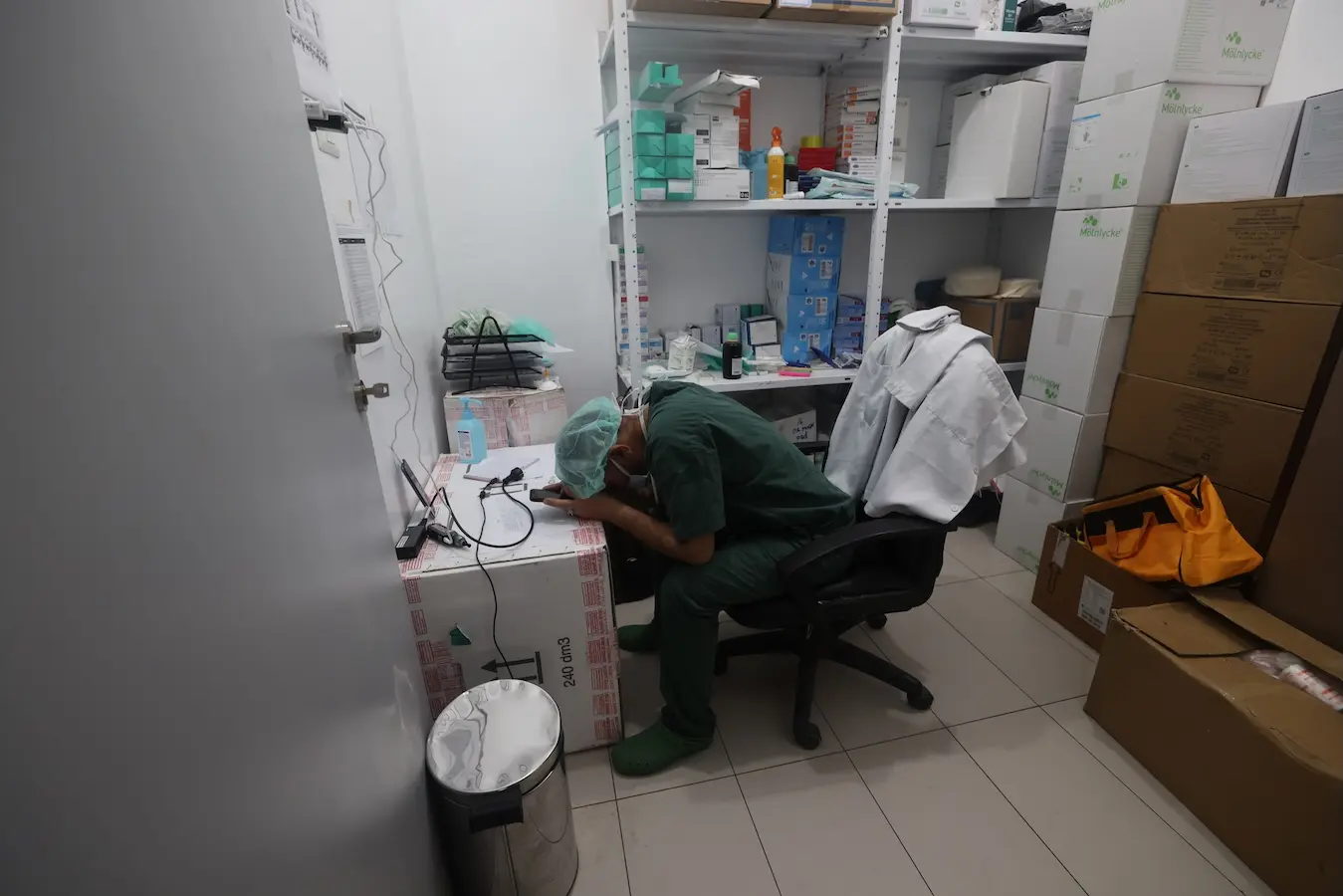
Healthcare workers in Gaza, affected like the rest of the population by war and bombing, hunger and displacement, work tirelessly, seven days a week. At the start of the war in December 2023, returning from a month-long mission, MSF emergency coordinator Marie-Aure Perreaut Revial spoke of colleagues working in the operating theatre until 1:00 or 2:00 in the morning every day. "They are beyond exhausted", she said.
Rafah, southern Gaza, March 2024.
Adding to the chaos of the influx of wounded people is that of displaced persons hoping to find refuge in hospitals. At the end of January 2024, MSF estimated that some 50,000 displaced persons had found refuge in Al-Shifa Hospital in Gaza City. Sometimes families accompany a wounded person and remain after treatment is completed.
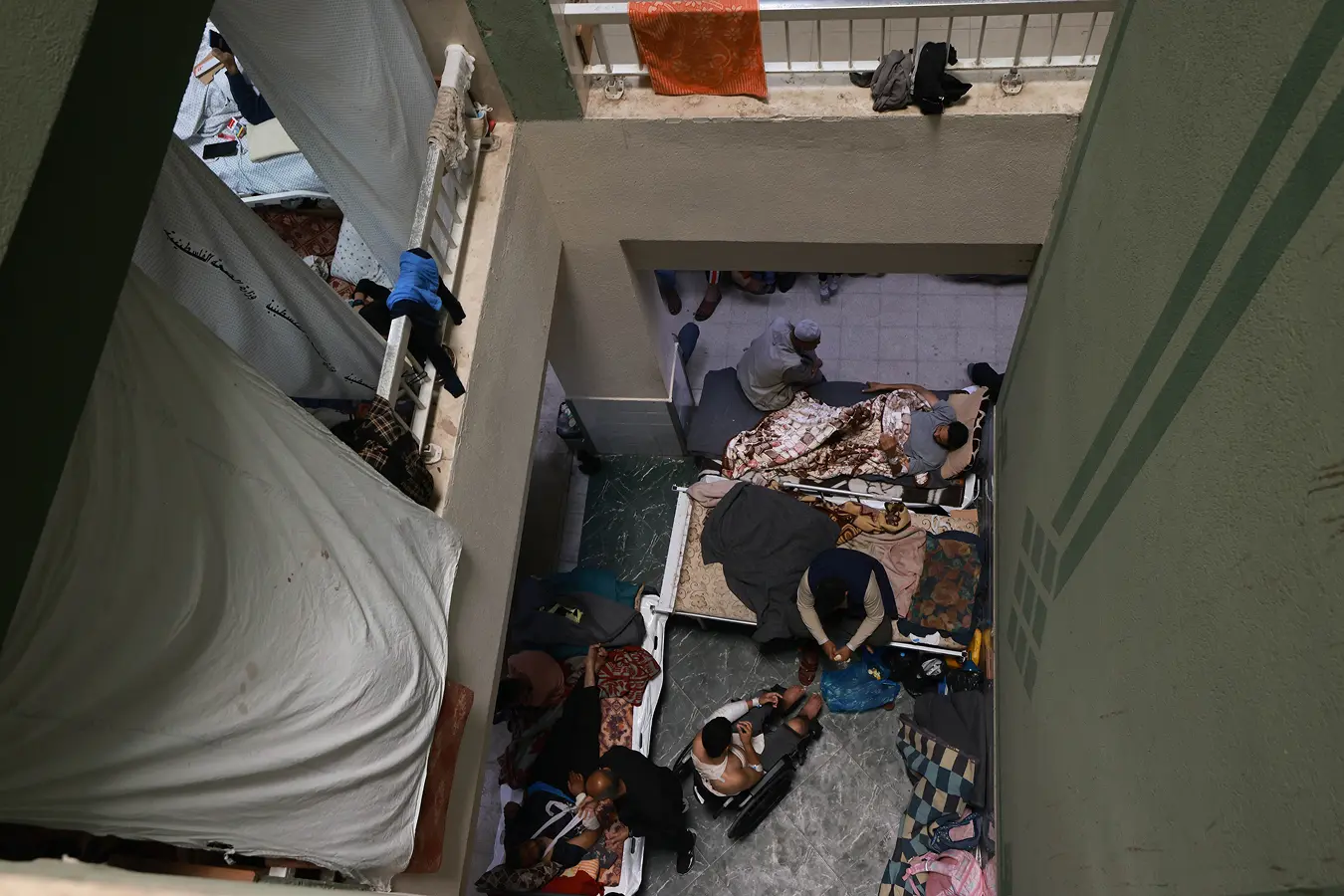
Displaced persons in the corridors of Al-Aqsa Hospital in central Gaza, November 2023.
Draw me the war
Children in conflict
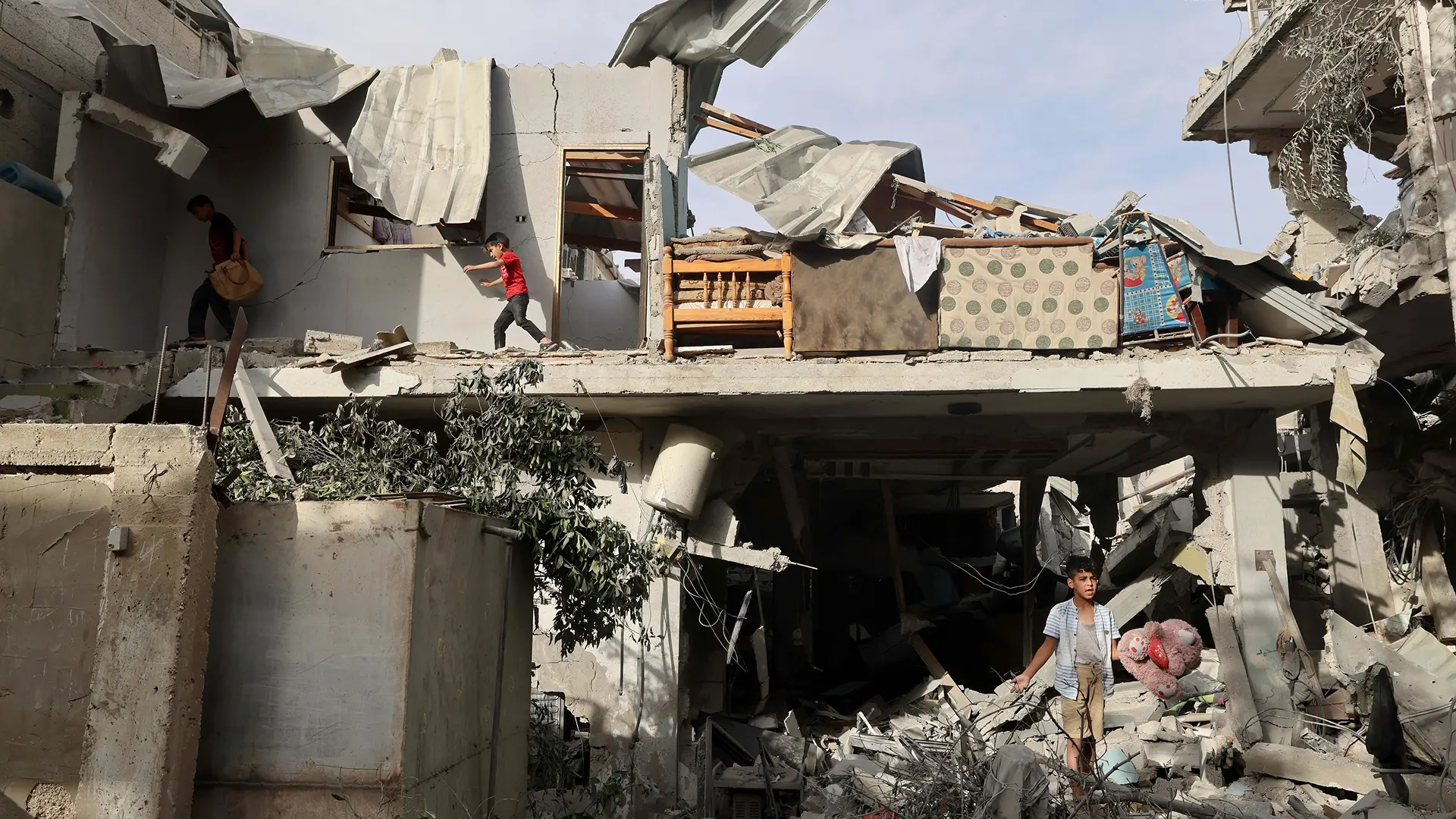
Children make up about half of Gaza's population. At the end of May 2025, UNICEF reported that more than 50,000 children had been killed or injured in the Gaza Strip. In October 2025, the Ministry of Health reported 157 child deaths due to starvation. A survey of MSF employees and their families between October 2023 and March 2025 showed that the mortality rate for children under five had increased tenfold compared to the period before 7 October, and sixfold for babies under one month old.
Caregivers reported a large number of very young patients suffering from devastating injuries – i.e., wounds that have largely destroyed tissue – who had limbs torn off and complex fractures. Children who survive the bombings are at risk of dying later from complications due to poor hygiene and limited resources in hospitals. Many will be disabled for life and will require regular and complex medical follow-up.
In addition to physical injuries, they have suffered severe trauma. MSF psychologists have noted symptoms of depression and acute stress reactions in children who have lost everything. Some have expressed a desire to die. These mental wounds have been constantly reactivated during two years of almost incessant fighting and bombing.
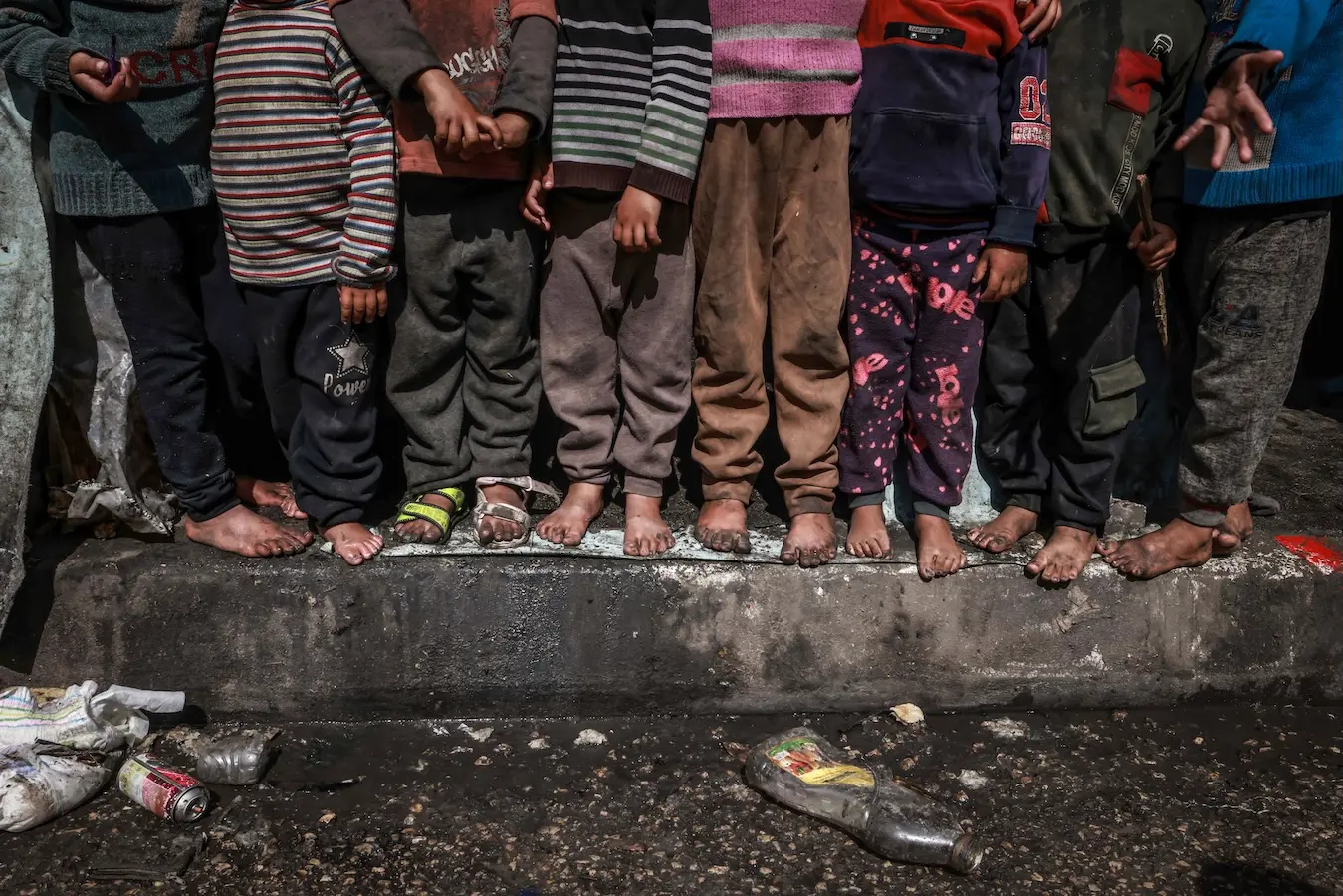
For two years, the children of Gaza have not been going to school, as schools have been destroyed or turned into shelters for refugees. They have lost their homes,
their neighbourhoods, their landmarks, their friends and their toys. The vast majority of them have been displaced several times, and any sense of “normality” has long since disappeared, which exacerbates their trauma.
Rafah, southern Gaza, 14 March 2024.
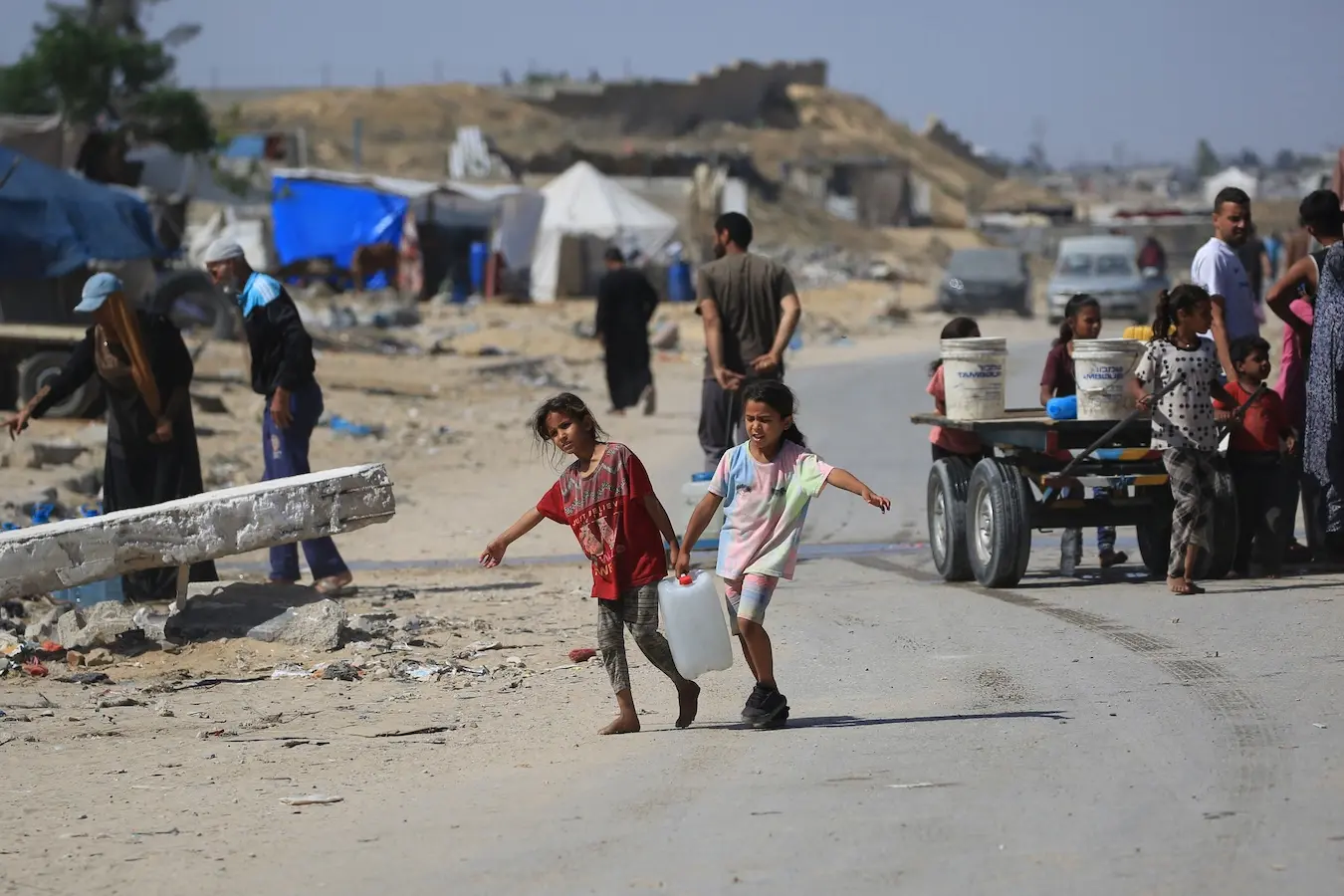
In Gaza, as in any other war zone, the youngest are forced to take on responsibilities that are not appropriate for their age. Older children take care of their siblings after the death of their parents; children sell tins of food aid at markets to buy other basic necessities; and many are tasked with carrying water cans, travelling long distances.
"When I grow up, I want to be a doctor, like my mother." This is the wish of Deema, a little girl from Beit Lahia, in northern Gaza, who has been living with her family in a tent among the rubble of her home for the past year and a half.

WCNSF is the acronym for "Wounded child, no surviving family".
It appeared just one week after the start of Israeli bombing of the Gaza Strip, as humanitarian workers sought to account for the unprecedented influx of orphans into Gaza hospitals. Some of these children are difficult to identify: they arrive at the hospital unconscious or are sometimes simply too young to know their names. Parents began writing their children's names on their bodies so that they could be identified in the event of a bombing.
According to the Palestinian Bureau of Statistics, by spring 2025, more than 39,000 children in Gaza had lost one or both parents. In Gaza, families often live in the same building, with each generation sharing the floors. Israeli bombs, by destroying homes, have decimated entire lineages.
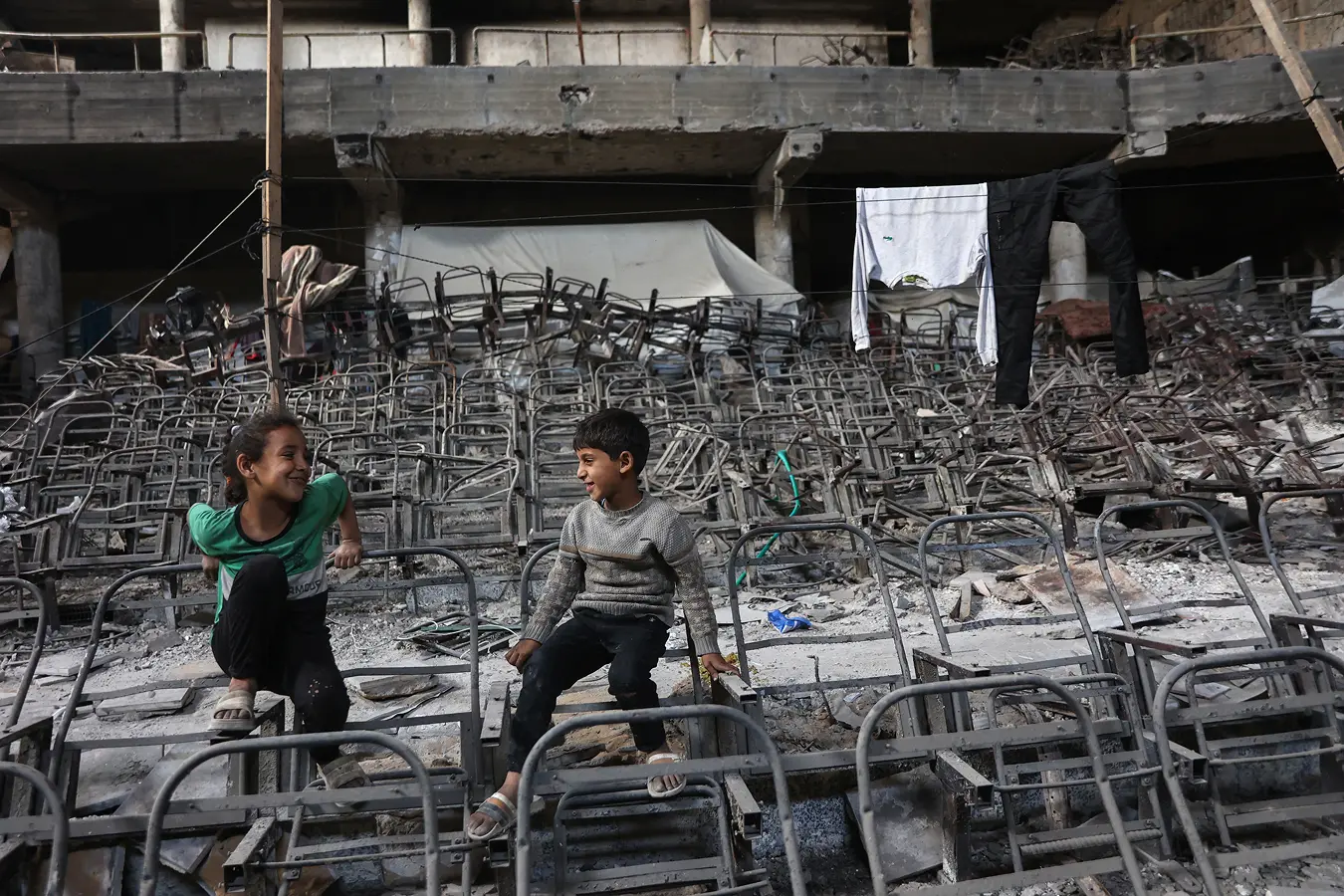
in Gaza City, 1 May 2025.
© Omar Al-Qattaa / AFP
Children are the most affected because they don't always have the ability to explain what is happening to them.
These drawings were made by children under the age of 15 at Al-Aqsa Hospital in Deir Al-Balah and collected by MSF psychologists between November 2023 and May 2024.
We only have God [to help us].


"Beyond the devastating violence depicted in the drawing, there are two worlds. A yellow world, with beautiful houses and bright sunshine. And a red world, with body parts torn apart, cut to pieces. It is as if there is a need to purge something from a deeply painful reality, too hurtful to be contained in the mind and heart of a child. And although we see missiles falling from the sky, what is also striking is that it is not houses that are destroyed, but bodies. This is a reality that is impossible for a child of this age to imagine. It is as if there is a before and after in this drawing. The world of the sun, where the colour chosen is yellow, a colour of light and joy.
And then the attack. And a world that becomes truly chaotic. A world where human bodies are somehow reduced to objects and can be taken apart as one would a puppet or a doll.
It's quite frightening."
Testimony of Audrey McMahon, MSF psychiatrist
Where our dreams flew away (left).
It takes years to build but only minutes to destroy (right).

A traumatised population
Healthcare workers confronting psychological suffering
Testimonies from Dr Abou Abed Moughaisib, head of MSF medical activities in Gaza, an MSF healthcare worker whose testimony has been anonymised for security reasons, and Audrey Mc Mahon, an MSF psychiatrist based in Jerusalem. All three describe the impact of the conflict on the mental health of Gazans. In September 2025, Dr Abou Abed Moughaisib was evacuated from the Gaza Strip to Ireland.
The hardest thing is hearing your little girl, who is less than three years old, ask you: "Mommy, has the house been bombed? Mommy, I want to go home. Mommy, what's that noise?" A little girl who knows the difference between the sound of an Apache helicopter and that of an F-16 helicopter.
I was very stressed about keeping them close to me. My sons are grown up. They are two adults. But I was acting as if they were five or six years old. At one point, I felt that I was going to lose them, that their identity and personality would no longer be the same.
Often, due to bombing or insecurity, medical staff have had to leave patients behind. And many of them share a sense of guilt at not being able to do more.
CROSSING POINTS
Movement restrictions and organised shortages
In 2007, when Hamas came to power in Gaza, Israel imposed a strict land, sea and air blockade on the Palestinian enclave. Smuggling tunnels to Egypt have enabled the development of a parallel economy that circumvents the blockade. After Marshal Al-Sissi's coup in 2013,
the Egyptian army began destroying these tunnels. Since 1967, in the eyes of international law, Israel has been the occupying power in Gaza, even after the withdrawal of Israeli settlers in 2005 The Israeli authorities control what enters and leaves the enclave, monitor the airspace via drones that constantly fly over the small territory, not to mention the military operations that the army regularly conducts there, even before 7 October.
On 9 October 2023, two days after the attack by Hamas and other Palestinian armed groups in Israel, Israeli Defence Minister Yoav Gallant announced a complete siege of the enclave: "There will be no electricity,
no food, no fuel, everything is closed."
This statement was noted by the International Court of Justice in the context of the complaint filed by South Africa, in which Israel is accused of genocide. This first siege lasted 15 days.
On 2 March 2025, in the midst of a truce, Israel again imposed a total blockade, which was only partially lifted on 18 May 2025. During these two years of war, humanitarian aid has been alternately exploited, used as a means of pressure, subject to conditions or simply blocked by the Israeli authorities. Faced with this situation, the international community has contented itself with ineffective statements.
The Rafah crossing on the border with Egypt was closed as soon as the Israeli army seized it on 7 May 2024. It had been the only way out of Gaza for Palestinians since the start of the war. At the end of 2023, the crossing, negotiated with a company close to the Egyptian regime, cost between €4,500 and €6,000 for an adult and more than €2,000 for a child – a fortune for Palestinians. Some patients in critical condition and dual nationals were also able to be evacuated via Rafah, after security checks by the Israeli authorities.
Since October 2023, foreign humanitarian workers have also been returning to Gaza via Rafah. Today, they must pass through Jordan and then through the Israeli crossing points of Kerem Shalom (Karem Abu Salem in Arabic), at the southern end of the Gaza Strip, or Kissufim, near Khan Younis. Rotations are more limited – around 20 international MSF employees take turns each month to support Palestinian medical staff.
Rafah, southern Gaza, 24 November 2023.
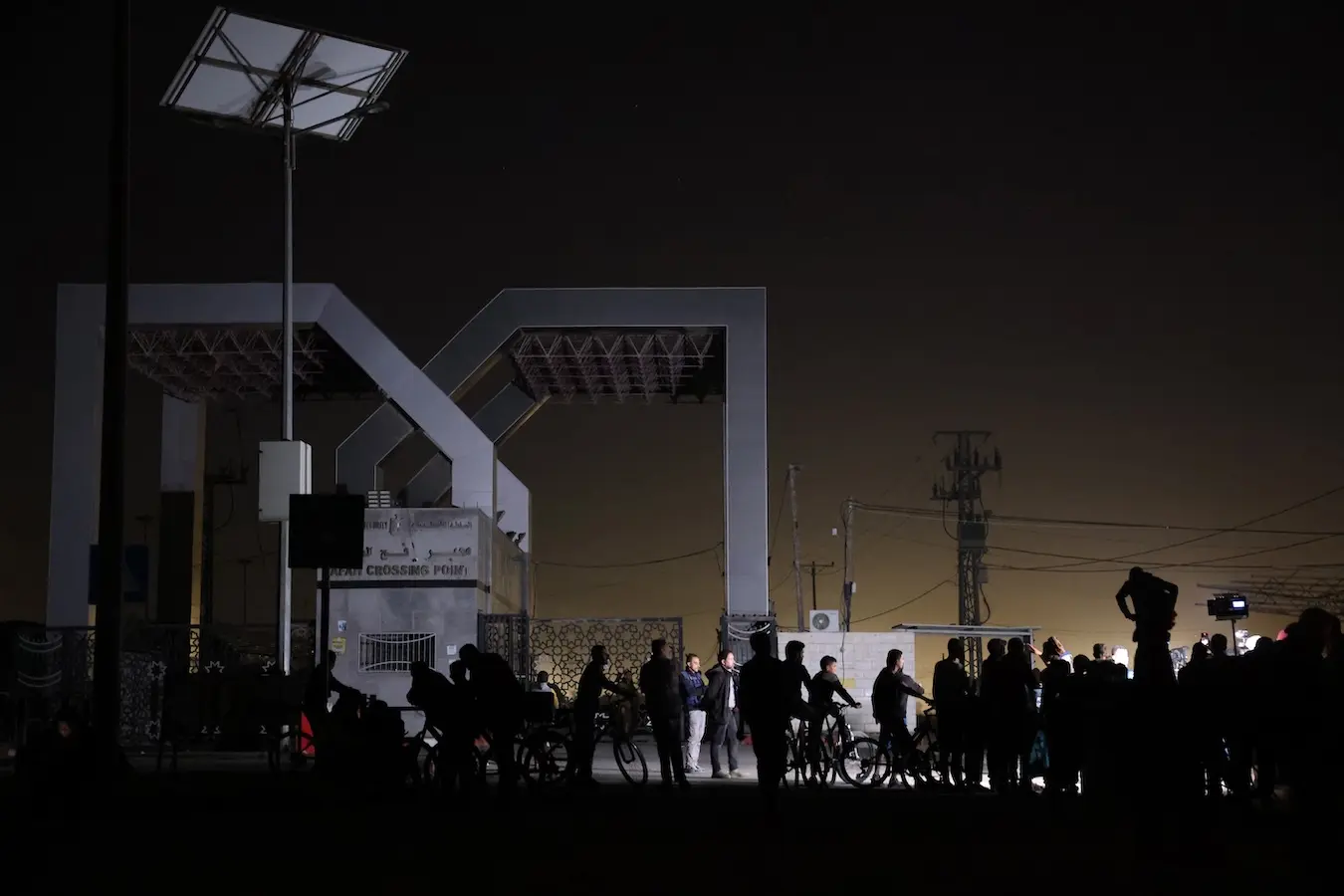
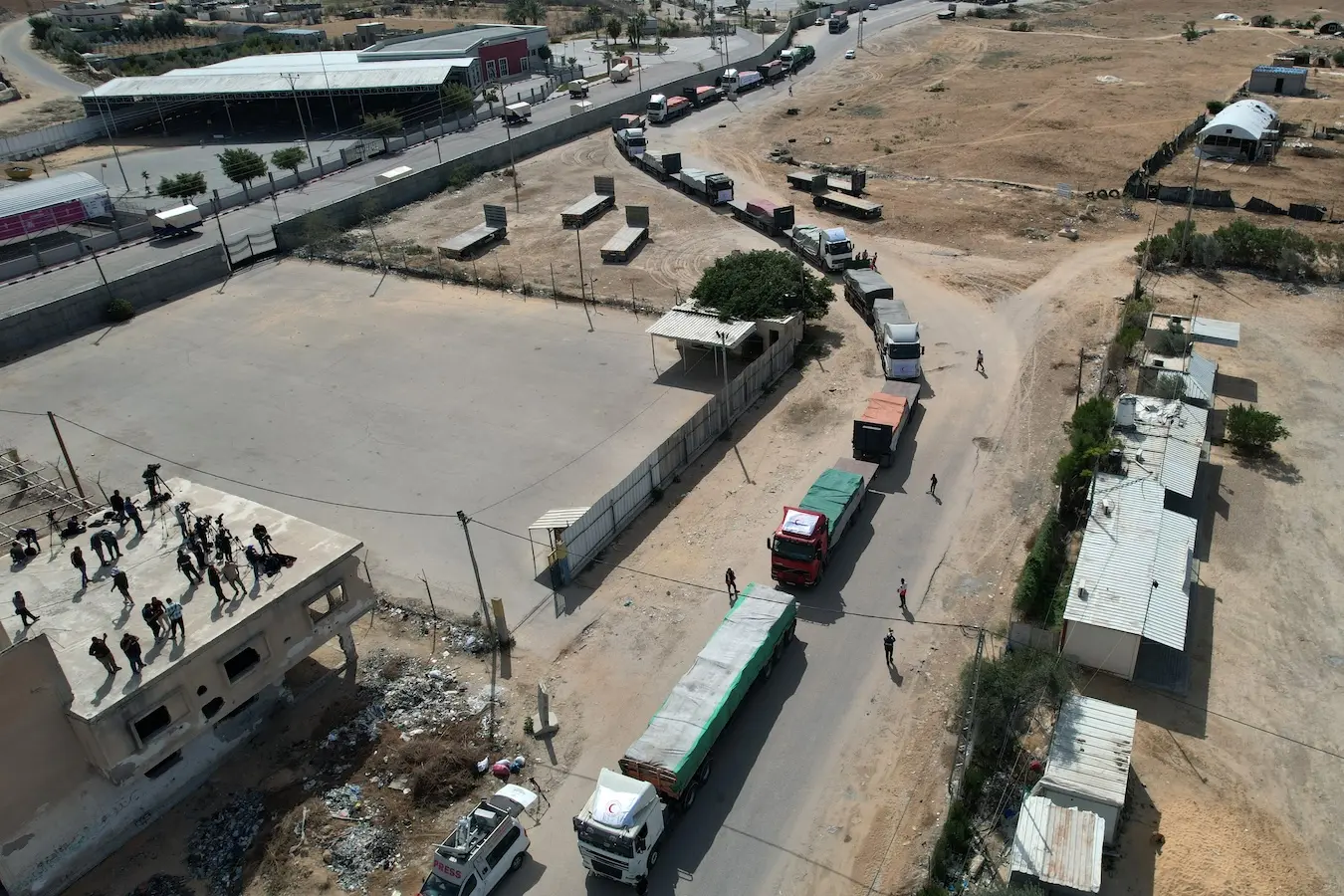
On 13 October 2023, the Israeli army ordered the evacuation of the northern Gaza Strip and cut the enclave in two. The north, including Gaza City, the largest city in the enclave, has been isolated for months. Two roads connect it to the south: the Al-Rashid road, which runs along the sea, and Salah Eddine Street, a little further inland. The army has set up checkpoints and uses facial recognition systems to control those fleeing south. Gazans such as the poet Mosab Abu Toha report that soldiers give orders to certain displaced persons via loudspeakers: "The man in the red T-shirt and glasses, on the side!" Those who are stopped are searched and often arrested. Some, like Mosab Abu Toha, end up in detention camps such as Sde Teiman in Israel's Negev, where numerous cases of torture have been reported. Here, on 7 April 2024, Palestinians who had taken refuge in Rafah, in the far south, are returning to Khan Younis after the withdrawal of Israeli troops.
This aerial photo shows thousands of residents leaving the centre of the enclave to walk to the city of Gaza in the north on 27 January 2025. During the second truce, Israel reopened this passage for the first time since the start of the war. Previously, the Israeli army had forbidden Palestinians who had left northern Gaza from returning.
In October 2025, after the third ceasefire came into effect, the same columns of Gazans rushing to return home formed again a few hours after the bombing stopped.
During the winter of 2023-2024, northern Gaza, which still had a population of 300,000,
was completely cut off by the Israeli authorities. Humanitarian aid, which is delivered via the southern Gaza Strip, was drastically reduced. When this testimony was recorded,
the situation was catastrophic. In the months that followed, the delivery of aid from the south to the north remained extremely complicated, with a large proportion of humanitarian missions being refused by the Israeli authorities or cancelled for logistical or security reasons. The road linking the north and south was completely reopened during the second truce, from the end of January 2025.
There is a great deal of hypocrisy in talking about sea routes and air drops.
This is not a logistical problem at all.
The real problem is political.
The Israeli government refuses to allow humanitarian aid into Gaza.
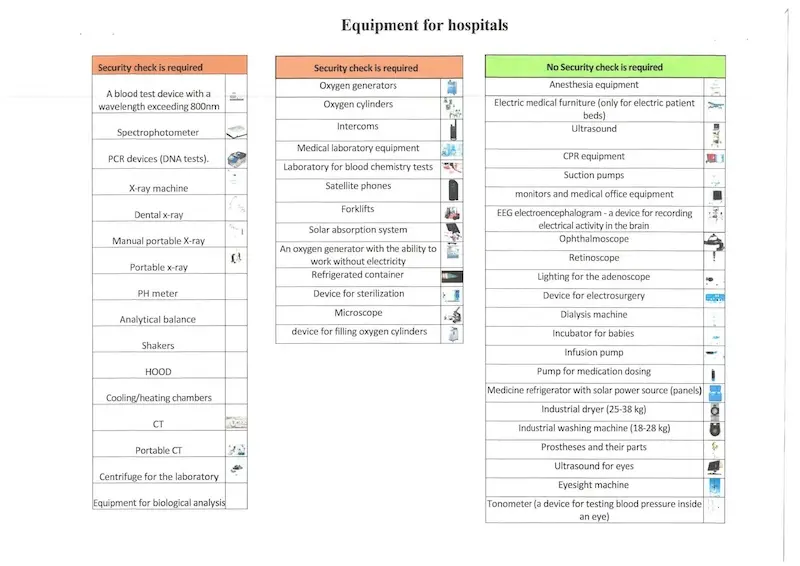
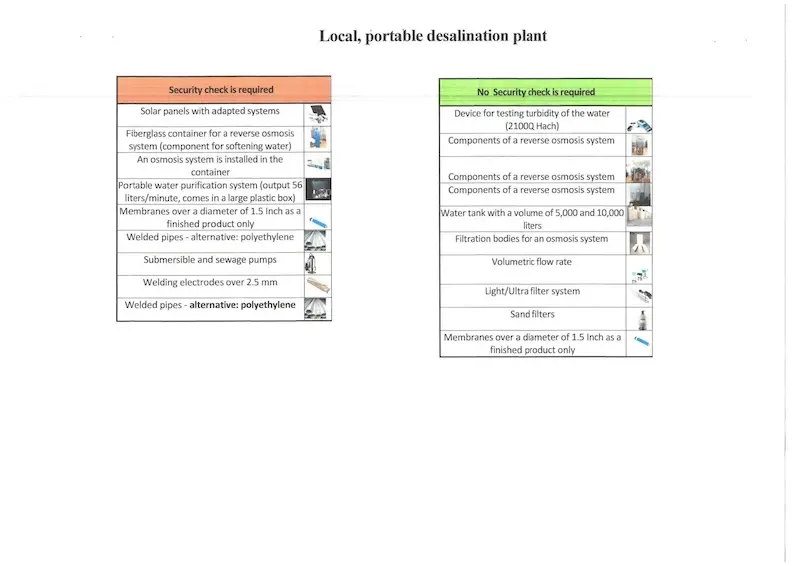
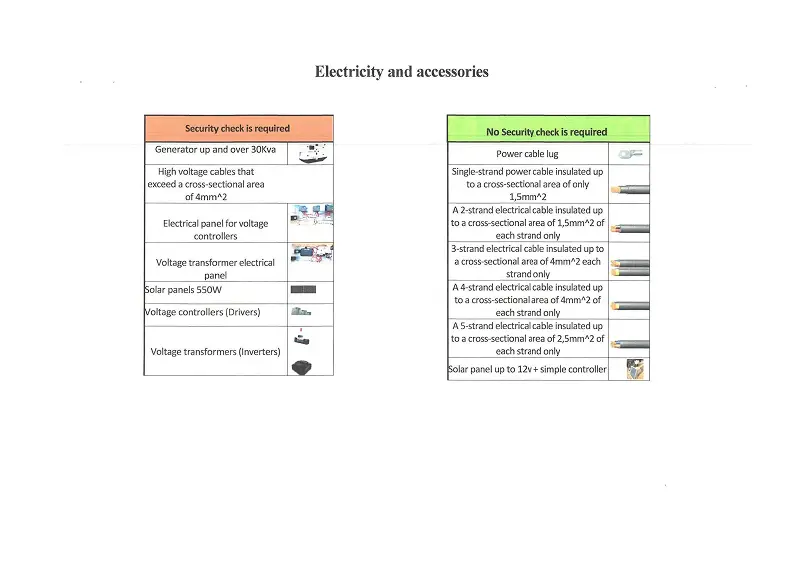
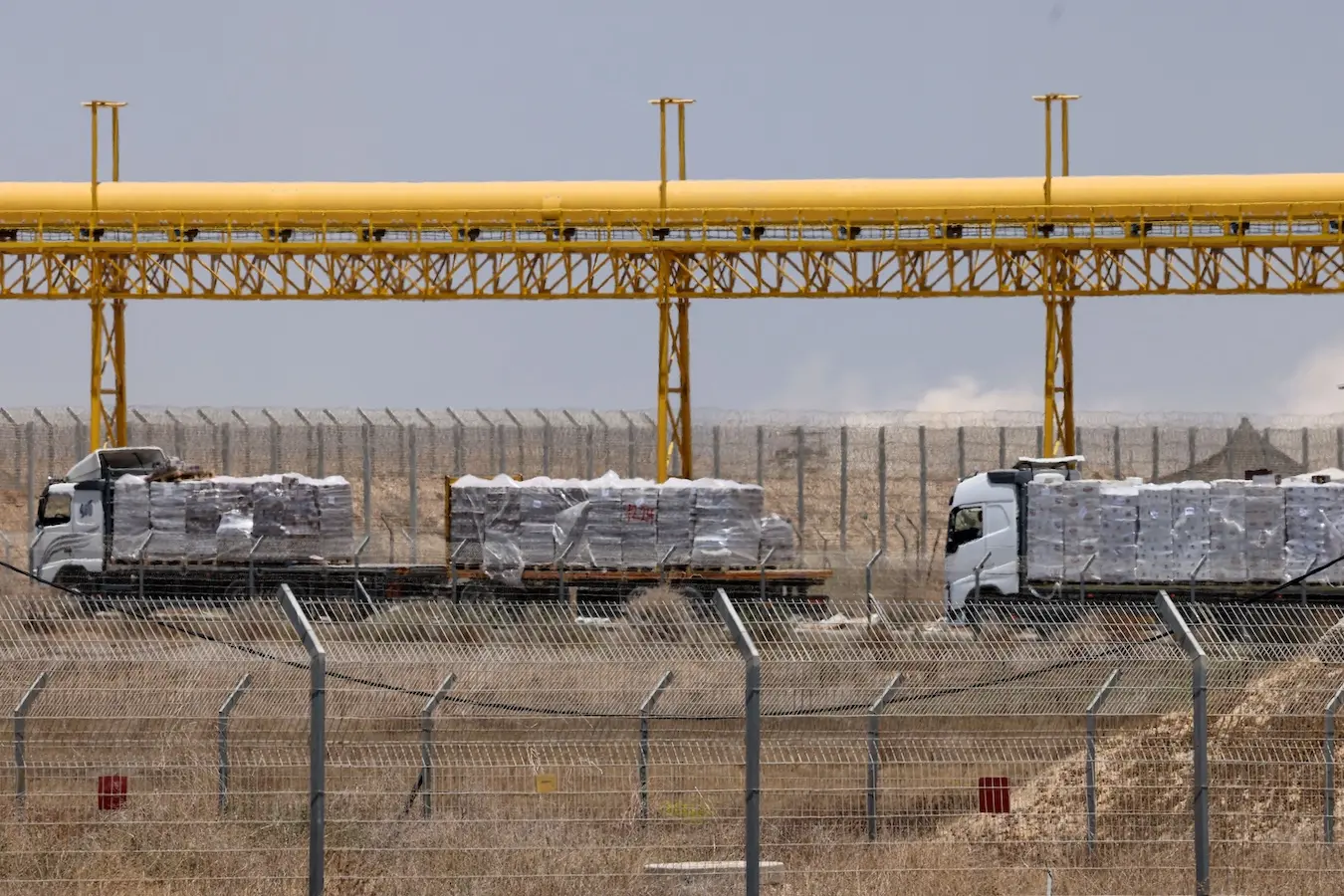
All trucks transporting humanitarian aid to Gaza must be approved by COGAT, the Israeli military administration responsible for civil affairs relating to Palestinians living in the West Bank and Gaza. The Israeli authorities reserve the right to refuse what they describe as "dual-use" equipment, i.e. equipment that could be used for military purposes.
COGAT has published a list of such items, which is regularly amended according to arbitrary criteria. Since early March 2025, for example, generators,
which were sometimes authorised, have been banned. Desalination plants have also been blocked for over a year.
Sometimes COGAT requests the exact composition of products such as soap, detergents, and washing powder. These products are essential for hygiene in healthcare facilities and for the population, but manufacturers do not provide this documentation for intellectual property reasons.
Each organisation submits a list of supplies it wishes to send to Gaza to COGAT. Once this list has been approved, the shipment is inspected at the crossing point. Sometimes, despite prior approval, equipment may be refused. In some cases, the entire truck has to turn back. This mechanism for controlling humanitarian aid shipments is lengthy and opaque.
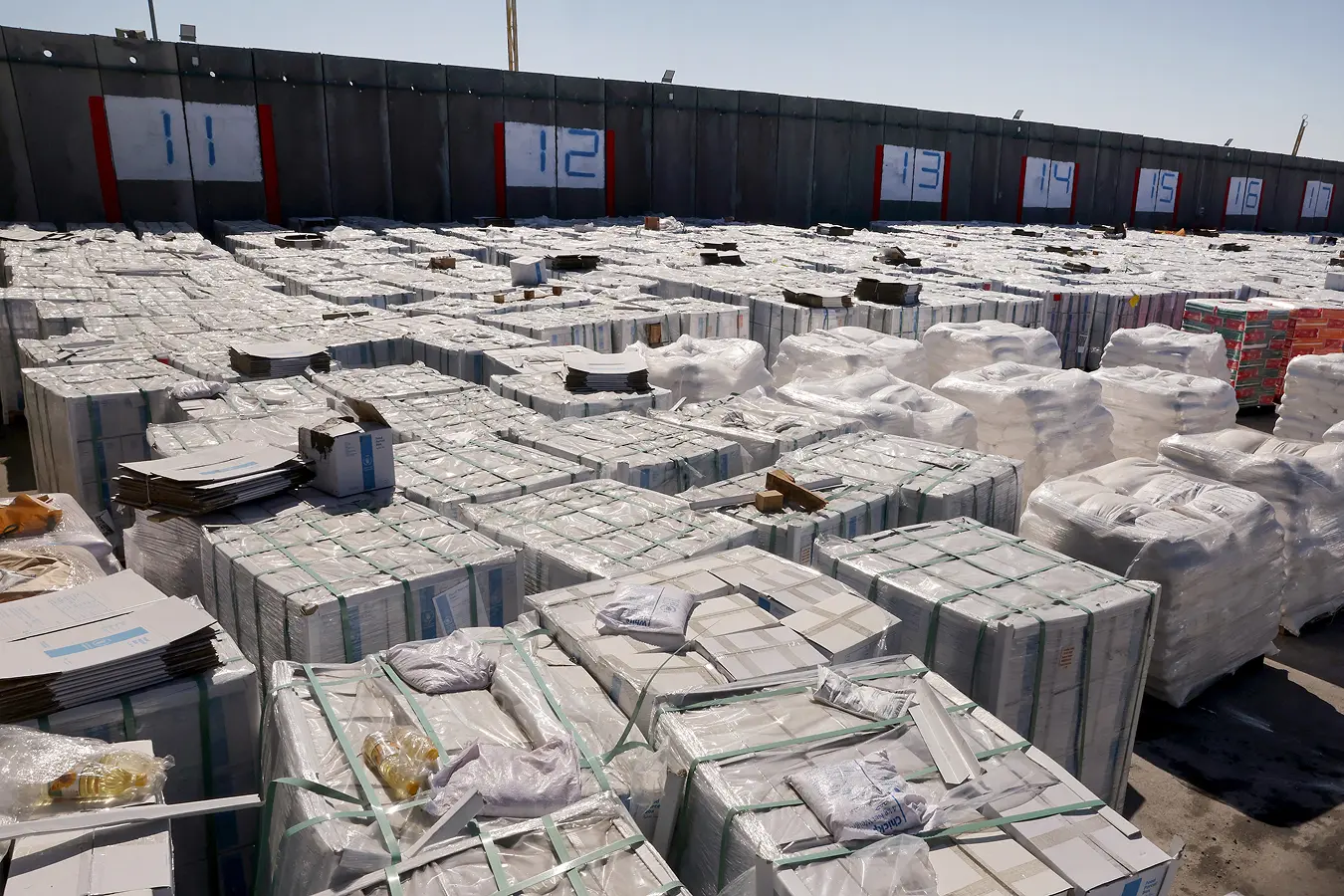
In July 2025, on average, only 28 lorries per day were authorised to distribute aid in Gaza. The Trump plan, presented on 29 September 2025, aims to bring in 600 lorries per day, but more than 1,000 would be needed to adequately meet the needs of the Gazan population, which has been deprived of everything.
Kerem Shalom, south of Gaza, 29 May 2025.

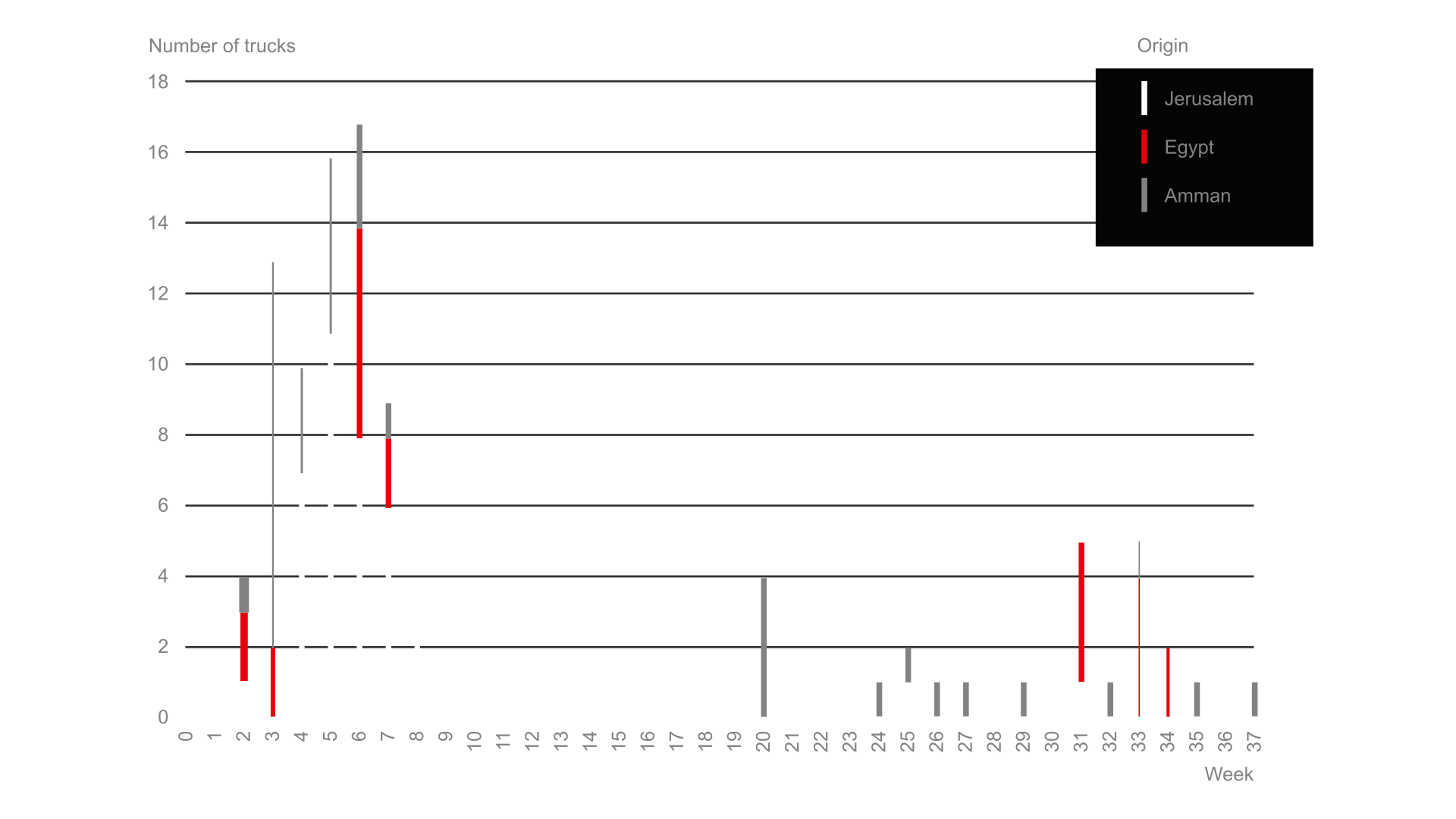
This graph shows the number of trucks that MSF was able to bring into the Gaza Strip between January and mid-September 2025. During the second truce, from late January to March 2025, international organisations were able to work effectively and deliver significant aid to the people of Gaza, although they were unable to meet all their needs.
After the complete siege of the Palestinian enclave between 2 March and 18 May 2025, flows remained very restricted. The Israeli authorities also created localised shortages by closing certain crossing points. On 12 September 2025, just before the launch of the ground offensive on Gaza City, they closed Zikim, the second most important crossing point after Kerem Shalom. Nearly 50% of aid passed through this crossing, supplying the entire north of the enclave, which the army intended to empty of its inhabitants before conquering the city.
As shortages worsen, trucks that manage to enter the Gaza Strip are becoming targets for looting. In September 2025,
of the 991 World Food Programme trucks that made it inside the enclave, only one reached the warehouses.
This looting is partly rooted in the extreme desperation of Gazans subjected to hunger and shortages organised by the Israeli authorities.
After months of war, the social fabric has disintegrated, giving way to chaos organised by the Israeli army itself. The latter has systematically targeted Palestinian police officers supervising the shipments, whom it has equated with Hamas because they are local government officials, thereby jeopardising the security of the convoys. Above all, it encouraged groups of looters, including that of the trafficker Abu Chabab, who admitted in July 2025 to cooperating with the Israeli military in southern Gaza, moving freely in the areas they control.
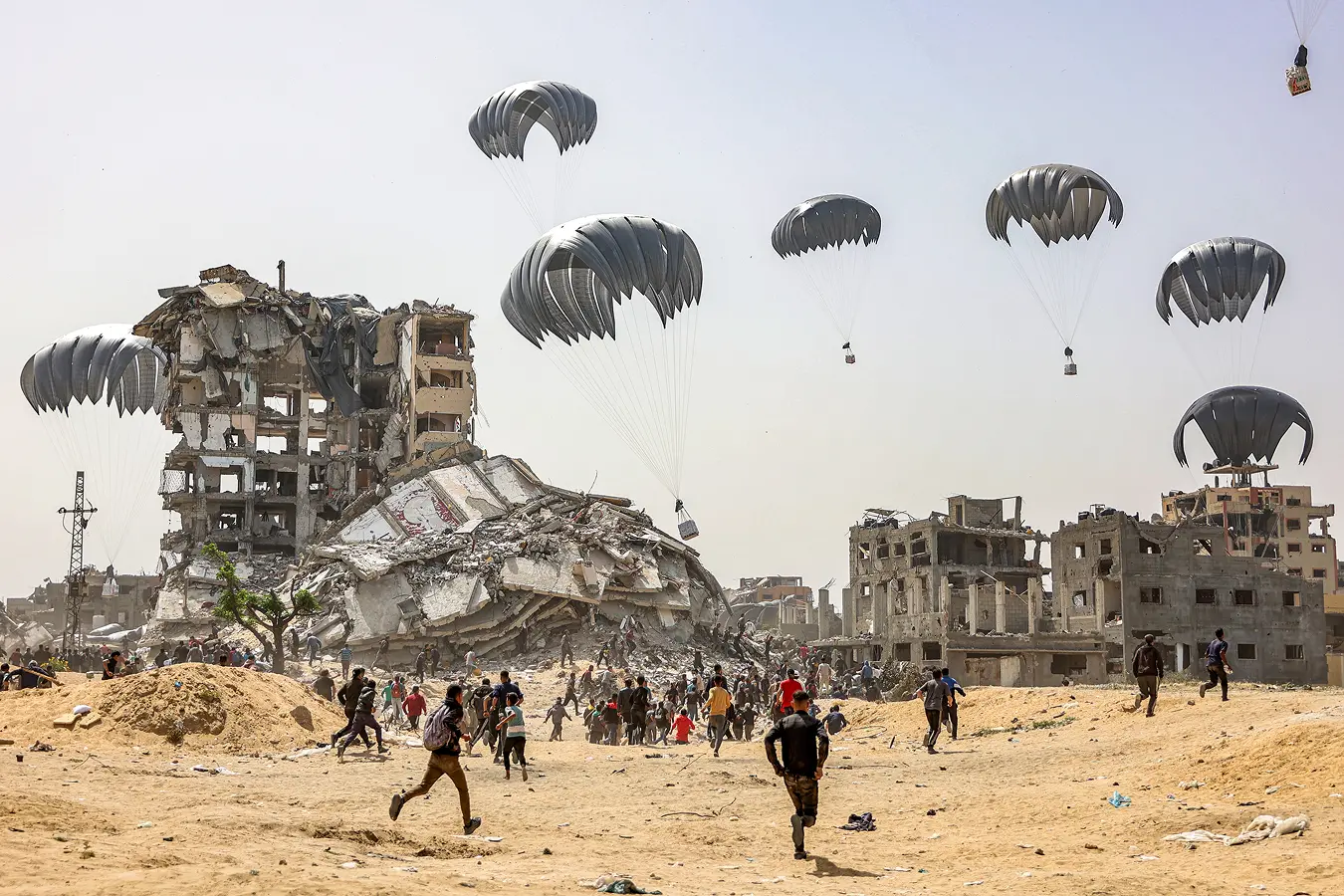
Palestinians rush to retrieve parcels dropped by air in northern Gaza City on 23 April 2024. Faced with the growing threat of famine and a lack of political will to force Israel to allow more aid into the Gaza Strip, particularly in the north, a few countries, including France, organised airdrops in early 2024 and then again in August 2025.
This process, which is humiliating for Gazans, has resulted in the deaths of several people, killed by parcels whose parachutes failed to open or who drowned while trying to retrieve boxes that had fallen into the water. Aerial drops provide much less humanitarian aid than deliveries by land: in August 2025, France announced it would drop 40 tonnes, the equivalent of two truckloads.
To avoid creating further chaos and to reach those most in need, humanitarian workers take care to organise distributions and announce them in advance. It is crucial that they are carried out by employees who are physically present on the ground, so that they can maintain contact with the population and assess needs in situ.
Fear in their stomachs
Famine as a weapon of war
On 29 February 2024, 118 Palestinians were killed and 760 others wounded while waiting for a humanitarian aid convoy.
The Israeli army eventually admitted that it had fired on the crowd because some people had advanced towards its troops. What has since been dubbed the "flour massacre" marks the first terrifying consequence of Israel's strategy of using hunger as a weapon of war. Under the yoke of a siege that is nothing more than yet another collective punishment, Palestinians in Gaza are facing severe food and medical shortages.
During the winter of 2023-2024, and then in the autumn of 2024, it was in the north of the enclave that Palestinians suffered the most.
Some – including MSF staff members – reported having to eat animal feed for lack of anything better. The Israeli authorities aim to push the inhabitants of the north towards the south of Gaza. There, food is slightly more available but it is not balanced: it consists mainly of tinned food, with no meat, fruit or vegetables.
In the spring of 2025, Israel imposed a complete siege for two and a half months, and for nearly 80 days, nothing entered the Palestinian enclave. These restrictions were only partially lifted afterwards, and the Gaza Strip continued to suffer from severe shortages. On 22 August 2025, the UN officially declared a state of famine there. In two years, 463 people, including 157 children, died of starvation in Gaza, according to the Ministry of Health.
In addition to hindering or blocking humanitarian aid, the Israeli authorities also attempted to control it by sidelining international NGOs and the UN.
In the spring of 2025, they tried to dismantle the humanitarian system that had been in place for decades. They replaced it with an obscure agency, the Gaza Humanitarian Foundation (GHF), which set up only four aid centres, all of which were heavily militarised and located in the south and centre of the enclave. Distributions are not clearly announced. Between late May and early August 2025, the United Nations reported that nearly 1,400 Palestinians were killed while seeking food, including 859 near GHF distribution sites and 514 near the truck entry point in Zikim, in the northern Gaza Strip. These distributions are part of a system that completely dehumanises Palestinians.
Children shot in the chest while looking for food. People crushed or suffocated in stampedes. Entire crowds shot at distribution points. GHF sites, which are supposed to be aid distribution points, have become laboratories for inhumane and cruel treatment.
This must stop immediately.
We heard about the aid centre in Rafah, in the
Al-Sultan area. I went there with some young people from my family. We went there around 11 p.m., because there are usually a lot of people there,
really a lot of people. If you go later, you won't get anything. We arrived and started moving forward; there were already people in front of us.
We approached the Al-Alam roundabout. Around 3 a.m., heavy firing began. There was firing from a quadcopter, an Apache helicopter, tanks, navy boats and the soldiers themselves. There were many casualties. A bullet hit me in the leg. At first, I thought I had really lost it. I was wearing jeans and a belt.
I took off my belt and tied it around my leg.
We remained trapped in that place until 5 a.m. I bled from 3:10 a.m. to 5 a.m. I was bleeding non-stop. There were a lot of young people with me. One of them tried to get me out of there. He was shot in the head and died on my chest. We had come only to find food, just to survive like everyone else.
Palestinians carry aid parcels they managed to obtain after humanitarian trucks entered Zikim, in the northern Gaza Strip.
Beit Lahia, northern Gaza, 29 July 2025.
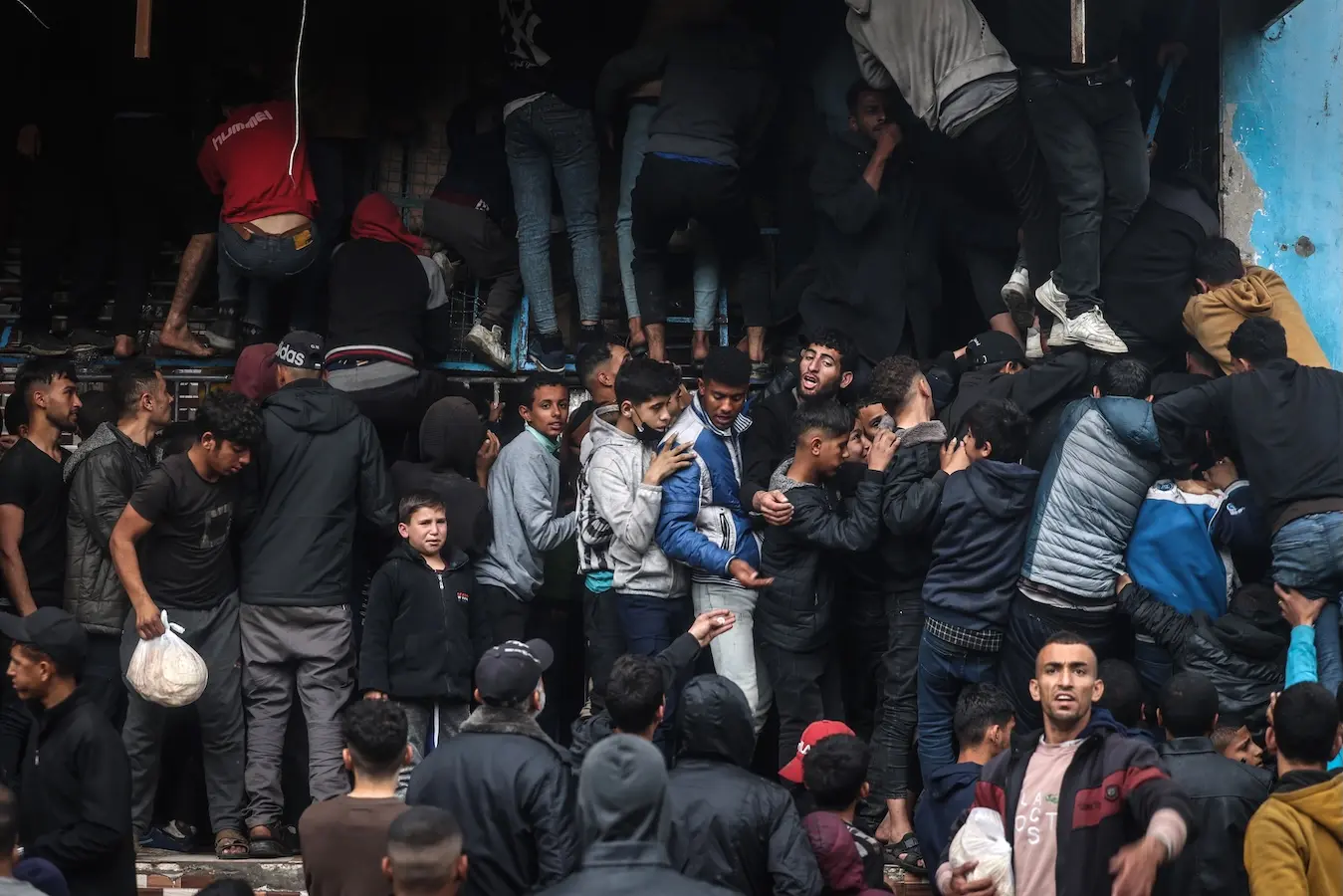
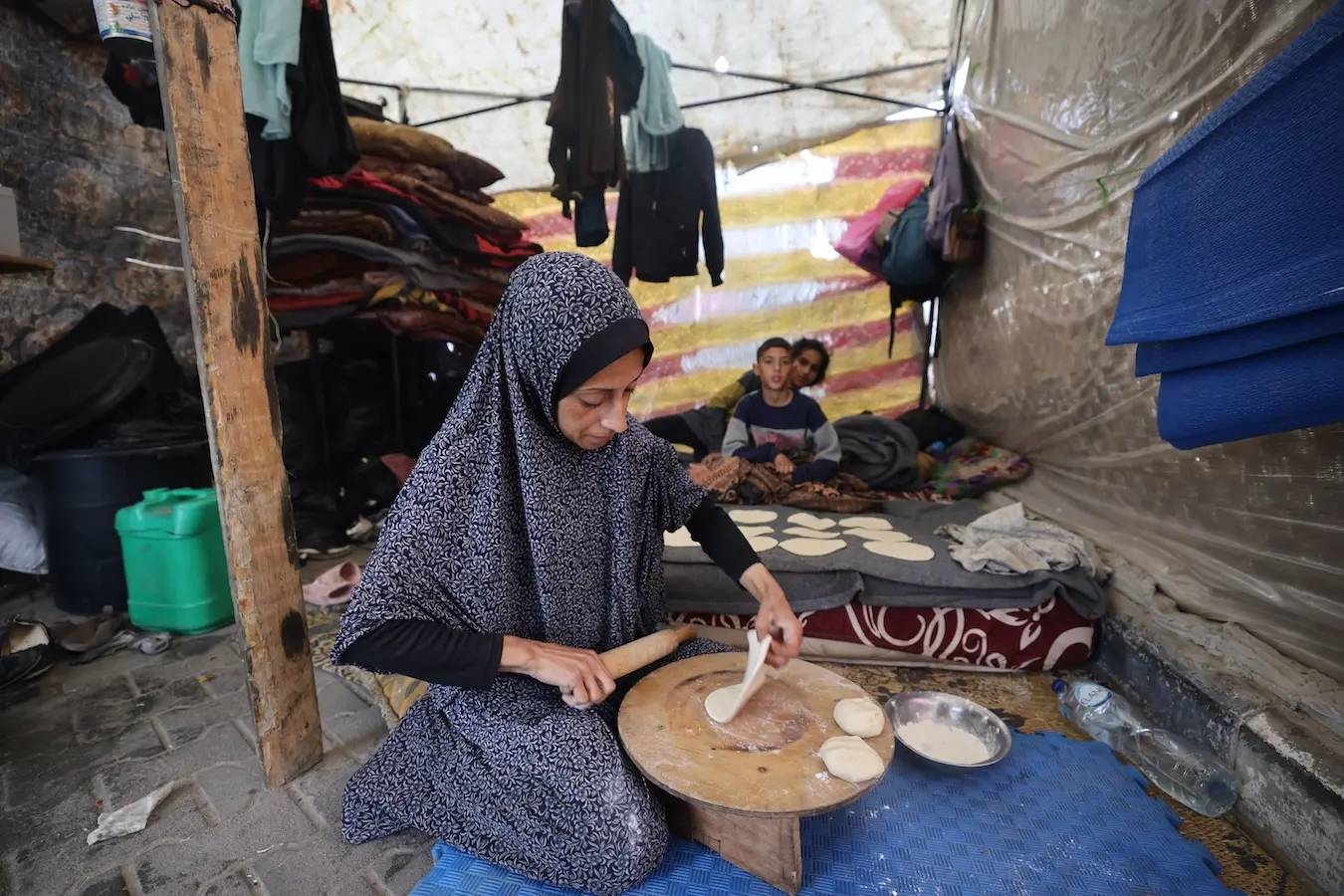
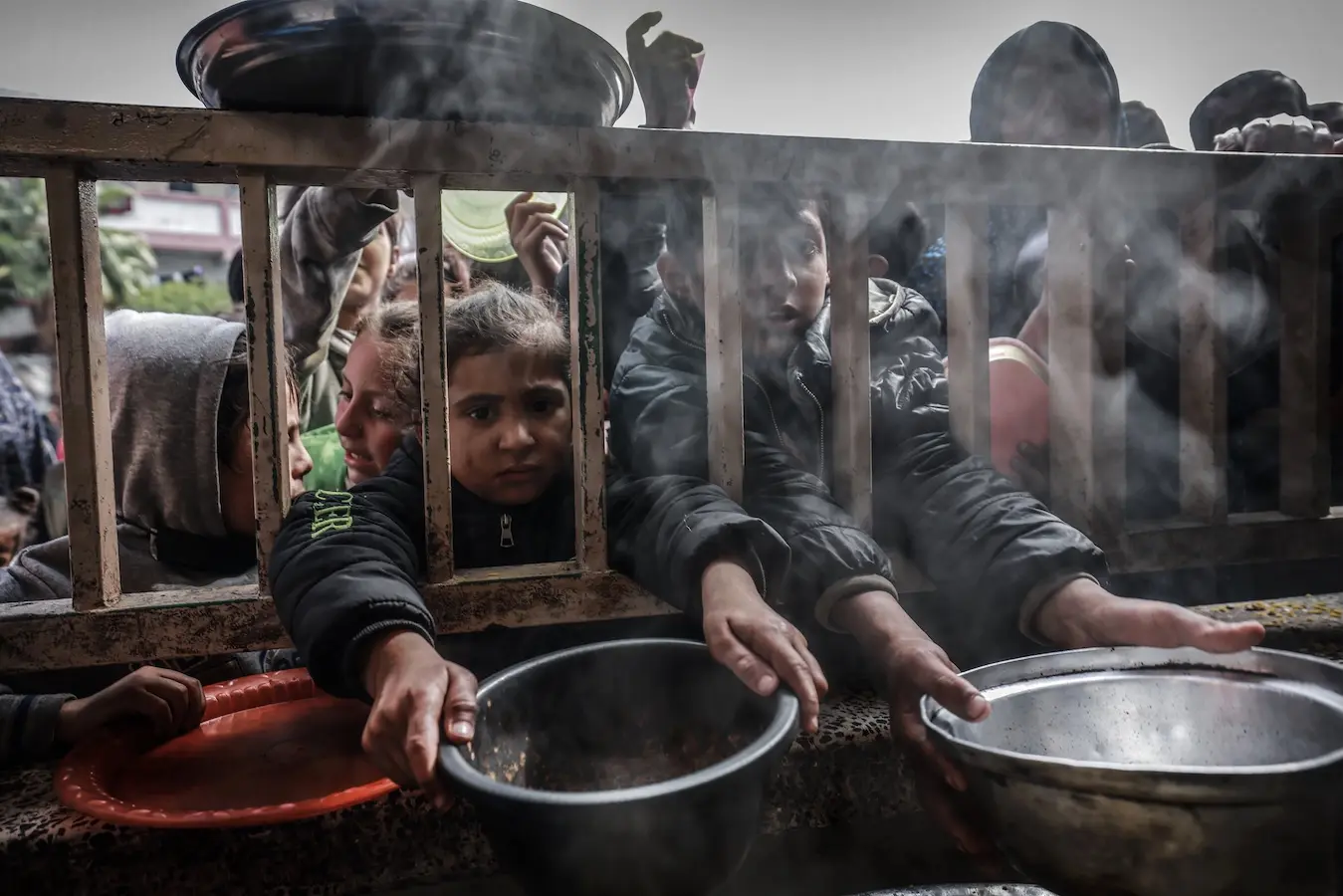
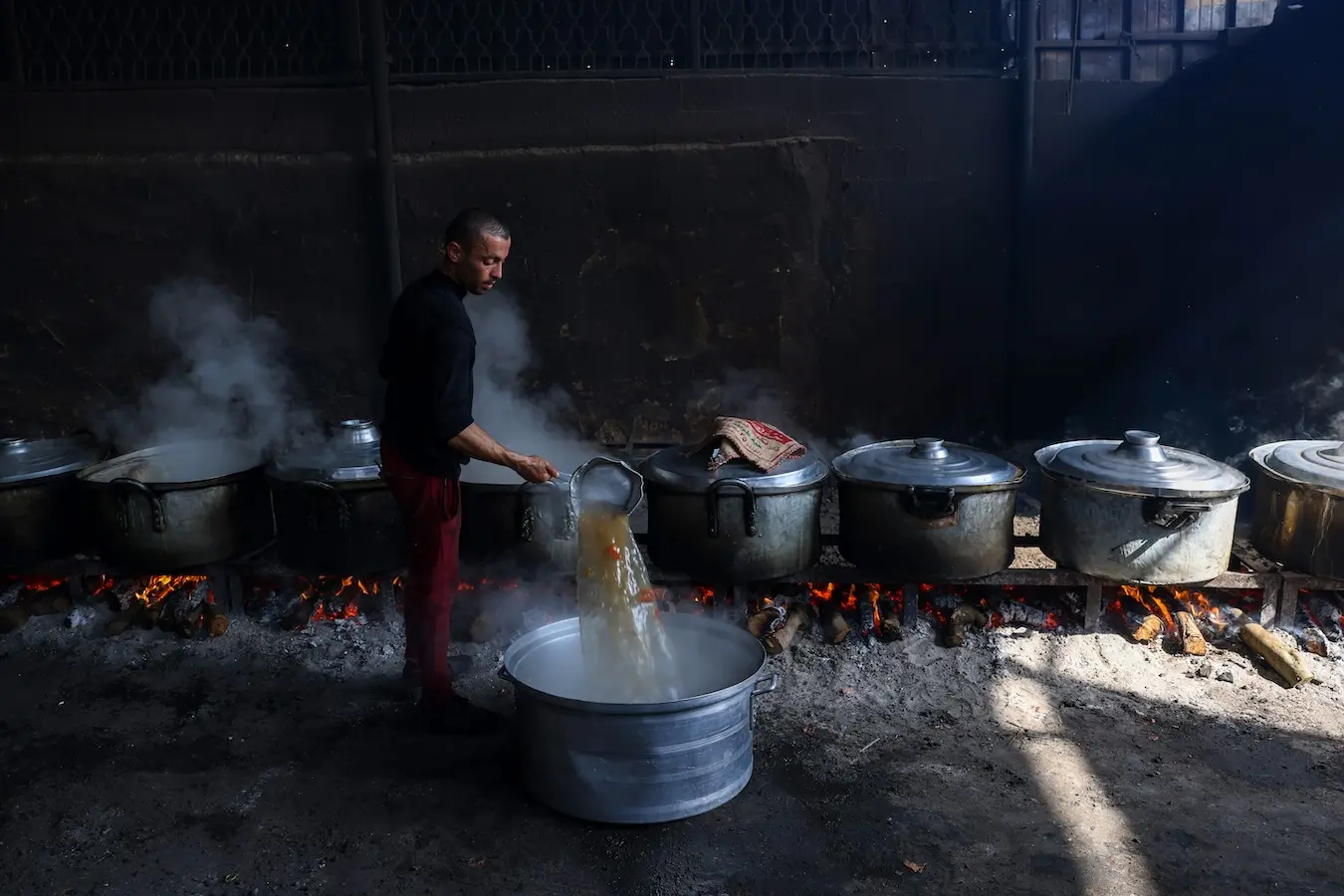
Takiyas, seen here in Nuseirat in the centre of the Gaza Strip, are a kind of soup kitchen found throughout the enclave. They stem from an old tradition of large communal iftar meals, breaking the fast, offered by the wealthiest people in their neighbourhood. The ingredients are often basic: pasta, rice, legumes, etc., but they provide an effective bulwark against hunger for the most disadvantaged families. Many of these community kitchens have been targeted by Israeli strikes throughout the war.
Nuseirat, central Gaza, 4 September 2025.
Khan Younis, southern Gaza, 22 July 2025.
A displaced Palestinian mother carries her five-year-old daughter, who is suffering from malnutrition, in Deir Al-Balah, in the centre of the Gaza Strip, on 24 December 2024. In July 2025, MSF teams observed widespread malnutrition among pregnant women, leading in particular to premature births. "This is my third time in Gaza and I have never seen anything like it. Mothers ask me for food for their children, and women who are six months pregnant often weigh no more than 40 kilos," said Joanne Perry, a doctor with MSF. According to the organisation Action Against Hunger, child malnutrition has increased by 700% in Gaza since the start of the war. Hunger affects everyone, including the Palestinian members of MSF staff: all of them reported losing weight, sometimes more than ten kilos.
Testimony of Dr. Abu Abed Moughaisib, head of MSF medical activities in Gaza, describing the effects of famine on the human body, July 2025.
With the siege imposed by the Israeli authorities on Gaza, water and electricity have been cut off, crossing points closed and then opened only sporadically, leading to food shortages and ultimately famine. Several NGOs, including Human Rights Watch, have accused Israel of using hunger and water deprivation as weapons of war against the population of Gaza.
Israel has systematically destroyed food sovereignty there: agricultural land has been bombed or destroyed by bulldozers. Fields and orchards, located mainly on the edge of the enclave, have been turned into military zones under Israeli control. During these two years of war, Gazans have become totally dependent on food aid, which the Israeli authorities have continually blocked or restricted. This is one of the elements that characterise the genocide in Gaza.
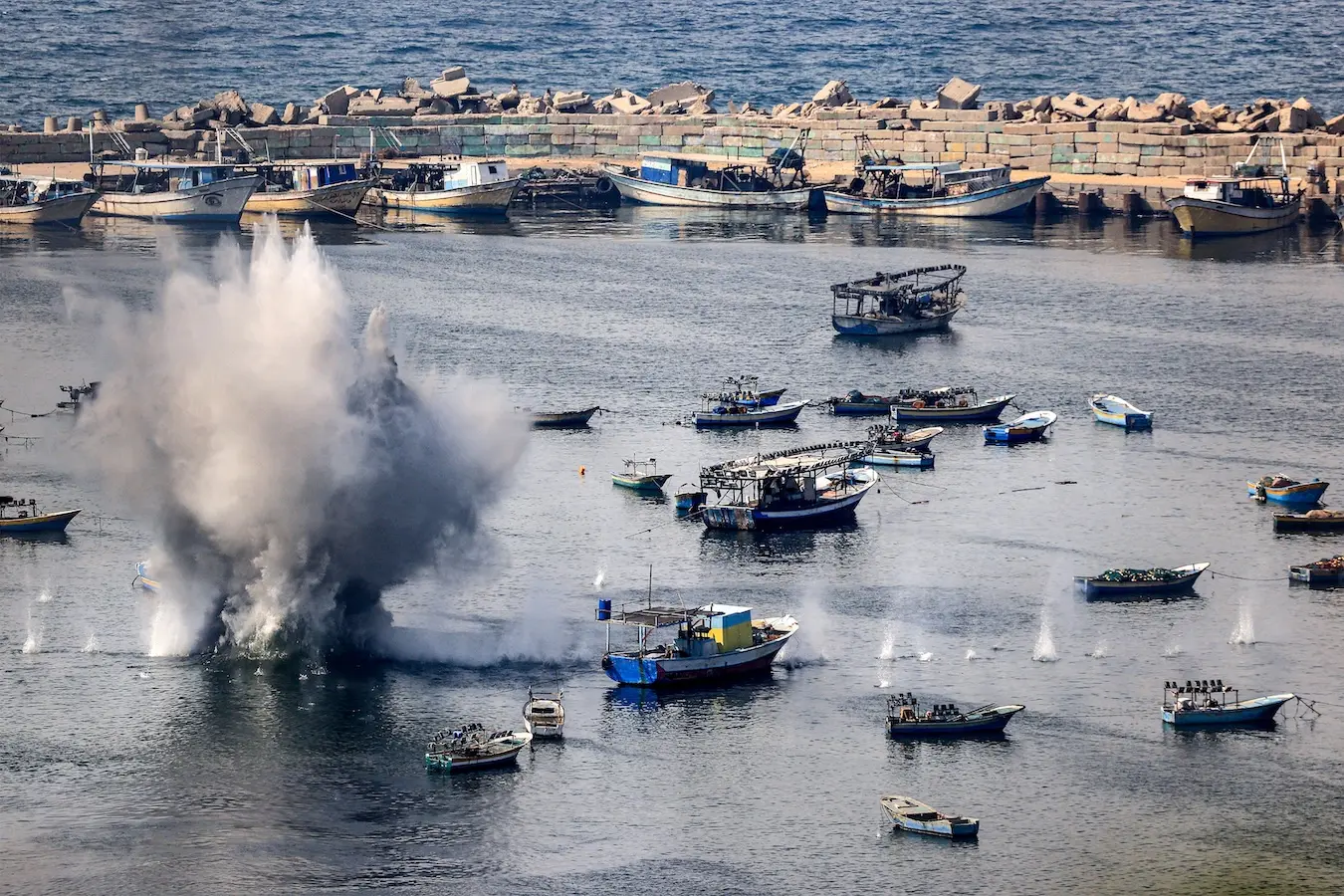
Israeli shells explode in the port of Gaza City on 11 October 2023. The blockade imposed by Israel in 2007 had already restricted fishing in the enclave to a limited area. The Israeli army regularly changed the authorised fishing areas, not hesitating to fire on boats that ventured too far out to sea. The port of Gaza has since been largely destroyed, and Palestinians who try to fish to feed their families are also targeted.
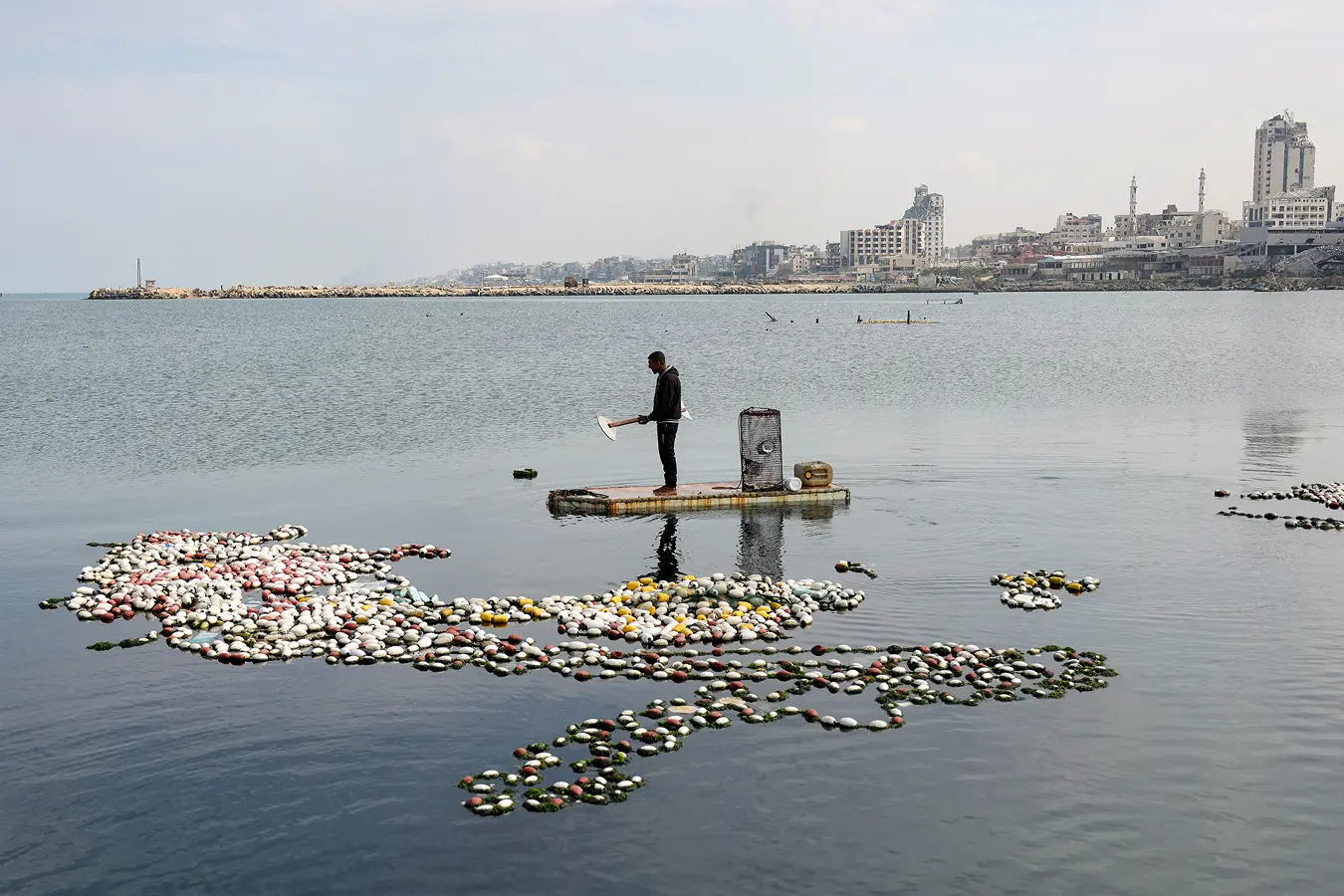
Port of Gaza City, northern Gaza, 9 March 2025.
Over the months, the Israeli authorities have deliberately deprived the population of Gaza of water, with the amount available per person per day insufficient to cover basic needs.
Targeted
The destruction of the healthcare system and facilities
Testimony of Dr Ahmed Moghrabi, surgeon, describing days of "horror" at Nasser Hospital
Source: New York Times, published on 24 January 2024
After a seven-day truce at the end of November 2023, fighting resumed on 1 December.
The Israeli army advanced towards Khan Younès, a large city in southern Gaza. Nasser Hospital, the second largest in the enclave, was besieged and then attacked by the Israeli army.
The Israeli army claimed it was searching for living hostages or their bodies. MSF staff present in part of the hospital recorded the various attacks and incidents between December 2023
and the end of February 2024, but did not have visibility of all the buildings in this huge hospital complex.
17 December 2023
Nasser Maternity Hospital targeted
The Nasser maternity hospital is targeted. A 13-year-old girl is killed and several other people are wounded.
25 December 2023
Heavy bombing
Violent bombing around Nasser following orders to evacuate blocks 64 and 112, located near the hospital.
8 January 2024
MSF shelter bombed
Israeli shelling of a shelter housing more than 100 MSF staff and their families in Khan Younès. The five-year-old daughter of one of the staff members is killed.
15 January 2024
Trucks unloading food hit by air strike
"On 15 January, at around 3 p.m., an air strike hit trucks unloading food. They were about 150 metres from the hospital. The noise was so loud that it hurt our ears. A few minutes later, many injured people arrived at Nasser, some carried by people on foot, others in ambulances or private cars. A total of eight people were killed, including two little boys aged 4-5, and 80 were injured, 20 of whom required surgery. The next morning, we examined a 10-year-old boy who had been injured by the blast while crossing the street."
Report on the visit by Aurélie Godard, medical manager, and Léo Cans, head of mission, to Nasser Hospital.
21 January 2024
Fighting around Nasser Hospital
Nasser Hospital is completely surrounded by Israeli troops. Heavy bombing and fighting all around the hospital.
23 January 2024
New evacuation order in Khan Younès
New Israeli evacuation order in Khan Younès, covering Nasser Hospital, Al-Amal Hospital and the Jordanian hospital. Nasser is at the heart of fierce fighting; no one can leave or enter. There are still many casualties and the operating theatre is not functioning. On the same day, three MSF staff members attempt to evacuate the hospital but are unable to do so. They report gunfire and explosions all around the hospital.
25 January 2024
Ambulances blocked
Ambulances cannot reach Nasser. There are three days of fuel left.
26 January 2024
Israeli army statement
"The Israel Defence Forces (IDF) are in contact with hospital directors and medical staff, by telephone and on the ground, to ensure that hospitals remain operational and accessible. The IDF has made it clear that there is no obligation to evacuate hospitals. On the contrary, we have reiterated the importance of safeguarding and protecting these hospitals (...). Gaza residents who wish to leave Nasser and Al-Amal hospitals, as many have chosen to do, can pass through the corridor on Al-Bahar Street, located on the west side of the hospitals."
Statement by the Israeli Defence Forces on the ongoing military operations in Khan Yunis.
6 February 2024
Violent fighting in Khan Yunis
Violent fighting in Khan Younès, near Nasser. The hospital is still under siege: approximately 450 wounded, 300 medical personnel on site and 10,000 displaced persons.
8 February 2024
Nurse wounded by gunfire
Nasser surrounded by tanks. Snipers firing at the hospital. A nurse is wounded by a bullet in the chest.
11 February 2024
Nasser under siege
The siege of Nasser continues. Snipers continue to target people in the buildings and outdoor areas of the hospital complex. A man is killed at the hospital entrance.
13 February 2024
Order to evacuate Nasser Hospital
The Israeli army orders the evacuation of Nasser Hospital. There are 402 patients in the hospital: 35 on dialysis, 18 in intensive care, three in neonatal intensive care, three or four women who have given birth, and just under 200 on stretchers. In addition, there are an unknown number of displaced persons who have taken refuge within the hospital grounds. Three people are killed and ten others wounded as a result of Israeli gunfire inside the medical complex. An Israeli military bulldozer destroys the gate at the northern entrance to the hospital, followed by a tank. Soldiers on site ordered the displaced persons to leave the hospital. A handcuffed Palestinian prisoner dressed in a white jumpsuit was then sent by the army to order them to evacuate again. Images available online, reproduced by several media outlets, show that he was then executed.
Night of 14 to 15 February 2024
Shelling of the orthopaedic ward
Shelling of the orthopaedic ward: one dead and eight wounded. The Israeli army enters Nasser, destroying equipment and ambulances. Staff begin to evacuate the hospital in the middle of the night. An MSF staff member is arrested by the Israeli army. He is released a few days later.
15 February 2024
Israeli army in Nasser Hospital
"At the time of writing, on 15 February, Israeli forces are reported to have entered Nasser Hospital in Khan Yunis, including the maternity ward, according to the Ministry of Health in Gaza. The Israeli army claims that Hamas is holding hostages inside the hospital or is keeping the bodies of Israelis there."
Flash update #119 from the Office for the Coordination of Humanitarian Affairs (OCHA)
16 February 2024
Electricity shortage
Five patients died due to lack of care caused by power shortages. The Israeli army arrested 20 people.
17 February 2024
No water, no food
The Israeli army is still inside Nasser. No water, no food. Evacuation of 14 patients organised by the United Nations and the Palestinian Red Crescent. A WHO team is not allowed to enter the hospital to assess the patients' health and urgent medical needs, even though it has reached the compound to deliver fuel. Fighting is still ongoing in the area around the hospital. Ambulances cannot enter the compound, so patients are being transported on foot.
22 February 2024
Withdrawal of Israeli troops
The Israeli army withdraws from Nasser Hospital. Patients are evacuated to Deir Al-Balah, Khan Younès and Rafah. No water, no electricity, no food. Rubbish and sewage everywhere.
27 February 2024
Evacuation of 72 critical cases
Evacuation of 72 critical cases. 120 patients still inside. 70 healthcare workers still detained.
On 25 August 2025, the Israeli army bombed the Nasser Hospital, where journalists were also present. Rescue workers and their colleagues rushed to provide medical care and bear witness. At that moment, a second strike hit the same location. Twenty-two people were killed, including five journalists, and 50 others were wounded. Among the victims was photographer Mariam Abu Dagga, who regularly collaborated with MSF.
Israeli Prime Minister Benjamin Netanyahu described the attack as a "tragic accident" and the army launched an investigation. It claimed to have targeted a Hamas camera, but in reality, it was that of Reuters journalist Hussam Al-Masri, who had set it up more than 30 times in the same location in recent months – it was well known and visible.
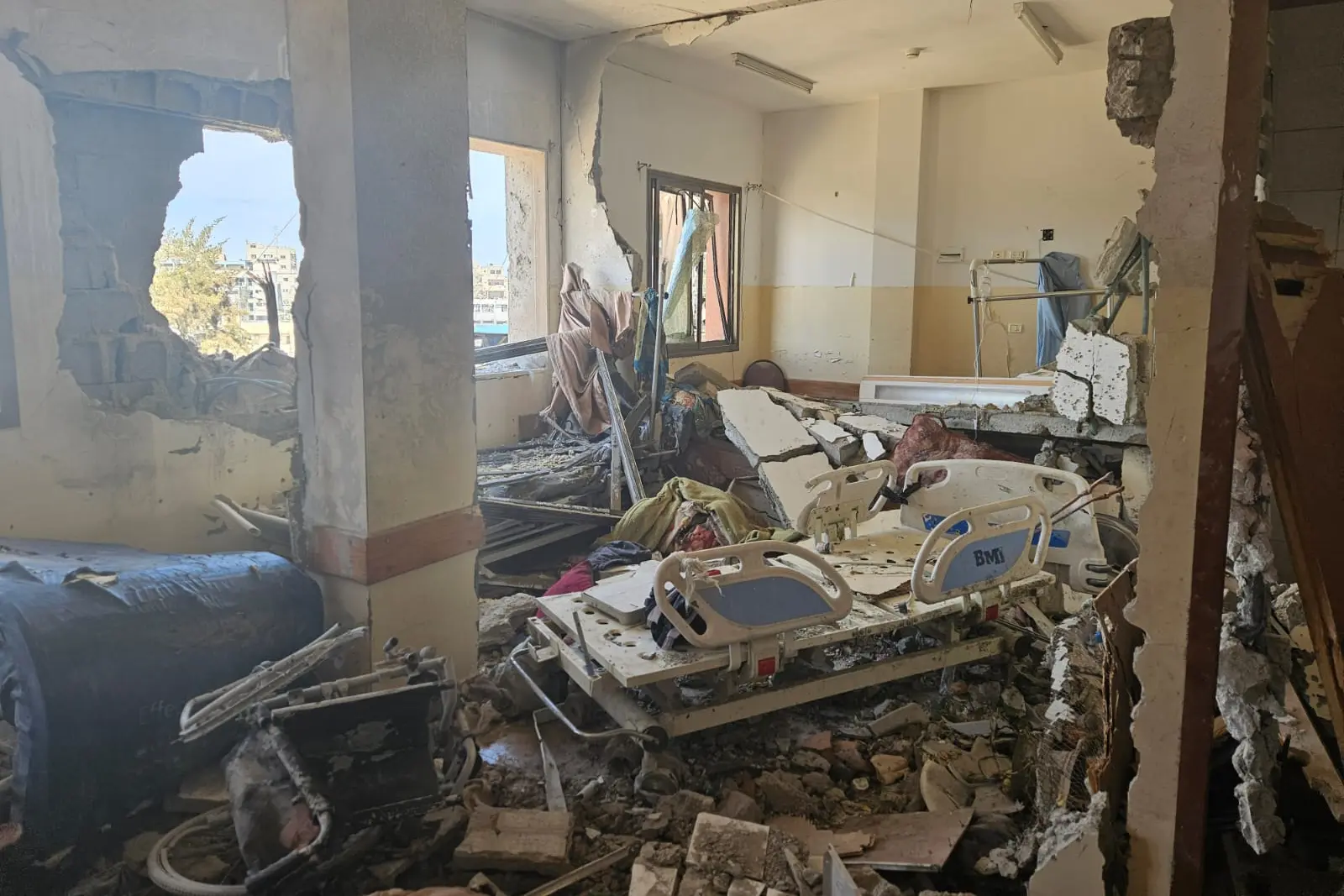
Photographs taken inside Nasser Hospital, located in Khan Younis in the southern Gaza Strip, after the attacks and siege of the facility by the Israeli army. 13 March 2024.
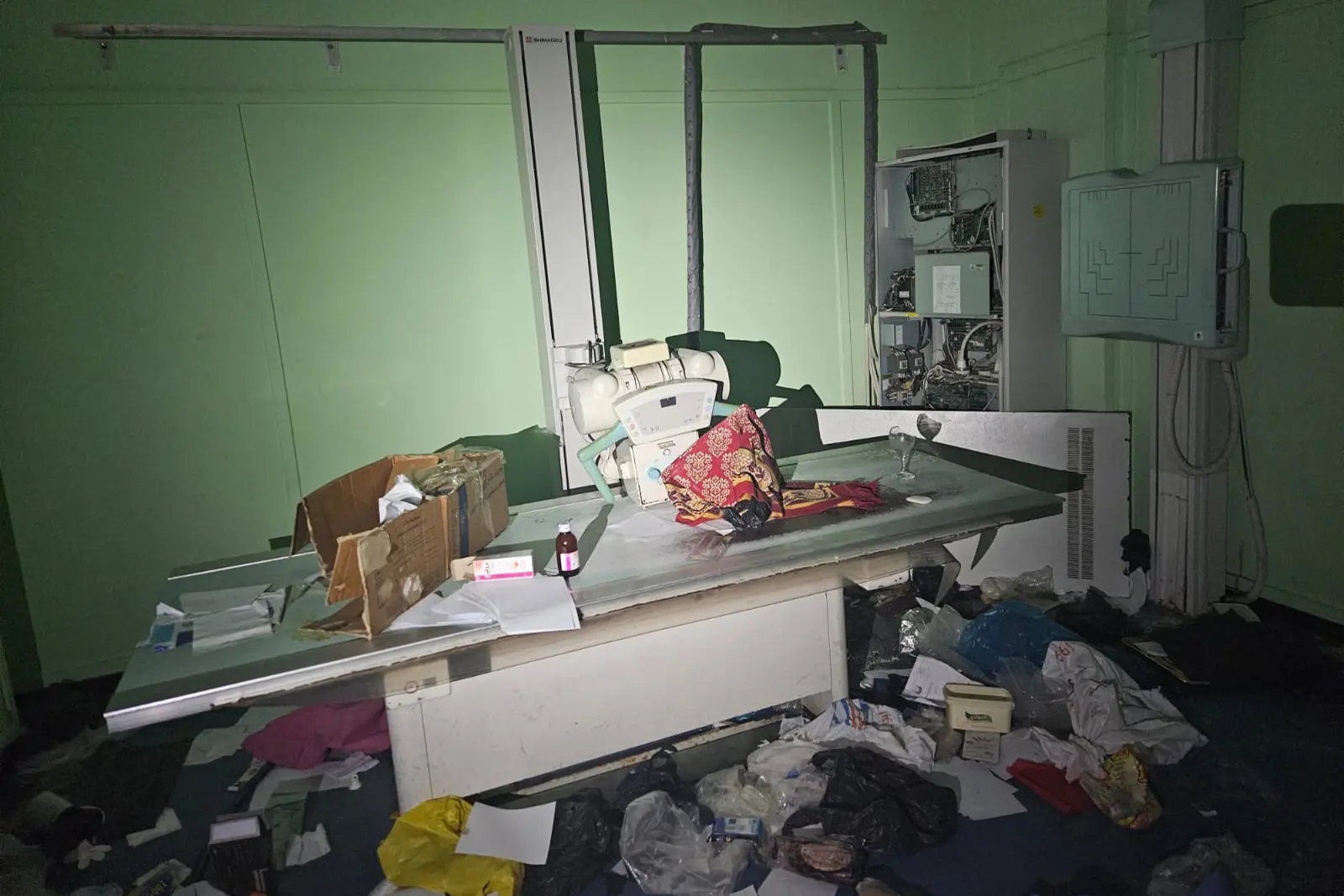
Photographs taken inside Nasser Hospital, located in Khan Younis in the southern Gaza Strip, after the attacks and siege of the facility by the Israeli army. 13 March 2024.
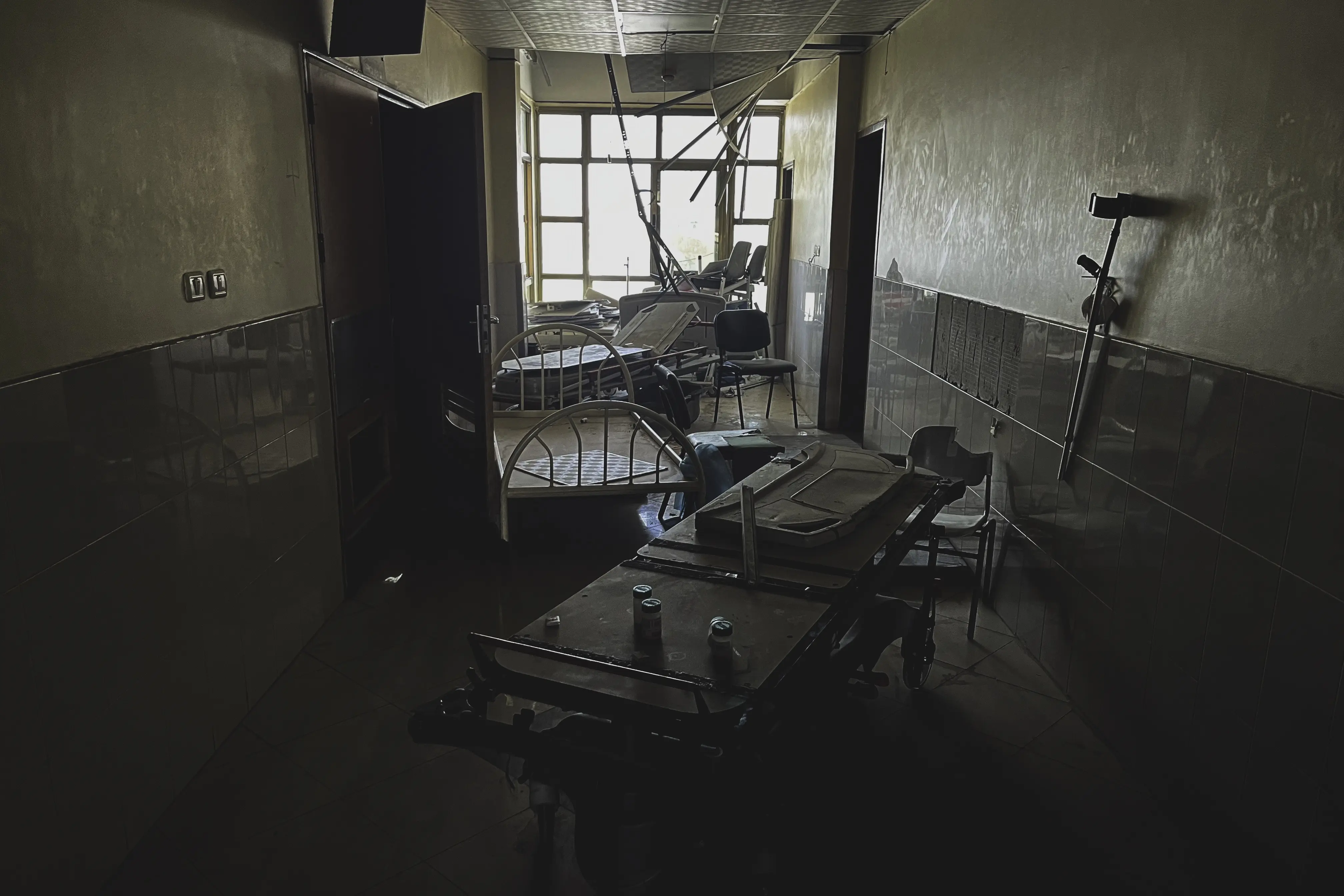
Photographs taken inside Nasser Hospital, located in Khan Younis in the southern Gaza Strip, after the attacks and siege of the facility by the Israeli army. 23 April 2024.
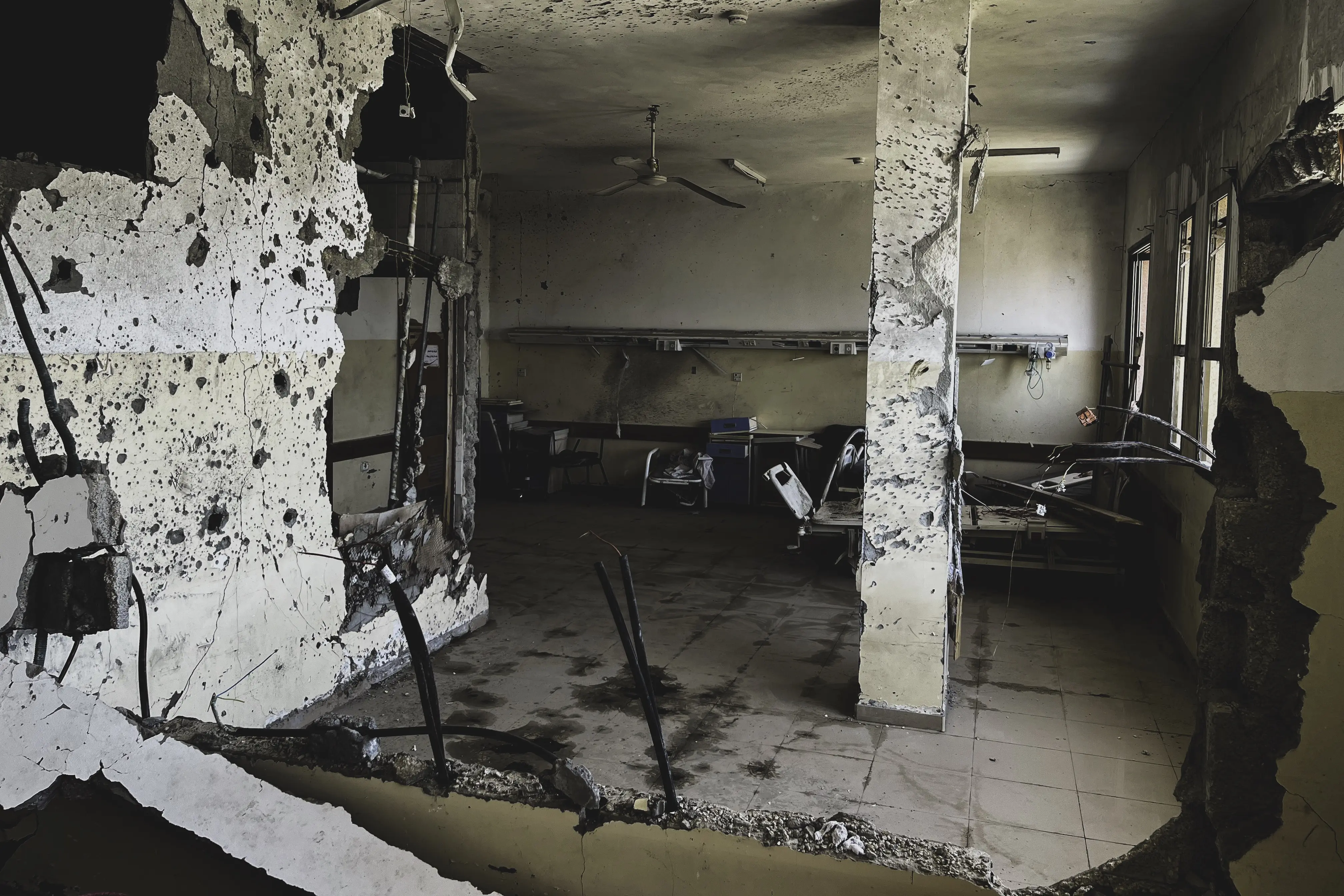
Photographs taken inside Nasser Hospital, located in Khan Younis in the southern Gaza Strip, after the attacks and siege of the facility by the Israeli army. 23 April 2024.
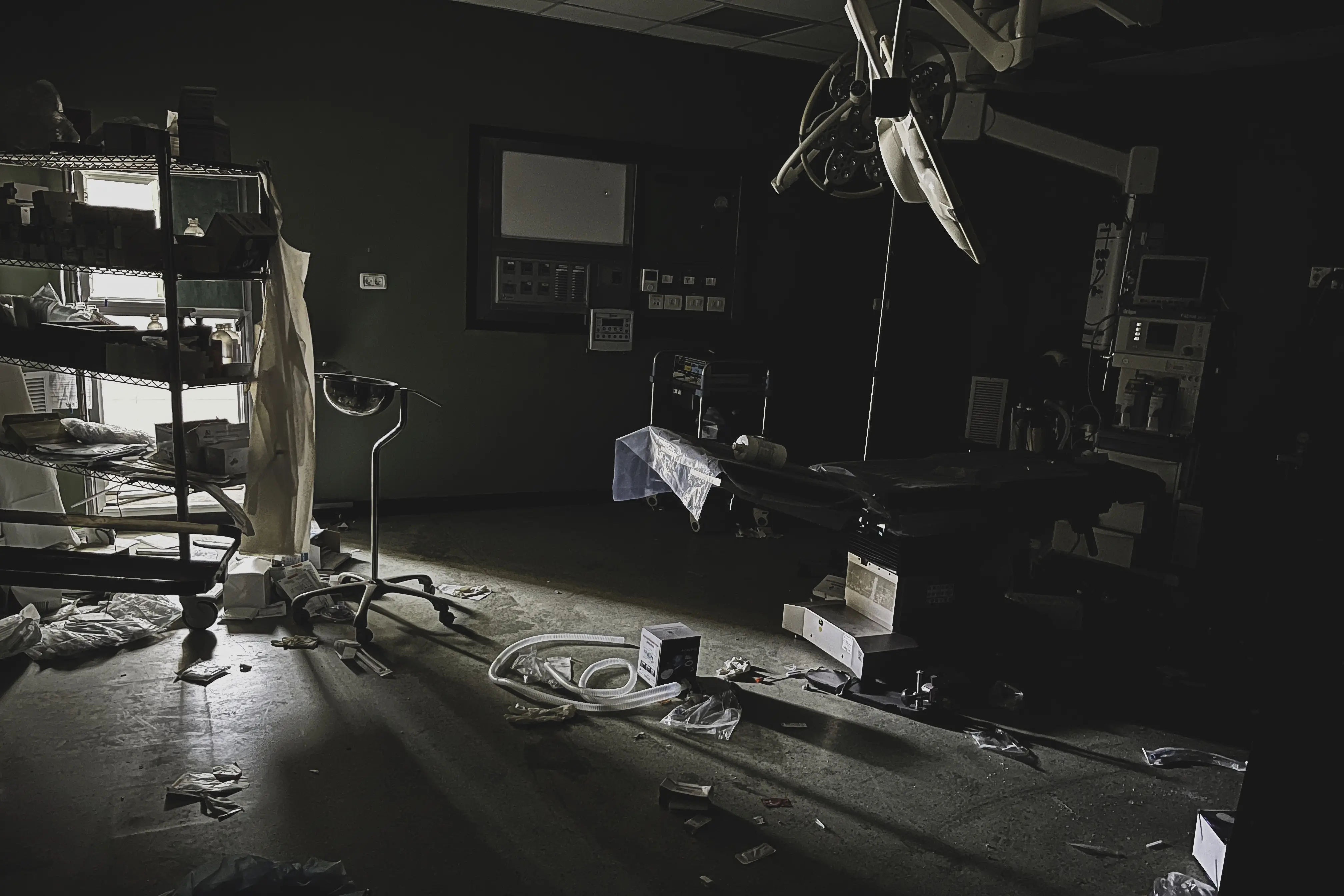
Photographs taken inside Nasser Hospital, located in Khan Younis in the southern Gaza Strip, after the attacks and siege of the facility by the Israeli army. 23 April 2024.
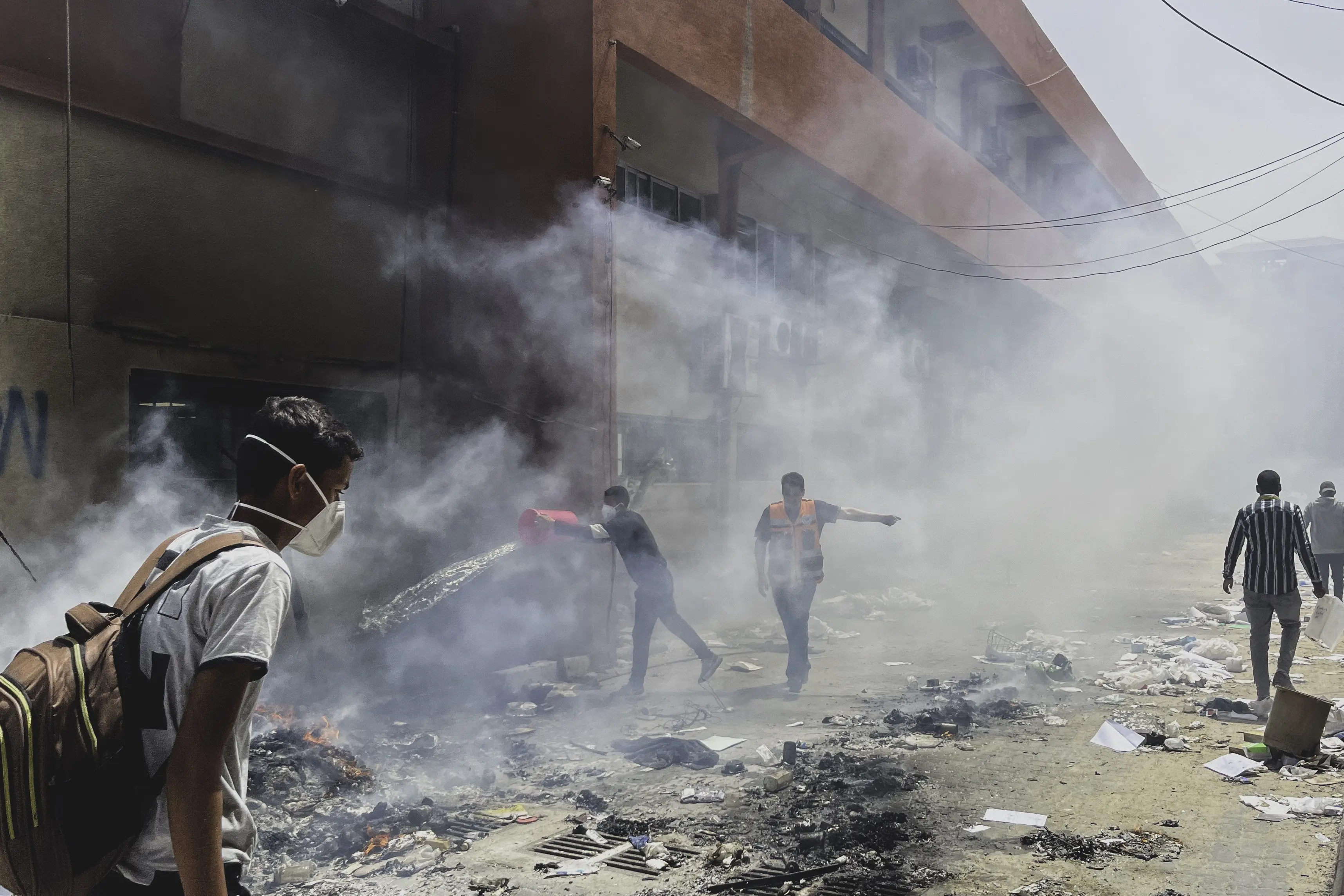
Photographs taken inside Nasser Hospital, located in Khan Younis in the southern Gaza Strip, after the attacks and siege of the facility by the Israeli army. 23 April 2024.
The attack on Nasser Hospital recounted by three MSF staff members.
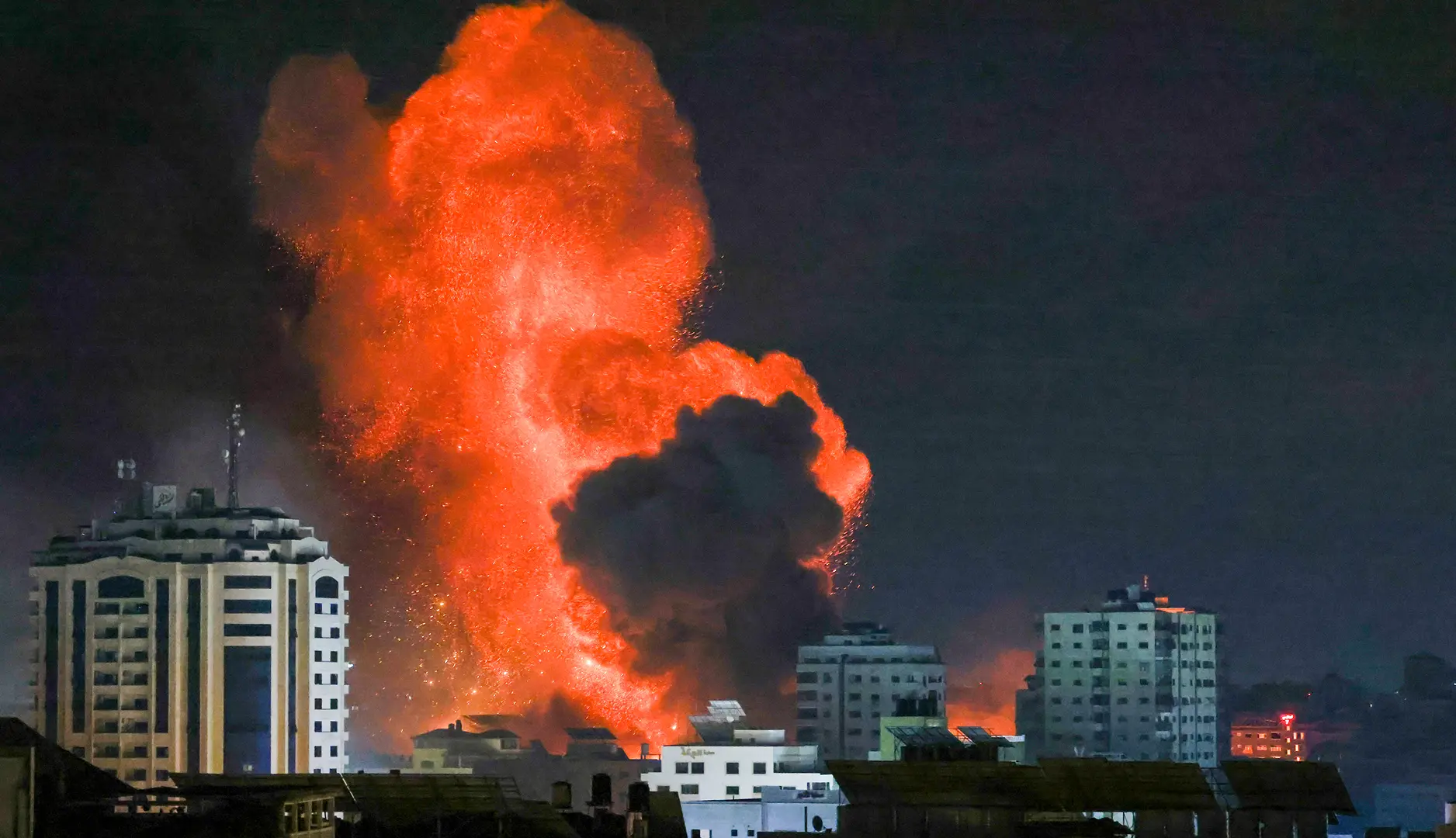
Of the 35 hospitals in the Gaza Strip, 17 were out of service in July 2025. Several field hospitals have been opened, but they are only a temporary solution and cannot compensate for the destruction of the healthcare system.
Israeli attack in early December 2023. Eight patients died during the siege, including
a nine-year-old child.
According to testimonies gathered by the American channel CNN, bodies were crushed by Israeli bulldozers in the hospital courtyard.
The Israeli army claims to have found Hamas weapons and documents during the raid.
At the end of December 2024, after several weeks of siege and Israeli attacks, the hospital was rendered inoperable. At least 50 people, including five staff members, were killed in bombings around the facility.
The hospital director, Dr Hossam Abu Safiya,
was arrested on 27 December 2024, along with 240 Palestinians. His lawyers claim that he was tortured.
Strikes near the hospital on 14 October 2023. The Israeli army calls for the evacuation of the facility, but several healthcare workers decide to stay.
21 November 2023: an air strike on the hospital killed Dr Ahmad Al-Sahar and Dr Mahmoud Abu Nujaila, who worked for MSF, as well as a third doctor, Dr Ziad Al-Tartari.
The hospital is attacked by the Israeli army from 5 to 23 December, killing three people and arresting twelve others.
The army besieges Al-Awda again and then raids it in May 2024 during the ground offensive in the Jabaliya refugee camp where the hospital is located.
On 30 May 2025, after a two-week siege, Israel ordered its closure. It was the last functioning hospital in the northernmost governorate of Gaza.
A strike injured four people and damaged the hospital on 14 October 2023.
On 17 October 2023, an explosion in the hospital car park killed several hundred people, according to the Palestinian Ministry of Health. The Israeli authorities blamed Islamic Jihad, an ally of Hamas. Palestinian armed groups blamed the Israeli army.
Responsibility for the explosion remains unclear in the absence of an independent investigation on the ground. A Human Rights Watch report published on 26 November 2023 refers to ammunition apparently propelled by a rocket, similar to those commonly used by Palestinian armed groups.
The hospital was attacked again by the Israeli army on 18 December 2023. More than 20 members of staff were arrested and six were released a few days later.
On 13 April 2025, the hospital was targeted by two Israeli air strikes that destroyed a large part of the facility. The Israeli authorities claimed to have struck a Hamas command centre in the hospital, without providing any evidence. A wounded child died during the emergency evacuation. Al-Ahli Hospital has since reopened.
On 14 July, one of its doctors, surgeon Ahmad Attallah Qandil, was killed by a targeted drone strike as he was returning home from work.
After intense bombing in the area around the hospital, the facility, which specialises in treating cancer patients, is evacuated on 1 November 2023.
The Israeli army claims to have discovered and destroyed tunnels under the hospital at the end of February 2024. Satellite images and photos and videos posted by Israeli soldiers led the Haaretz newspaper to conclude that the hospital was subsequently converted into an Israeli military base. It is located in the Netzarim corridor, where the army has built a road that cuts the Gaza Strip in two.
On 21 March 2025, the Israeli army confirmed that it had blown up the hospital.
Hit by a bombing on 8 December 2023. On 27 and 28 December 2023, Israeli shelling hit the hospital and its surroundings, killing 41 people. A few days earlier, a 13-year-old child was killed by a drone inside the Palestinian Red Crescent headquarters, adjacent to the hospital.
Between 22 January and 22 February 2024,
the UN recorded 40 attacks on the hospital, killing 25 people and largely destroying the building.
At the end of March 2024, the Israeli army imposed a new evacuation of the hospital. Two bodies of people killed were found there.
On 26 March 2024, the International Federation of Red Cross and Red Crescent Societies announced the closure of the hospital in due to fighting around and inside the facility for more than 40 days. It has since reopened.
On 15 November 2023, after several days of siege, Israeli troops invaded Al-Shifa Hospital,
the largest in the Gaza Strip, and ordered its evacuation. Israel claims that it houses a Hamas command centre, but struggles to present convincing evidence, according to the vast majority of international media outlets. The WHO mission that finally reached the hospital a few days later described it as a "death zone". At least forty people, including eight premature babies, died because there was no electricity to power the incubators and dialysis machines.
A second major attack was carried out by the Israeli army against the hospital from 18 March to 1 April 2024; 21 patients died due to lack of care, according to the WHO, and at least 500 people were arrested. Al-Shifa was left largely in ruins. Mass graves containing dozens of bodies were discovered in the hospital courtyard.
Hospitals out of service
Partially functional
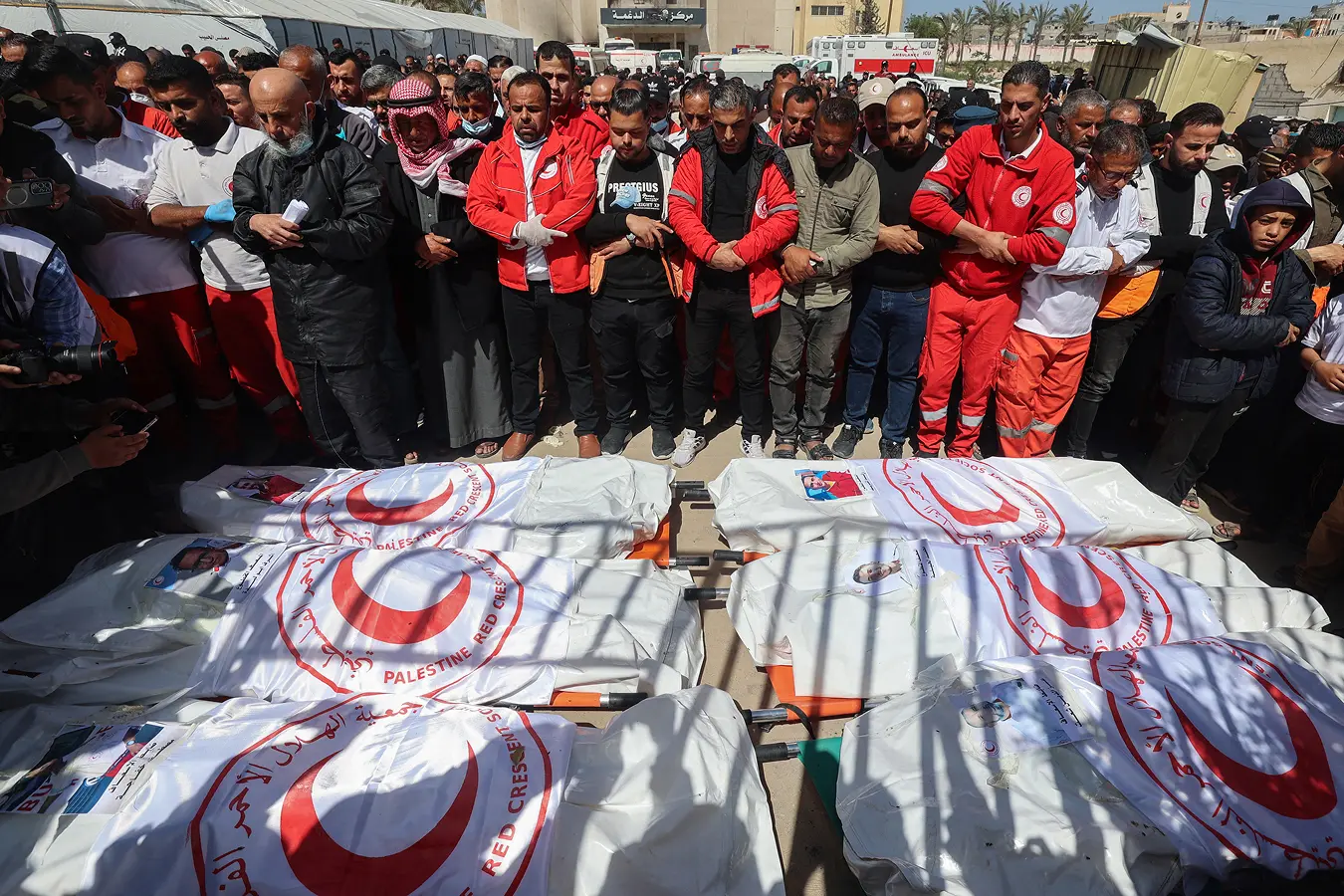
Members of the Palestinian Red Crescent gather in front of the bodies of 15 rescue workers killed by the Israeli army in Rafah – eight Red Crescent employees, six from the Gaza Civil Defence and one Palestinian who worked for UNRWA. Their bodies were found buried in the sand next to their clearly marked emergency vehicles on 30 March 2025, a week after they were killed.
Khan Younis, southern Gaza, 31 March 2025.
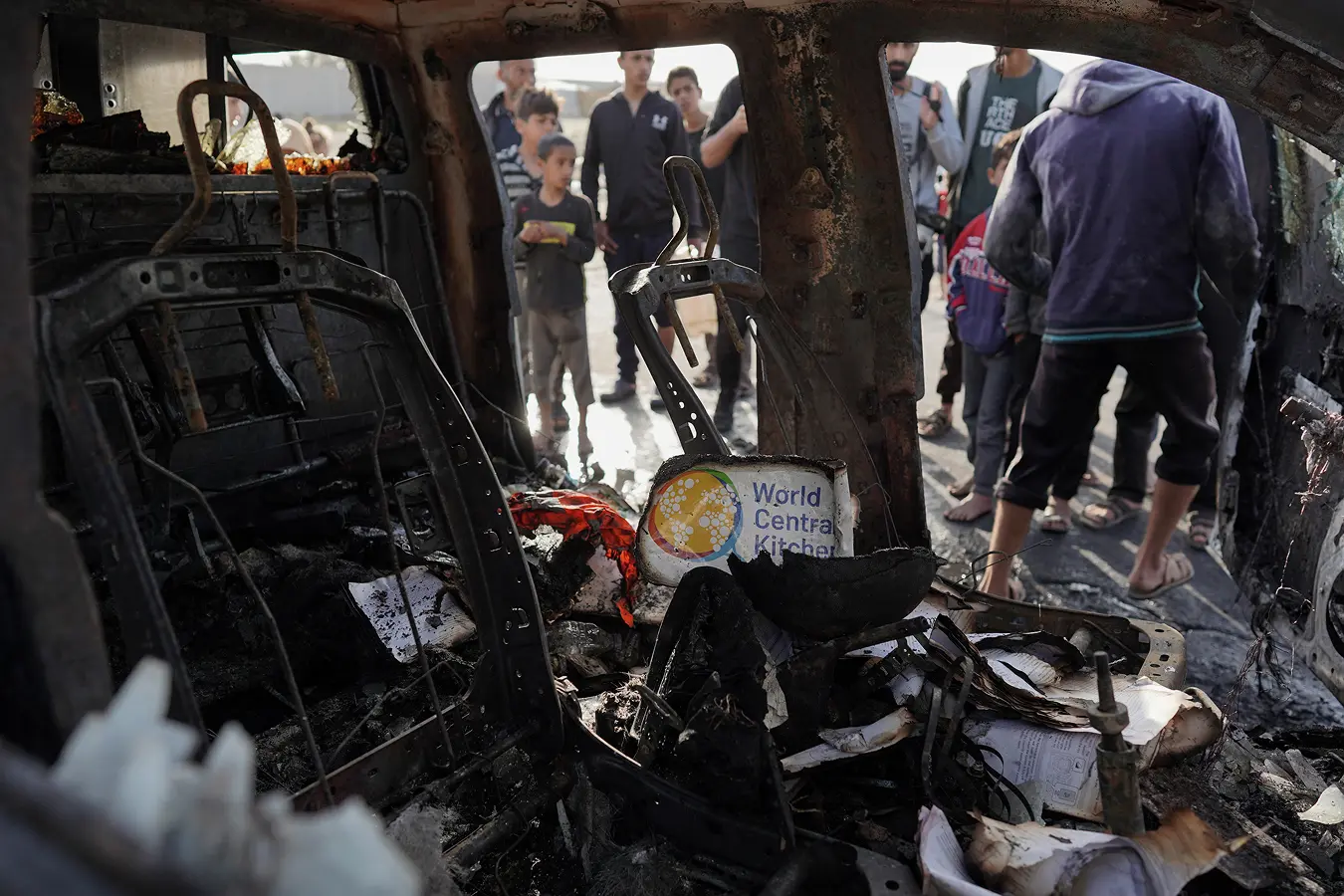
The remains of one of the vehicles in the convoy of the American NGO World Central Kitchen, after the attack on 1 April 2024, in which seven employees of the organisation were killed.
Deir Al-Balah, central Gaza, 2 April 2024.
Major attacks against humanitarian workers
8 December 2023
Shooting at UNRWA in Rafah
Israeli navy fire hit and damaged a pavilion housing UNRWA employees on the coast in Rafah, without causing any injuries.
2 January 2024
Strike on Red Crescent premises
An Israeli strike on the Palestinian Red Crescent premises, right next to Al-Amal Hospital, killed five displaced persons, including a five-year-old child. The organisation's insignia was clearly marked on the roof of the building that was hit.
10 January 2024
BBombing of an ambulance
Six Palestinians are killed in a bombing of an ambulance in Deir Al-Balah: four Palestinian Red Crescent paramedics and the two patients they were transporting. The organisation attributes the strike to the Israeli army.
5 February 2024
Attack on an UNRWA convoy
An UNRWA convoy - ten trucks and two clearly identified armoured vehicles - is targeted by Israeli navy fire while waiting to pass through northern Gaza. The attack causes no injuries. The route had been coordinated in advance with the Israeli army.
20 February 2024
MSF shelter targeted
During a military operation in Al-Mawasi, an Israeli tank fires on a house sheltering MSF staff and their families. The attack kills two people and injures six others. The building was clearly marked with the MSF logo. No evacuation order was issued prior to the attack.
1 April 2024
Attack on the NGO World Central Kitchen
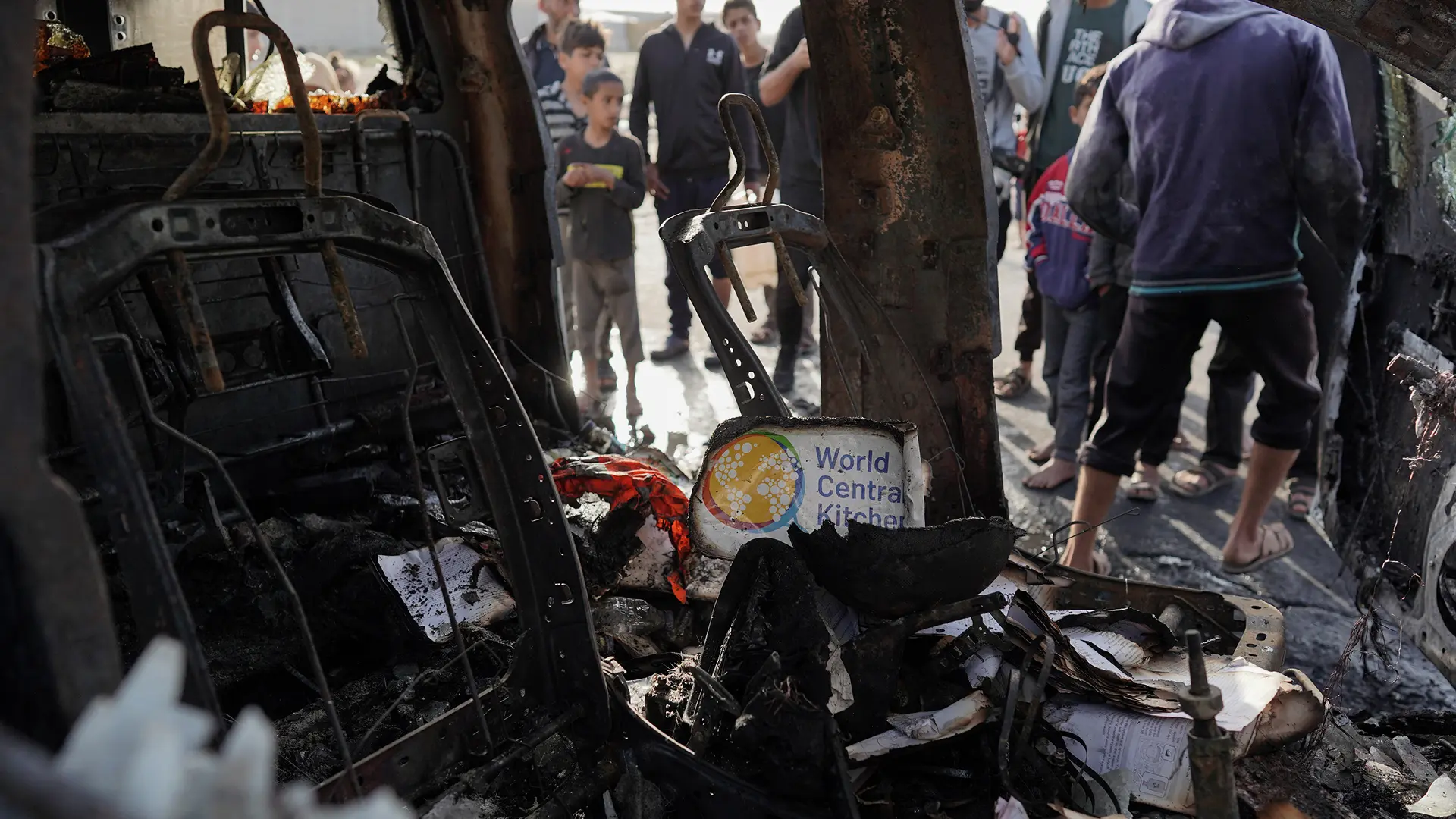
Seven employees of the American NGO World Central Kitchen – six foreigners and one Palestinian – are killed when their convoy is attacked by Israeli drones in Deir Al-Balah. The convoy's route had been coordinated in advance with the Israeli authorities and the vehicles were clearly marked with the organisation's logo. According to the Israeli newspaper Haaretz, three missiles were fired within a few minutes. After the first strike, the group of humanitarian workers took refuge in a vehicle, which was then targeted. Injured, they tried to take shelter in the last vehicle but were killed by a third strike. The Israeli army later acknowledged a "serious mistake" and dismissed two senior officers.
22 June 2024
ICRC office damaged
The International Committee of the Red Cross office in Gaza, located in the Al-Mawasi area, was damaged by "heavy calibre" fire that killed 22 people and wounded 45 others among the displaced persons living nearby. The army denied carrying out a direct attack on the organisation's building but opened an investigation.
12 July 2024
Destruction of UNRWA headquarters
The UNRWA headquarters in Gaza City is largely destroyed in an attack in which twelve displaced persons and three guards are wounded. The Israeli army claims to have clashed with Palestinian fighters and discovered weapons there. The UN organisation calls for an investigation. It had left the premises on 12 October 2023 after intense bombing.
27 August 2024
World Food Programme team targeted
A World Food Programme team is fired upon a few metres from an Israeli army checkpoint after escorting a humanitarian aid convoy. No one is injured, but the armoured vehicles are hit by at least ten bullets. The team's route had been coordinated with the Israeli army.
30 November 2024
Three employees of the NGO World Central Kitchen killed
An Israeli bombing kills five people in a car in Deir Al-Balah, in central Gaza, including three Palestinian employees of the NGO World Central Kitchen. Israel claims responsibility for the strike, saying that one of them had participated in the attacks on 7 October. His family strongly rejected these accusations.
19 March 2025
Attack on the UNOPS office
An Israeli tank shell fired at the UN Office for Project Services (UNOPS) building in Deir Al-Balah, in central Gaza, kills one of their employees and injures five others. The Israeli army, which had been informed of the location of the premises by the UN, acknowledges in an internal investigation that it was responsible for the shelling.
30 March 2025
15 Palestinian rescue workers found dead
The bodies of fifteen Palestinian rescue workers, killed by the Israeli army, are found in a mass grave in Rafah, in the south of the Gaza Strip. Eight worked for the Palestinian Red Crescent, six were members of the Palestinian Civil Defence and another was an UNRWA employee. On 23 March, they had gone to rescue survivors of a bombing. According to the UN, the victims were buried under sand, next to the wreckage of their vehicles - identified ambulances, a fire truck and a UN car. The army blocked access to the area for several days. It claims that the rescue workers approached its soldiers without identifying themselves, which is contradicted by the clearly identified vehicles found and the images contained in the phone of one of the rescue workers. According to the International Red Cross, this is the deadliest attack on its personnel worldwide in the last eight years.
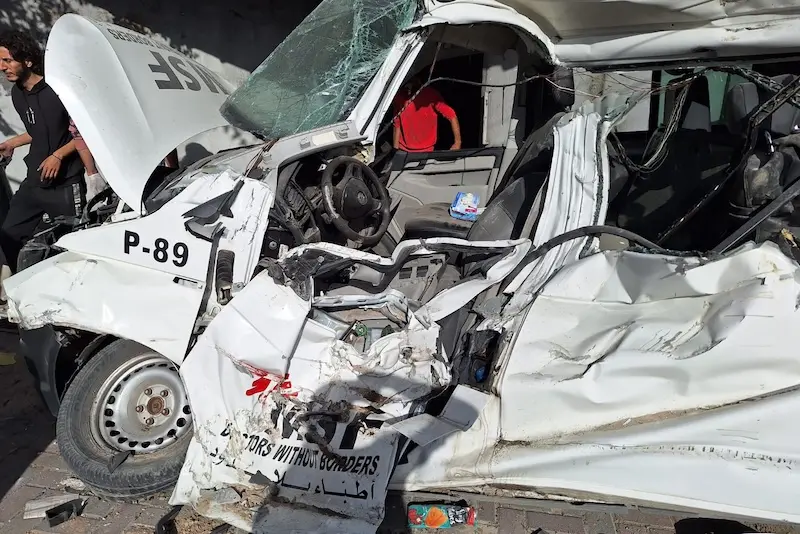
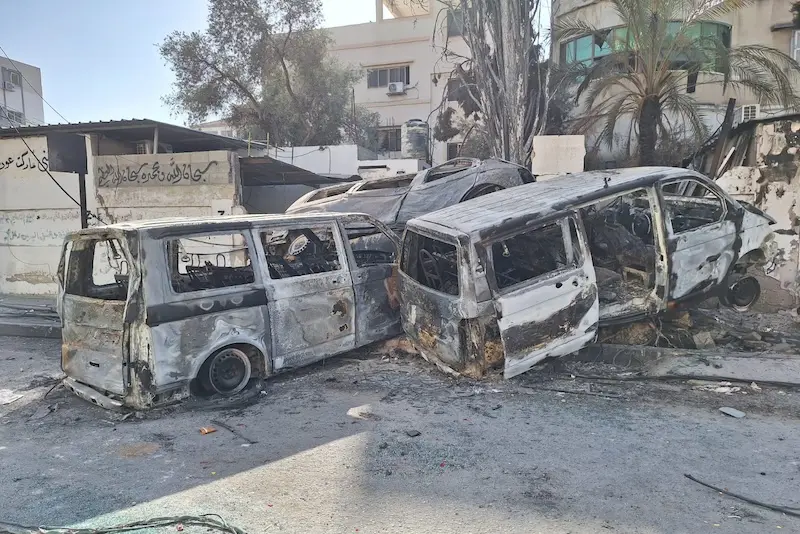
Destroyed MSF vehicles, Gaza City, northern Gaza, 20 November 2023.
On 18 November 2023, MSF staff and their families – several dozen people – were finally allowed to evacuate to the south after spending several days trapped in the MSF clinic amid intense fighting in Gaza City. The organisation informed both sides of the conflict of this movement.
The convoy of five cars, all marked with the MSF logo, took the route indicated by the Israeli army. For several hours, MSF staff and their families are stuck at the checkpoint separating northern and southern Gaza.
After hearing gunfire, the convoy decides to turn back and return to the MSF clinic. They notified the organisation to coordinate their movement to Gaza City.
On the way back, between 3.30 p.m. and 4 p.m., the convoy was attacked on Al-Wahida Street, near the MSF office.
Two of the organisation's cars were deliberately targeted, killing
a volunteer nurse who was working alongside MSF teams and injuring
a family member of another employee, who died from his injuries on 22 November All the evidence gathered by MSF points to the Israeli army's responsibility for this attack.
On 20 November, the five MSF vehicles were destroyed and the clinic where staff had once again taken refuge suffered significant damage.
The Israeli army's fire targeted MSF premises. The destruction of the organisation's five vehicles obliterated any possibility of collecting potential evidence, which was essential for an independent investigation into
the 18 November attack.
MSF staff and their families were trapped for nearly two weeks in the organisation's premises, in the midst of heavy fighting, without electricity and with limited access to food and water. Another attempt to evacuate them was thwarted after one of the MSF minibuses sent to pick them up was destroyed. On 24 November, the group was finally evacuated to the south of the Gaza Strip.
Isabelle Defourny, president of Doctors Without Borders in France
What are the main difficulties that MSF healthcare workers and teams have faced since October 2023?
The most difficult thing has been working in an extremely dangerous environment, where the situation is changing very quickly, with fighting, evacuation orders and often indiscriminate bombing. Usually in conflict zones, healthcare facilities are behind the front lines. This is not the case in Gaza. Hospitals, which are supposed to be sanctuaries, are just one of many places where the Israeli army is pursuing its goal of eradicating Hamas.
On 20 occasions between October 2023 and June 2025, our teams – and patients who were able to do so – had to leave healthcare facilities.
They witnessed bombings, heavy gunfire and ground offensives around and inside hospitals. The teams' movements were also highly dangerous. International NGOs can notify the Israeli authorities of the coordinates of the facilities where their staff are located, as well as their movements.
But this so-called "deconfliction" system does not work. Numerous humanitarian convoys have been targeted by Israeli fire, sometimes with fatal consequences, such as in November 2023 when an MSF convoy was attacked, or in April 2024 when seven volunteers from the American NGO World Central Kitchen were killed by Israeli fire. Buildings housing MSF staff and their families have also been targeted by shelling. We have never received any official explanation for these attacks. The Israeli army has sometimes presented them as incidents, but the problem lies in the rules
of engagement for Israeli soldiers in Gaza, which are permissive to the point of recklessness. Added to this are problems of access and supply: despite statements by the Israeli authorities, there are numerous obstacles to the deployment of aid, which Israel justifies on security grounds, depriving the population of vital assistance.
The Israeli army justifies its attacks on hospitals by the need to dismantle Hamas' military infrastructure and free Israeli hostages. What do MSF teams see and report?
The protected status of hospitals requires the attacker to provide very solid justification for the loss of their neutrality before attacking or destroying them. However, in Gaza we are witnessing a reversal of the burden of proof: healthcare workers and humanitarian workers are required to prove that they have no information about the presence of military bases or the detention of hostages in hospitals.
It should be noted that MSF teams often only worked in certain departments or buildings within hospital complexes that were sometimes very large, such as Al-Shifa or Nasser. But if such information had been brought to our attention, we would have had no interest in maintaining our presence in these hospitals, as this would have endangered our own teams.
Only an independent investigation would be able to confirm the Israeli authorities' claims. However, they oppose this, insinuating that healthcare and humanitarian workers are at best silent witnesses, if not accomplices of Hamas. This assimilation exposes them to particular danger:
at least 565 humanitarian workers were killed between October 2023 and October 2025. Medical and humanitarian personnel have also been intimidated, detained, humiliated and tortured.
This rhetoric legitimises the destruction of the healthcare system. It has also been used to support a violent campaign against UNRWA, the main provider of humanitarian aid to Gazans. Accusations of criminal acts have been levelled against UNRWA staff without any formal evidence being provided, leading to a reduction or even cessation of funding from certain states. Humanitarian workers have a duty of impartiality, and any criminal acts must be independently investigated and punished where appropriate. But the exploitation of isolated incidents to discredit humanitarian actors and put them in danger must stop.
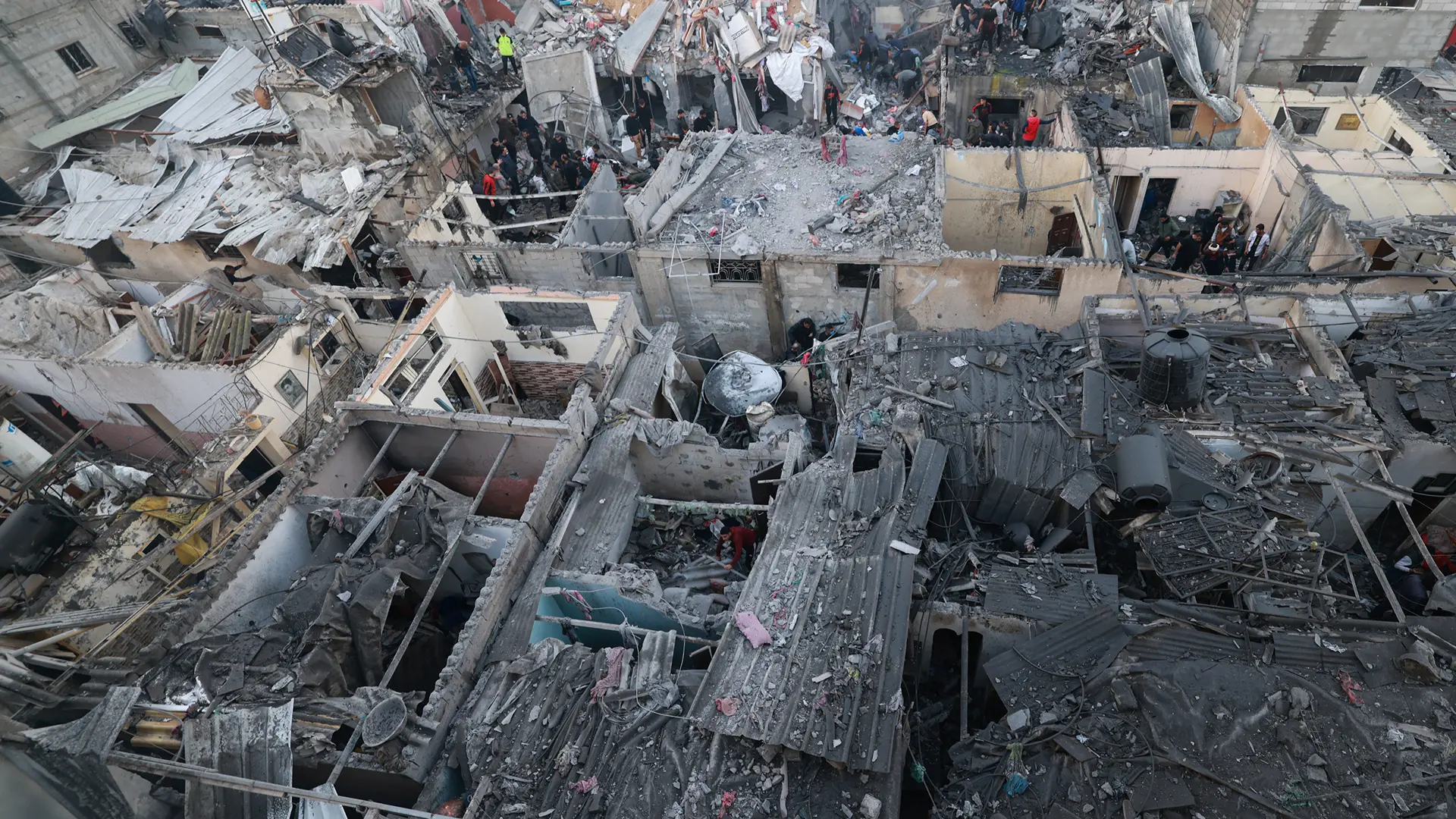
© Omar Al-Qattaa / AFP
In September 2025, an independent UN international commission of inquiry concluded that Israel had committed genocide against the Palestinians in the context of the war waged in Gaza in response to the Hamas attacks on 7 October 2023. What is your view on this assessment?
No military objective can justify the genocidal campaign waged by the Israeli authorities in Gaza. As early as January 2024, the International Court of Justice referred in its order to a plausible risk of genocide in relation to Israeli actions in Gaza and imposed provisional measures. Since then, the Israeli authorities have done nothing to improve the plight of the population - on the contrary, we are witnessing the opposite on a daily basis: the acceleration of destruction, evacuation orders and forced displacement of the population, the total siege of Gaza followed by the opening of certain crossing points at the discretion of the Israeli authorities, the famine created by the Israeli authorities and used as a weapon of war, the increasing obstruction of humanitarian aid deliveries, its exploitation for Israeli political and military strategies, the destruction of the population's means of survival, but also of schools, mosques, markets – of any present or past trace of Palestinian life in Gaza.
We have collectively and repeatedly warned about Israel's all-out war against the people of Gaza and the impossibility for NGOs to work in the Gaza Strip. As early as April 2024, we testified to what we believed to be genocide. Subsequently, the observations of our teams, recorded in particular in the MSF report Life in a death trap, published on 19 December 2024, also corroborated the characterisation of genocide put forward by a large number of legal experts and organisations, which we share.
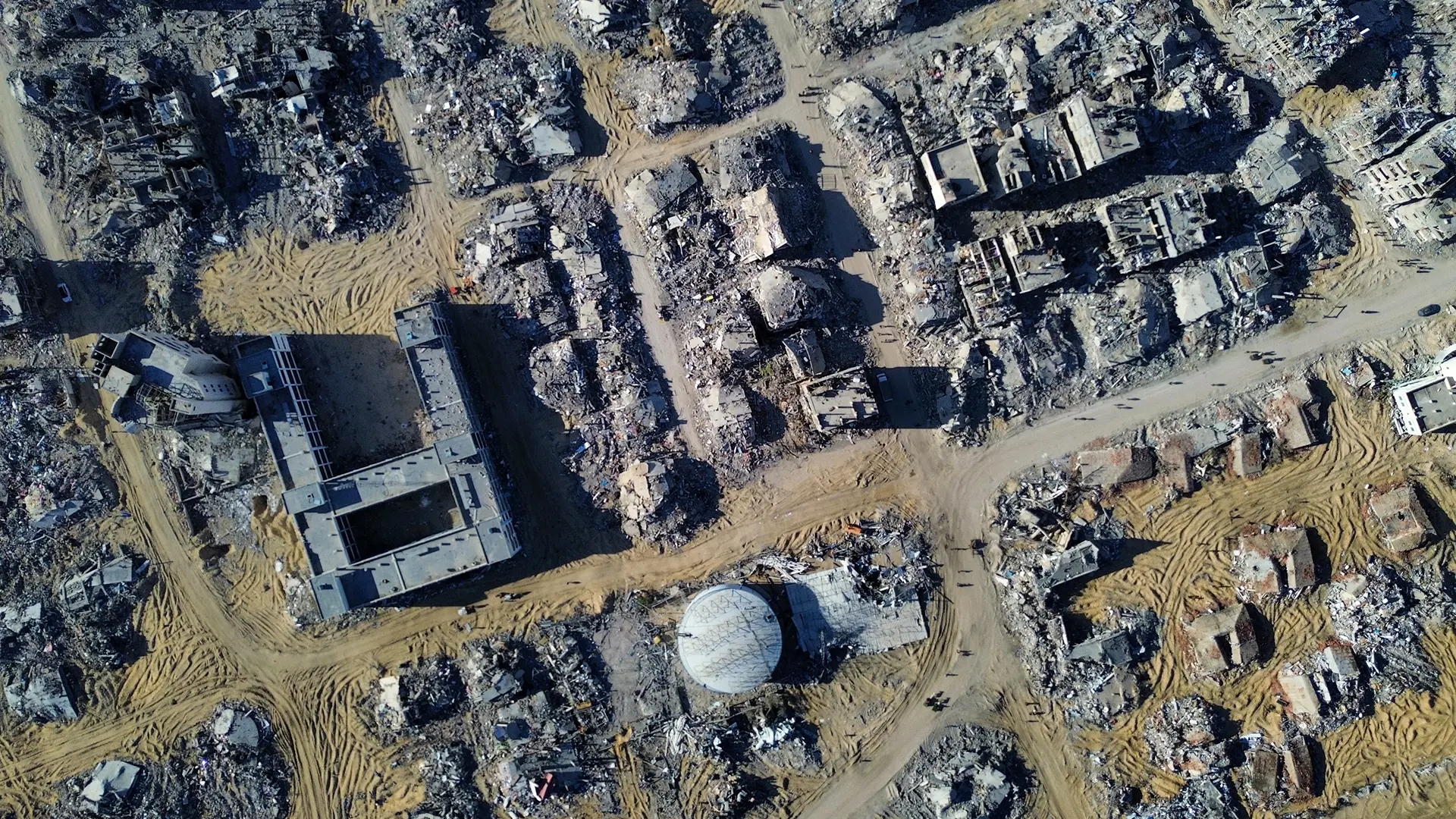
On 13 October 2023, in response to statements made by several Israeli officials, Raz Segal, an Israeli historian specialising in the Holocaust and genocide, stated that Gaza was a "textbook case of genocide". Two and a half months later, South Africa filed a complaint against Israel before the International Court of Justice and requested provisional measures against the Israelis for "failure to comply with the Convention on the Prevention and Punishment of the Crime of Genocide in the Gaza Strip". Pretoria was joined by Colombia, Libya, Mexico, Palestine, Spain, Turkey, Chile, the Maldives, Bolivia, Ireland, Cuba and Belize.
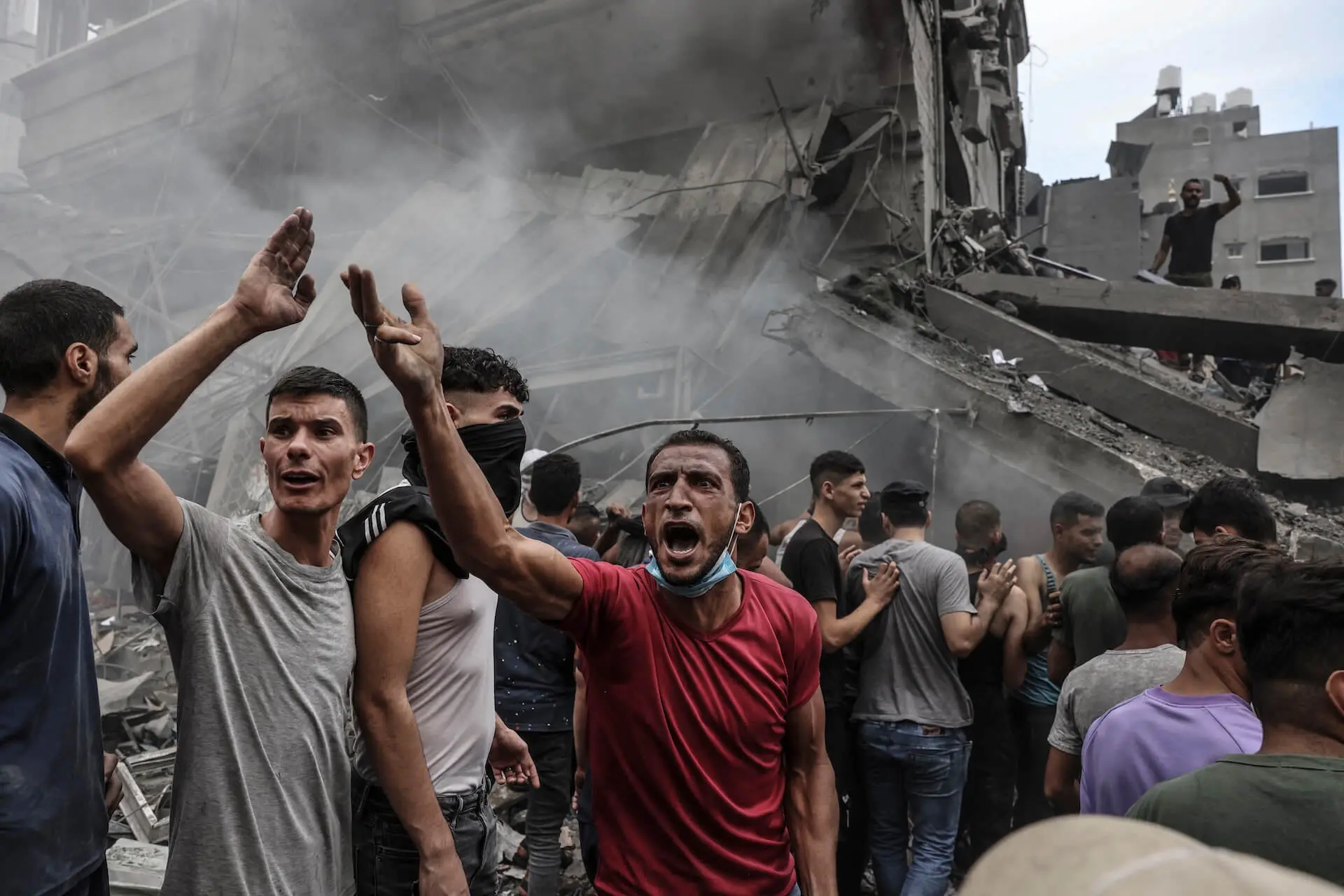
On 25 March 2024, the United Nations Special Rapporteur on human rights in the Palestinian territories occupied since 1967, Francesca Albanese, publishes a report entitled "Anatomy of a Genocide" which asserts that Israel, through the crimes committed in Gaza,
has demonstrated an "intention to physically destroy the Palestinians as a group".
"Yes, it is genocide," writes Amos Goldberg, an Israeli historian and chair of Holocaust studies at the Hebrew University of Jerusalem, in an article in Hebrew published by the online magazine Local Call in April 2024.
On 5 December 2024, Amnesty International released a new report, the result of months of investigation, "whose findings show that the Israeli authorities are committing genocide against the Palestinian population of Gaza.
In mid-December, Human Rights Watch also accused Israel of "acts of genocide," citing in particular the fact that Israel is depriving Palestinians
of water, threatening their survival. In a report published around the same time, Doctors Without Borders stated:
What our medical teams have observed on the ground throughout this conflict corresponds to the descriptions of a growing number of legal experts and organisations who conclude that genocide is taking place in Gaza.
On 16 September 2025, an independent UN international commission of inquiry asserts that Israel is committing four of the five categories of acts that define the crime of genocide, according to the 1948 Convention on the Prevention of Genocide: killing members of the group, causing serious bodily or mental harm to members of the group, deliberately inflicting on the group conditions of life calculated to bring about its physical destruction in whole or in part, and measures intended to prevent births within the group.
Soumoud
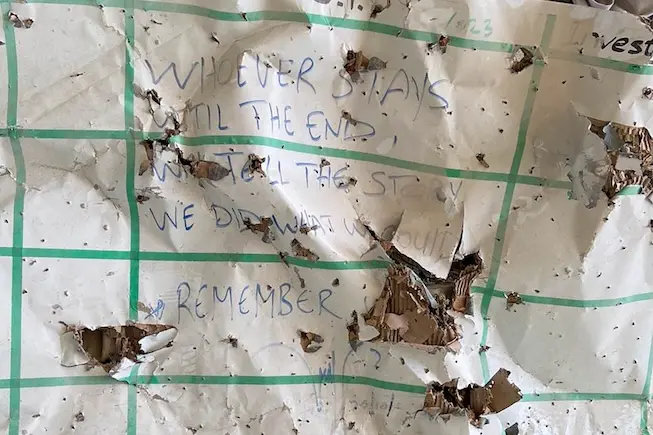
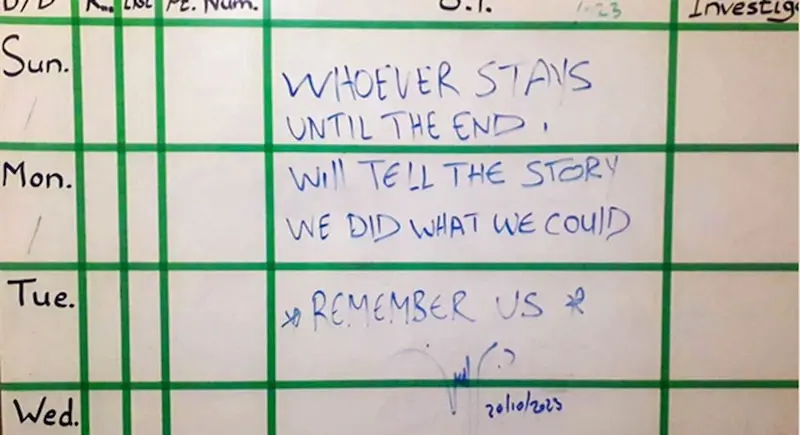
On 20 October 2023, as the Israeli authorities ordered the evacuation of Al-Awda Hospital in the northern Gaza Strip, Palestinian healthcare workers decided to stay with their patients, despite the danger. Among them was an MSF doctor, Dr Mahmoud Abu Nujaila, who wrote these words on the duty roster, a kind of testament: "Whoever stays until the end will tell the story. We did what we could. Remember us." He was killed a month later, on 21 November 2023.
On 23 October 2023, while Al-Awda Hospital was under siege, healthcare workers filmed themselves singing in protest against the evacuation of the facility ordered by the Israeli army. The song was written by a Libyan doctor for his graduation in Benghazi in 2005.
"We will stay here
So that the pain will disappear
We will live here...
The melody will be sweeter
Let us all rise up
With medicine and the pen
We feel compassion for those who struggle
with illness
Let us continue to move towards greater goals
We will be the best nation among nations
We will remain here...
So that the pain may disappear
We will live here...
The melody will be sweeter."
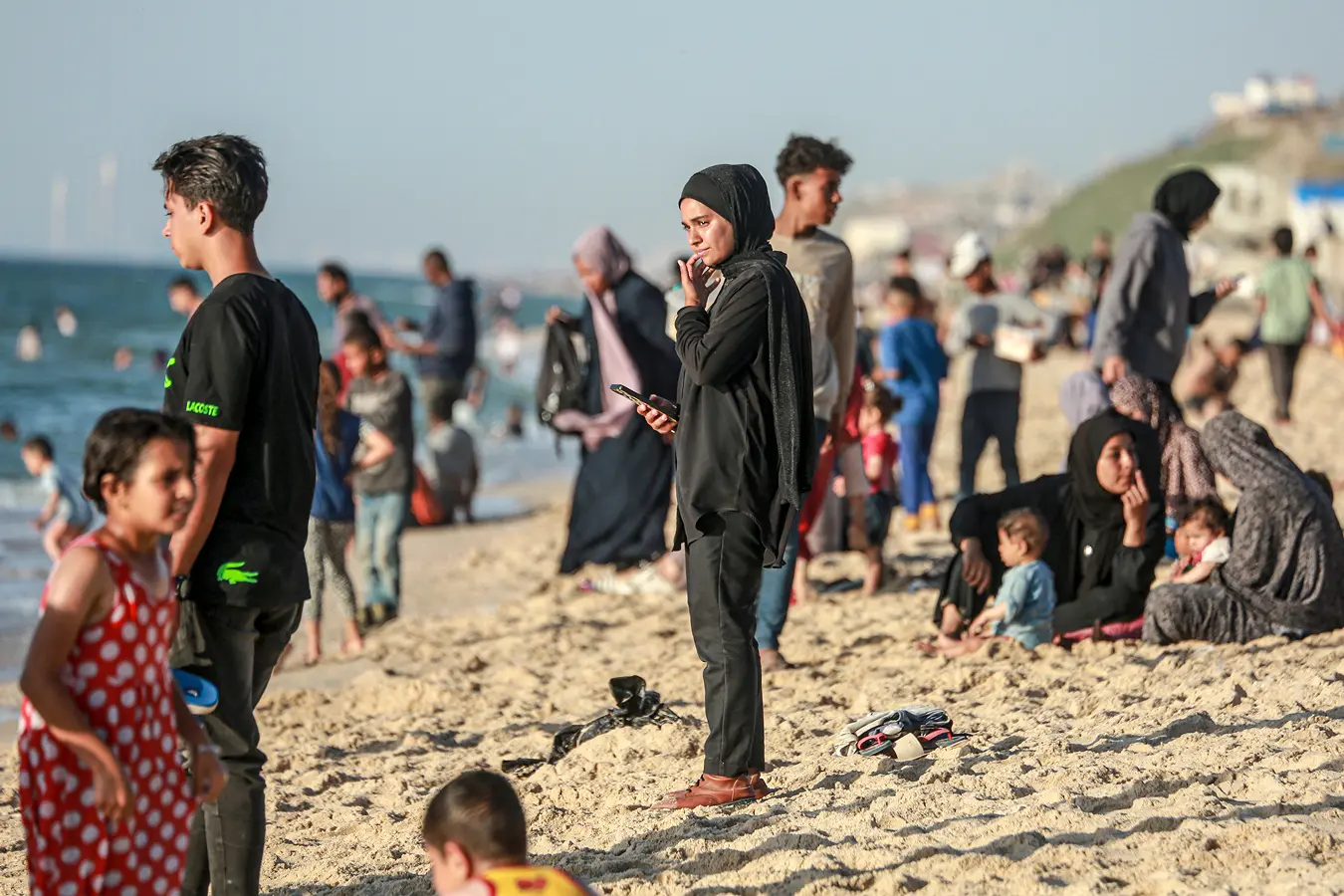
On 17 April 2024, Gaza journalist Osama Al-Kahlout posted a short 40-second video on his Instagram account, filmed on a beach in Deir Al-Balah, in central Gaza.
It shows a crowd of young people in the water, having fun on the beach. That day,
the temperature was over 32°C. A wide shot in the video shows the tents of displaced people scattered across the sand, not far from the bathers. Under the canvas,
the heat is unbearable. For months, Gazans have been washing their dishes and doing their laundry in the sea, for lack of anything better. For them, the beach has always been a refuge. Many went there before 7 October, during the blockade:
the Mediterranean represented a horizon, far from overcrowded apartments and power cuts. The video sparked numerous comments in Israel: journalists and ministers saw it as proof that the Israeli army was not going far enough in its offensive on the enclave. In France, too, it was shared with ironic comments and used to deny the atrocity of the daily Israeli attacks on Gazans.
Some Palestinians, on the other hand, posted it as a symbol of their love for life.

A difficult concept to translate, soumoud is a way of being, somewhere between resistance and resignation. The term appeared in the Palestinian lexicon in the late 1970s. It expresses the idea of "holding on" in order to maintain a presence on Palestinian soil. For Palestinians, soumoud is a daily political practice: it means defending their cause through everyday actions, both individual and collective.
Soumoud does not only mean psychological resilience,
it encompasses political action to remain rooted where you are.
And that does not mean that you do not feel pain. If you are a woman, giving birth to a child does not mean that you suffer or that you are happy to have a child. You can suffer and be happy to have a child. There can be a combination of both.
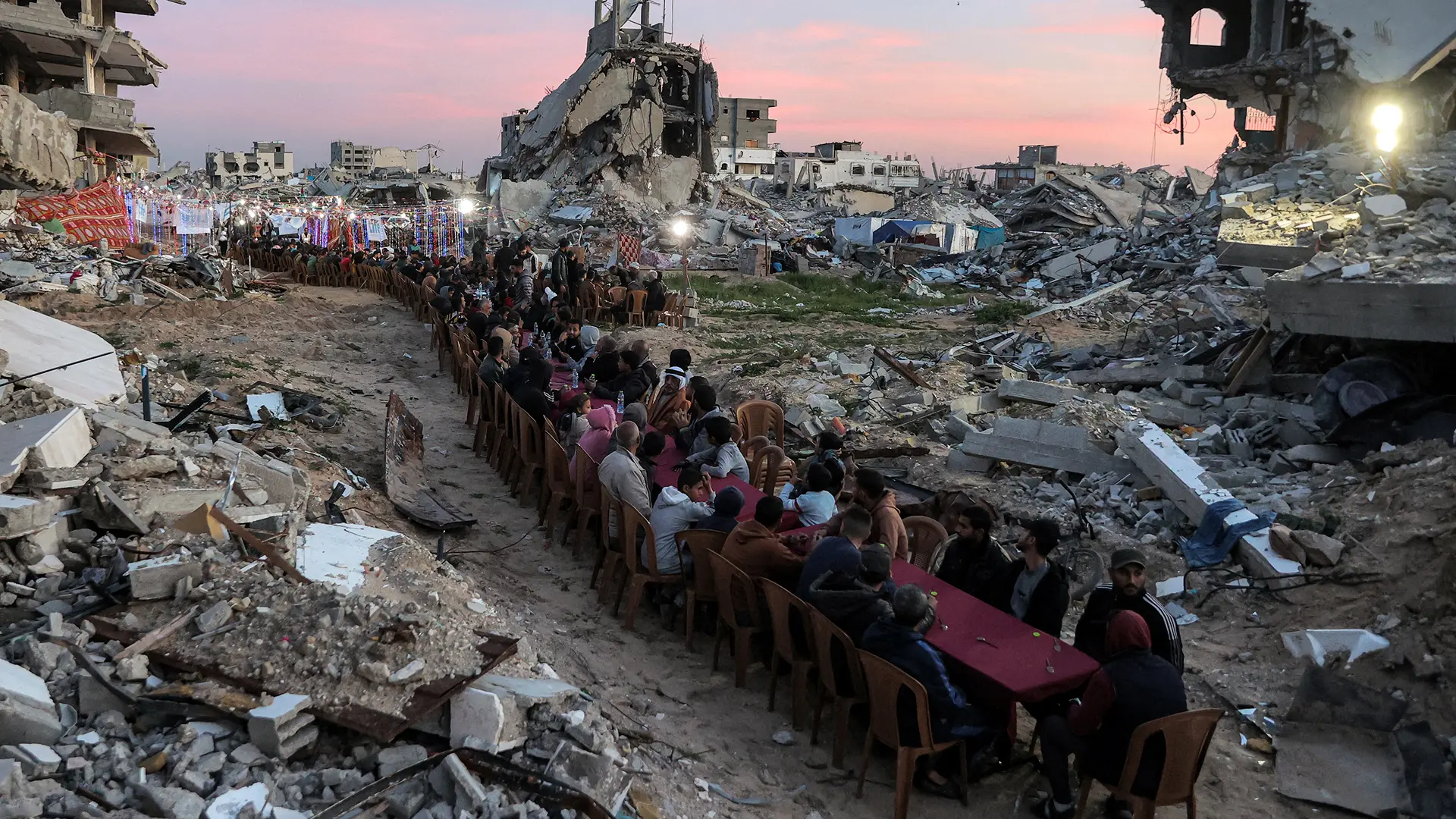
© Omar Al-Qattaa / AFP
Fleeing Gaza
18 September 2025
"Today, I left Gaza after 172 days of war. I left without even being able to take my clothes with me. The horror lasted 712 days, without interruption. Night after night, the same fear. Day after day, the same losses.
I had a home. I was forced to leave it. I had a family. Distance tore us apart. I had friends by my side. I had no choice but to leave them.
All I have left are a few photos, nothing to hold in my hands.
But Gaza remains in my heart, in every street, every voice, every mourning. My wound is so deep that I don't think it will ever heal.
I keep the memory, and the desire to bear witness. I keep the duty to tell the world what is happening there. I leave with mixed feelings. Sadness at what has happened. A strange, tiny happiness at having survived and having the chance to express myself. If you see our pain and can act, do so. If you can speak out, do so.
Goodbye Gaza. You will remain with me, always."
Dr. Abu Abed Moughaisib has been MSF's medical coordinator in Gaza for over 20 years. In September 2025, after 712 days of war, he left Gaza. Almost every day since the war began, he has been giving voice to the Palestinian people by posting on social media about daily life and survival in Gaza.
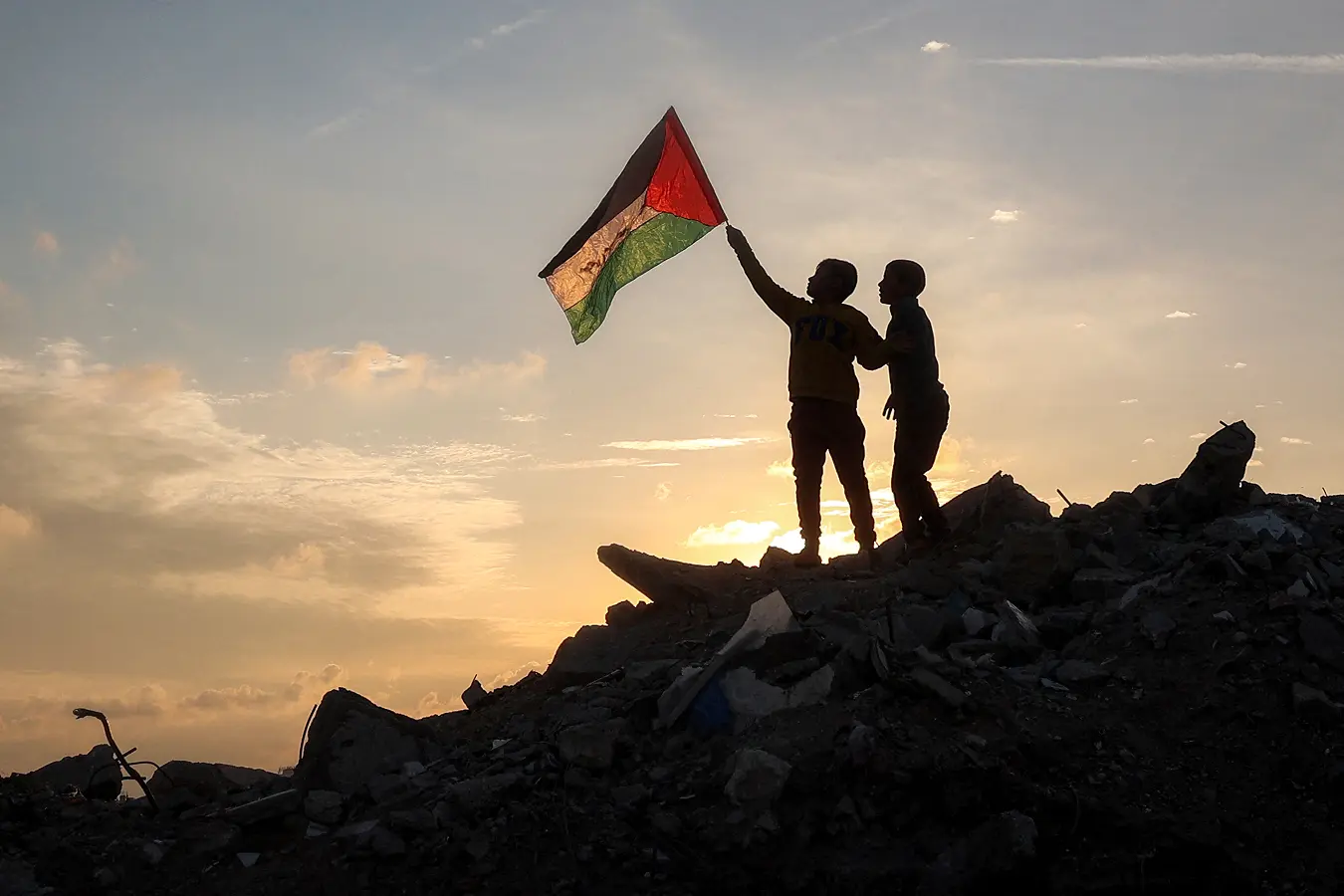
On France's initiative, a number of countries recognised the State of Palestine at the annual session of the United Nations General Assembly in New York in September 2025. On the 21st, the United Kingdom, Canada, Australia and Portugal took the plunge; on the 22nd, it was the turn of France, Belgium, Luxembourg, Malta, Andorra and Monaco. This recognition is primarily symbolic, tempered by the conditions attached to it by the French President: the disarmament of the Palestinians and the exclusion of Hamas from the political scene.
These externally imposed requirements seem to contradict the very idea of a state that was supposed to allow the Palestinian people to achieve self-determination.
Recognition seems to have served as a loophole for these countries to avoid adopting more effective political initiatives, particularly in terms of military, economic and diplomatic support for Israel, and to break with the impunity it enjoys.
On the ground, the contours of this state are also not guaranteed: Palestine is being eroded every day, whether by military zones and destruction in Gaza or by the advance of settlements in the West Bank.
Today, 158 of the 193 UN member states recognise the State of Palestine.
This exhibition is dedicated to MSF staff members and their loved ones who have been killed since the start of the Israeli offensive, as well as to all Palestinians who bear witness, sometimes at the risk of their lives.